
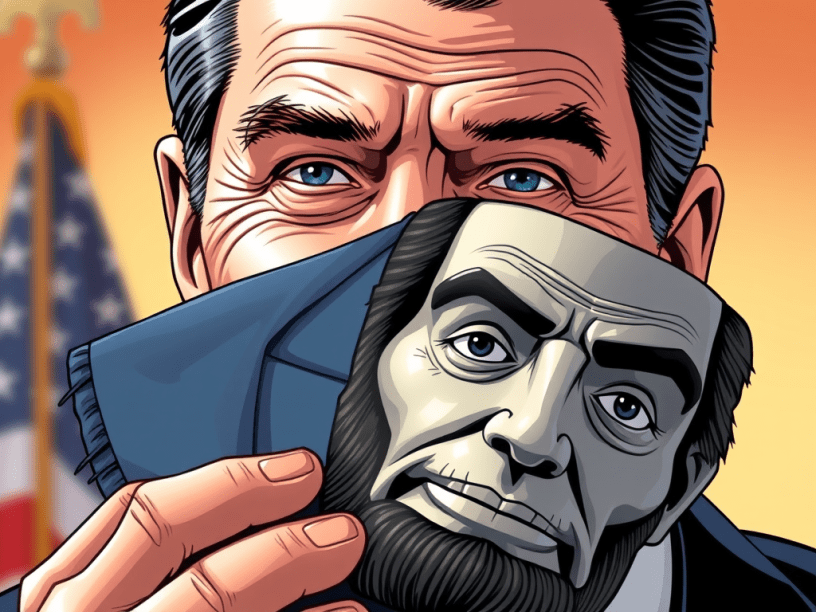
If you pay even the slightest bit of attention to politics, you’ve heard someone say, “Actually, the Republicans and Democrats switched sides!” Usually, this comes from some libertarian guy with a Ron Paul sticker and a podcast about fiat currency who wants you to know he’s “above the fray.” Basically it’s some casual trivia fact, a fun little “did you know” to toss around while you’re choking down your IPA. But nobody—nobody—ever explains the damn thing. What switched? When? Why? And what the hell does it mean for the steaming pile of dysfunction we call politics today? Well, grab a seat, because I’m about to rip the lid off this festering historical turd and show you how the parties traded jerseys, why it happened, and why we’re still choking on the fallout.
Let’s rewind to the 19th century, when the Republicans and Democrats weren’t just different flavors of the same corporate Kool-Aid—they were legit ideological opposites. The Republican Party—freshly minted in 1854—built itself around abolitionism, infrastructure spending, and education funding. They were literally the “Big Government” progressives of their day, pushing railroads, land grants, and tariffs to juice the North’s factory boom. Call ’em progressive if you want—back then, they were the ones dragging America, kicking and screaming, toward something resembling modernity.
The Democrats? Oh, they were a different beast—straight-up villains in a cowboy flick. The original “Don’t Tread On Me” guys. Born in the Jacksonian era of the 1820s, they were the party of the slaveholding South, states’ rights, and small-government dogma so rigid it’d make a libertarian blush. These were the cotton kings and their dirt-poor white lackeys, clinging to a feudal fantasyland where Black folks were property and the feds couldn’t touch their “way of life.” They’d sooner burn the Constitution than let Washington meddle—unless it was to enforce the Fugitive Slave Act, of course. Hypocrisy was their brand: freedom for me, chains for thee.
So, yeah, Civil War-era Republicans look like today’s bleeding-heart liberals—anti-racism, pro-infrastructure, big on federal power. Democrats? They’re the ancestors of every redneck MAGA hat screaming about “tyranny” at a school board meeting.
But here’s where the tracks start to twist.
After the Civil War, Radical Republicans (yes, that used to be a thing) pushed Reconstruction, trying to rebuild the South into a multiracial democracy. Lincoln’s dead, the Union’s intact, slavery’s toast. Reconstruction kicks in, and for a hot minute, Republicans are the good guys: 14th Amendment, 15th Amendment, Black voting rights, federal troops in the South to keep the ex-Confederates from turning Jim Crow into a full-time gig. But the shine fades fast.
Southern Democrats, predictably, responded by throwing tantrums involving white hoods, burning crosses, and lynch mobs. Reconstruction collapsed quicker than a Ted Cruz presidential campaign, and the Republican Party slowly lost its stomach for fighting the racial justice battle.
So now we’ve got Republicans morphing into the party of corporate interests and Democrats holding firm as the party of Southern racism, Jim Crow laws, and sweet tea served by the oppressed.
Confused yet? Good—because it gets even messier. By the 1870s, the Republican Party’s industrialist wing—think robber barons like Carnegie and Rockefeller—starts flexing. They don’t give a rat’s ass about racial justice; they want cash, contracts, and control. The Compromise of 1877 pulls federal troops out of the South, leaving Black folks to the wolves, and the GOP pivots hard. Suddenly, they’re the party of big business—laissez-faire fanatics drooling over tax cuts and deregulation, waving the bloody shirt of “Union pride” while they cozy up to Wall Street.
Meanwhile, the Democrats are licking their wounds, still the South’s pit bulls—bitter, racist, and rural. They double down on segregation, building the Solid South into an impenetrable fortress of white supremacy. But they’re not just yokels; they’ve got urban machines too—think Tammany Hall in New York—where Irish and Italian immigrants trade votes for jobs. It’s a weird mash-up: Dixie planters and city bosses, united by a hatred of federal overreach and a knack for screwing the little guy.
By the time the Great Depression hits in 1929, the Republican Party, now the suits-and-top-hats crowd, insists the market will “correct itself,” presumably by starving millions to death to fix inflation. President Herbert Hoover, a Republican, is out there telling people to eat bootstraps or something equally deranged.
Then Franklin Delano Roosevelt—a rich Democrat who actually liked poor people—rides in on a wheelchair with the New Deal, dragging America toward something resembling social democracy. Suddenly, Democrats pivot to supporting workers, unions, and social programs. FDR’s coalition unites urban progressives, blue-collar workers, immigrants, intellectuals, and crucially, black voters fleeing Republican neglect. The New Deal effectively flips the script: Democrats are now the champions of the working class, while Republicans scream “communism!” and plot their revenge.
Republicans start framing themselves as the party of fiscal conservatism, terrified that spending money to keep people alive might cut into profits. Meanwhile, Southern Democrats keep the racism but begrudgingly support social programs because even racists need food stamps sometimes.
America’s two-party system starts to look less like ideological factions and more like the cast of a particularly vicious season of Survivor—each tribe desperately forming alliances to stay alive.
Fast-forward to the 1960s. Civil rights movements explode, and President Lyndon B. Johnson, a Democrat from Texas who previously dropped the n-word like it was punctuation, does the unthinkable: he signs the Civil Rights Act of 1964 and the Voting Rights Act of 1965. Johnson famously mutters, “We have lost the South for a generation,” proving he could predict electoral trends better than Nate Silver on his best day.
Southern Democrats—furious at being told they couldn’t oppress people anymore—begin defecting to the Republican Party. Meanwhile, Richard Nixon sees opportunity in chaos. He deploys the “Southern Strategy,” courting disgruntled Southern whites pissed about integration and civil rights. This isn’t subtle: the GOP trades Lincoln’s legacy for George Wallace’s constituency, embracing dog-whistle racism as official strategy.
The Republican Party’s soul officially vanishes into the racist ether, replaced with coded talk of “states’ rights,” “law and order,” and “welfare queens”—all while pretending this shift was about fiscal conservatism, not a desperate grab at the votes of bigoted Uncle Billy and Aunt Mildred in rural Alabama.
The transformation is complete: Democrats are now the civil rights, worker-friendly, multiracial party; Republicans are the anti-government, anti-tax, wink-and-a-nod racism party. In one generation, the parties switch roles, like Batman and Joker trading costumes for Halloween and deciding to stick with it permanently.
And then comes the reign of Ronald Reagan, patron saint of American conservatism, and proof that America prefers smooth-talking actors to actual policy wonks. Reagan crystallizes the GOP’s switch, perfecting dog-whistle politics while wrapping conservatism in a folksy, grandfatherly charm. His election solidifies the GOP as the party of big business, social conservatism, and minimal social spending. Unions? Crushed. Taxes on billionaires? Slashed. Social programs? Decimated. He gives America what it craves: optimistic speeches that make dismantling public infrastructure seem patriotic.
Meanwhile, Democrats, traumatized by repeated electoral ass-kickings, move to the center, giving birth to “New Democrats”—Clintonian triangulators who adopt moderate economic policies while remaining socially progressive. The Democratic Party becomes Wall Street’s “second-best friend,” a slightly gentler corporate-friendly option that at least pretends to feel bad when foreclosing your house.
Today’s Republicans scream about “the Party of Lincoln,” conveniently leaving out that Lincoln would likely puke into his stovepipe hat at the sight of their 21st-century xenophobia and race-baiting tactics. Democrats—who once formed the backbone of Southern racism—now loudly champion racial equity, LGBTQ+ rights, and social justice, often through awkward, performative gestures that involve kneeling in kente cloth or tweeting #BlackLivesMatter before heading to a Wall Street fundraiser.
The real kicker? Neither party really resembles their historical roots. Republicans went from abolitionists to corporatists to culture-war moralists, while Democrats evolved from slaveholders to labor advocates to identity-politics panderers who occasionally stumble into doing something genuinely helpful. Both parties have abandoned working-class America, but the Republicans did it openly, while Democrats politely apologize on their way out the door.
The ramifications? A political shitshow that’s still unfolding. The GOP’s now a Frankenstein of corporate cronies and Bible-thumping populists—tax cuts for billionaires paired with abortion bans and AR-15 worship. They’ve got the South, the Plains, the “heartland”—a map painted red with resentment and nostalgia for a white-picket past that never was. Democrats are the urban rainbow—minority voters, college grads, city slickers—pushing identity politics and climate agendas while pretending they still care about the working stiff. Both are corporate whores at heart, just with different branding: GOP’s for oil and guns, Dems for tech and pharma.
The switch flipped the script—Republicans, once the radicals, are now the reactionaries, guarding a mythical “real America” against change. Democrats, once the slaveocrats, play the progressive card, but it’s a thin veneer over the same old power games. Voters? Screwed either way. The GOP’s base clings to culture wars; the Dems’ base chases woke points—neither gives a damn about the rusting factories or crumbling bridges. Polarization’s the legacy—two tribes, red and blue, screaming past each other while the rich laugh and the poor bleed.
So, yeah, the parties “switched sides”—a slow, sloppy tango driven by race, region, and raw opportunism. Republicans traded Lincoln’s torch for Thurmond’s torch; Democrats swapped plantations for protest marches. Why? Because power doesn’t care about principles—it follows the votes, the money, the fear. And us? We’re stuck in the wreckage, picking teams in a game that’s been rigged since the ink dried on the Constitution.
 The American Beast