
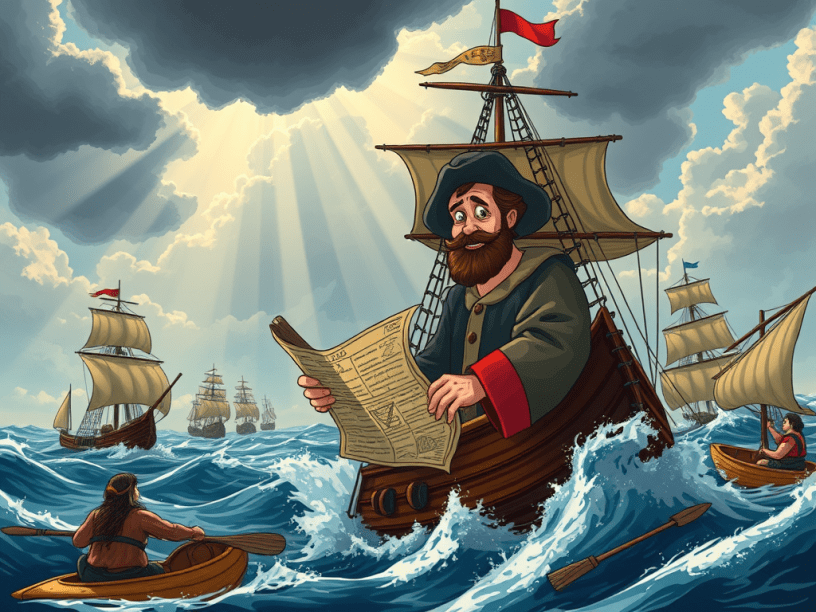
Part 1: Columbus and the Great Continental Fender-Bender (1492–1600s)
History likes to dress up Christopher Columbus as some kind of swashbuckling genius, a visionary who “discovered” a New World and set the stage for apple pie and bald eagles. The truth? He was a third-rate hustler with a lousy sense of direction, a guy who couldn’t find India with a GPS and a Sherpa, but somehow stumbled into the greatest real estate fluke of all time.
In 1492, Columbus cons Ferdinand and Isabella into funding his wild hunch that Asia’s just a quick jaunt west. They hand him three creaky ships—the Niña, the Pinta, and the Santa María, which sound like a folk trio but handle like shopping carts with busted wheels—and a crew of salty degenerates who’d rather slit his throat than salute him. He promises gold, spices, and a trade route to make Spain the envy of Europe. What he delivers is a continent-sized oopsie that sets the stage for five centuries of chaos.
Columbus sails west, hits the Caribbean—probably the Bahamas, but who knows, the guy couldn’t read a map—and declares it “close enough.” The locals, the Taino, paddle out to meet him, offering food and a puzzled “who the hell are you?” vibe. Chris, squinting through his scurvy haze, spots their gold nose-rings and decides he’s struck it rich. His first move? Snag a few locals to parade back to Spain like souvenirs, because nothing screams “diplomat” like human trafficking on day one. He scribbles in his journal that they’re so chill they’d make perfect servants—imagine the Yelp review: “Five stars, super friendly, would enslave again.” By his second trip, he’s hauling 500 Taino across the Atlantic; half die en route, because apparently “cargo” doesn’t need air or dignity. The Spanish crown nods approvingly, and the Caribbean’s fate is sealed.
Within a few years, the Spanish are swarming the place, turning islands into death camps with a side of mining. Disease does half the work—smallpox, the original European houseguest who overstays his welcome—and the rest is just good old-fashioned brutality. By the time the Taino figure out they’ve been had, their population’s a rounding error.
The conquistadors roll in next, a parade of armored lunatics with a hard-on for gold and glory. Hernán Cortés lands in Mexico in 1519, eyeballing the Aztec empire like it’s a piñata at a kid’s party. Montezuma, the Aztec head honcho, tries the diplomatic route—sends gold, feathers, the works, hoping this pasty stranger will take the hint and leave. Cortés, though, smells weakness and a payday. With 500 men, some horses that spook the locals into thinking he’s a god, and a smallpox assist that’d make a bioterrorist jealous, he sacks Tenochtitlán—a city bigger than Paris at the time—and turns it into Mexico City, Spanish edition. The Aztecs go from millions to a footnote in about 20 years, and Cortés struts around like he invented conquest.
Then there’s Francisco Pizarro, the budget-bin Cortés, who pulls the same stunt in Peru against the Inca in 1532. He’s got 168 guys—half of ‘em probably hungover—and ambushes Emperor Atahualpa after the guy shows up with 80,000 troops but no weapons, because who needs swords for a friendly chat? Pizarro’s crew slaughters thousands, grabs Atahualpa, and demands a room full of gold for his ransom. The Inca deliver—literally tons of it—only for Pizarro to strangle him anyway and melt the loot into bars. It’s less a military victory than a murderous heist, and the Inca empire crumbles while Spain’s accountants cheer. Between the germs and the greed, native populations crash—some say 90% gone in a century—leaving behind ghost towns and a lot of “what just happened?” stares.
Back in Hispaniola, Columbus is busy proving he’s not just a lousy navigator but a world-class fuck-up at running things. Spain makes him governor, and he turns the place into a dystopian summer camp—floggings, mutilations, and a gold quota so insane the Taino start killing themselves to escape it. His colonists—lazy, entitled treasure-hunters—hate him too, because he’s hogging the profits and sucking at basic logistics. The Spanish crown hauls him back in chains by 1500, which is honestly the funniest part of the story: the guy who “discovered” America gets fired for sucking at colonialism. His successors aren’t much better, though. They set up encomiendas—fancy word for “slavery with extra paperwork”—forcing natives to dig for gold until they drop. When the locals run out, they start shipping in Africans, because the only thing worse than a bad idea is doubling down on it.
And the kicker? All that gold—the stuff Spain bled the New World dry for—tanks their economy. They flood Europe with so much bullion it triggers inflation, turning their windfall into a fiscal faceplant. Meanwhile, the Taino are gone, the Aztecs are a memory, and the Inca are a tourist trap waiting to happen. The locals didn’t get a say, the profits didn’t last, and the legacy? A big, messy stain that somehow became the foundation for everything that followed. And to this day we still celebrate that scumbag Columbus, the patron saint of happy accidents—proof that even a blind squirrel finds a nut, or in this case, a whole damn continent to rape and ruin.
This isn’t the triumphant “dawn of a new era” crap you got in school. It’s a comedy of errors with a body count—greedy schmucks tripping over themselves to exploit a place they didn’t understand, while the people who actually lived there paid the price.
 The American Beast