
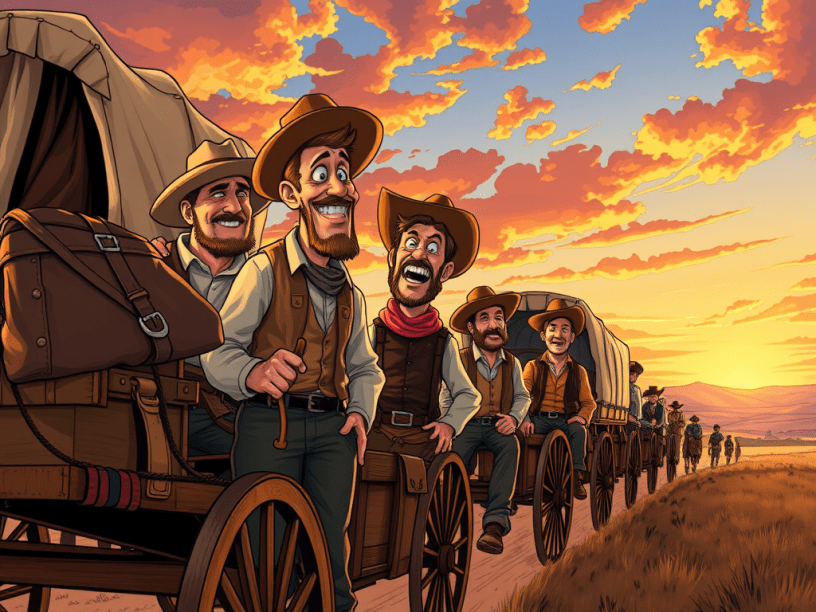
Part 4: Manifest Destiny, AKA Stealing Cuz God Said To (1800s)
The 1800s swagger in with America acting like a teenager who’s outgrown his bedroom—cocky, ambitious, and primed to trash the neighbor’s yard. The Revolution’s old news, the Constitution’s wheezing along like a two-pack-a-day smoker, and the population’s multiplying faster than an evangelical homeschool family—4 million in 1790, doubling roughly every two decades. Back East, they’re stepping all over each other; to the West lies a tempting blank check of land, glistening with possibility—or, more accurately, with the potential to stomp whoever’s already hanging around.
In 1845, a journalistic shill named John O’Sullivan brands this frenzied land grab “Manifest Destiny,” a term meaning God’s apparently chosen America to smear its democracy—or at least its tobacco plantations—across the continent. Of course, what follows isn’t exactly the majestic spread of civilization your eighth-grade textbook panted over—it’s closer to a cosmic-level mugging, sanctified with a pat on the back from Jesus.
It kicks off with a classic rip-off: the Louisiana Purchase. Thomas Jefferson, imperial ambition hidden behind his nerdy Enlightenment façade, capitalizes on Napoleon’s financial desperation. In 1803, America scoops up 828,000 square miles—territory bigger than France itself—for a measly 15 million bucks, about four cents an acre. The only catch: it wasn’t exactly vacant. Tribes like the Osage, Sioux, and Mandan had been settled for generations, and Spain lingered in the background, perplexed and irritated. Jefferson dispatches Lewis and Clark to size up the merchandise, guided largely by Sacagawea—a Shoshone teen mom whose main job was keeping the explorers alive and vaguely oriented. Their findings ignite a fevered stampede westward among settlers tired of scraping a living from New England’s rocky fields.
Not everyone’s thrilled about the invasion. Tecumseh, the Shawnee chief with an actual grasp of geopolitics, tries rallying tribes against the encroachment, even aligning with Britain during the War of 1812—a forgettable sequel nobody asked for. His efforts flame out after his brother fumbles at Tippecanoe, and Tecumseh himself meets an unceremonious end in 1813. The war fizzles, but America comes away with more turf, reinforcing the timeless principle: a stalemate is just another excuse to move the goalposts.
The land-grab hunger intensifies in the 1820s as settlers pour into the Midwest, forcing baffled tribes like the Miami and Potawatomi into sketchy treaties scribbled in a language they barely comprehend. But the nastiest chapter unfolds down South, where tribes labeled as “civilized”—Cherokee, Creek, Choctaw, Chickasaw, and Seminole—had mistakenly believed literacy and agriculture would shield them from white greed. Enter Andrew Jackson, a belligerent, genocidal redneck who, after clawing his way into the presidency in 1829, decides these indigenous communities are inconvenient obstacles rather than human beings. Gold strikes Georgia, settlers drool, and Jackson strong-arms the 1830 Indian Removal Act, effectively a legal eviction notice at gunpoint. Even when the Cherokee win a Supreme Court ruling in 1832, Jackson sneers, ignores it, and marches 60,000 Native Americans to Oklahoma on the infamously brutal Trail of Tears. Four thousand die of exposure, disease, or simple cruelty, while their lands become prime real estate for smirking speculators.
But why stop there? Down in Texas, American settlers—originally invited by Mexico to buffer against Comanche raids—swiftly outbreed and overpower the locals, dragging along their slaves despite Mexico’s abolition laws. By 1835, these Texans decide they’re tired of Catholic moralizing and Mexican taxes, launching a revolt. The Alamo’s heroic last stand is mostly PR; Sam Houston’s subsequent revenge at San Jacinto is a savage slaughter, gifting Texans independence until they beg to join the U.S. in 1845. President James K. Polk, a devout Manifest Destiny fanboy, eagerly starts another brawl, kicking off the Mexican-American War. It’s less a war than a playground bully taking lunch money; America marches south, takes Mexico City, and leaves with California, Nevada, Utah, and half of Mexico’s backyard for another bargain-basement 15 million bucks. Mexicans left behind get citizenship but no dignity, watching their ranches turn into playgrounds for American opportunists.
By now, Americans can’t quit heading West. The Oregon Trail, opening in the 1840s, transforms into a 2,000-mile death march fueled by dreams of free farmland and spiced with cholera. Mormons flee persecution, setting up shop in Utah after Middle America decides Joseph Smith’s polygamy is a bridge too weird. Then California explodes in gold fever in 1848; 80,000 starry-eyed idiots swarm westward, turning pristine rivers into battlegrounds over shiny dust. The Apache, Comanche, and Cheyenne fight back fiercely, but the U.S. Army answers with guns, cannons, and treaties as disposable as toilet paper. By the 1850s, the native resistance is beaten into submission or extermination, their buffalo massacred for sport or railroad convenience.
This wasn’t some grand tale of heroic pioneers. It was daylight robbery painted in holy colors, from Jefferson’s smooth hustle to Jackson’s ethnic cleansing to Polk’s imperial war. America devoured a continent, spinning genocide and theft as destiny. Settlers called it God’s plan; the dispossessed called it theft. And thus, “Go West, young man” became the polite euphemism for “take it all, leave nothing, and never look back.”
 The American Beast