
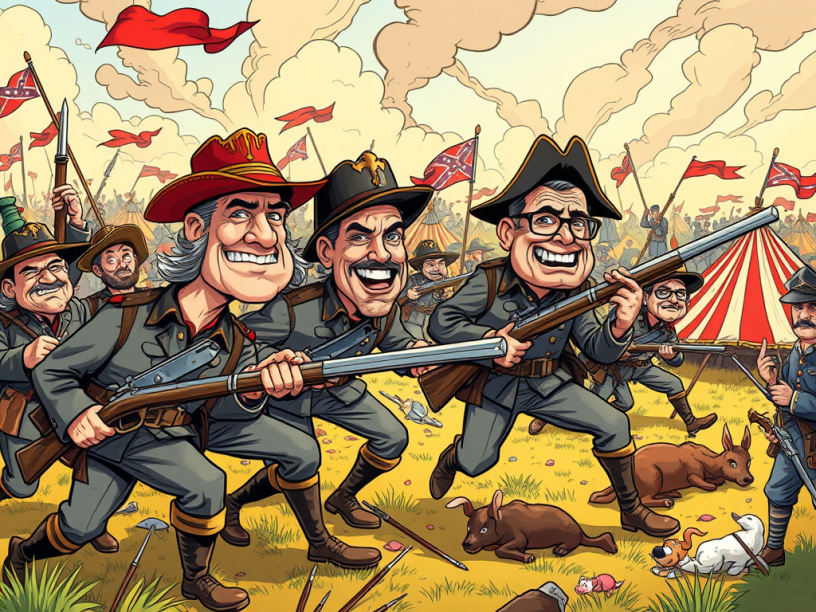
Part 5: The Civil War, or Family Feud Featuring Corpses
Picture America in the mid-1800s: a bloated, bickering conglomeration of loosely associated states, half industrial madhouse, half plantation nightmare, sprawling like a drunk across the continent and primed to implode. The North hums with factories and fresh-off-the-boat immigrants, a chaotic engine pumping out smoke, goods, and grime; the South is a money-soaked cotton cartel, built on the sweaty backs of 4 million slaves—human beings treated as disposable machines. Manifest Destiny’s sweeping land grab only deepens the divide, with every new acre bringing the same explosive question: slave soil or free?
The Founders conveniently kicked the slavery question down the road, sealing their compromises with the moral integrity of wet tissue paper—the Missouri Compromise of 1820, the Compromise of 1850—temporary band-aids on a gaping wound. By the 1850s, these flimsy fixes unravel spectacularly. Enter Stephen Douglas, a slick Illinois politician whose Kansas-Nebraska Act of 1854 was supposed to elegantly sidestep the issue by handing slavery decisions to settlers. Predictably, it explodes in his face. Kansas becomes a blood-soaked mess, a brutal frontier war where abolitionists and slaveholders eagerly spill each other’s blood. The sack of Lawrence by pro-slavery Missouri hooligans prompts a retaliatory massacre from John Brown, a wild-eyed abolitionist whose Old Testament justice at Pottawatomie Creek leaves slaveholders hacked apart, feeding headlines and nightmares alike.
This chaos spills into the Supreme Court in 1857 with the Dred Scott decision, delivered by Chief Justice Roger Taney, whose ruling—that Black Americans have no rights and slavery can stretch anywhere—plays like a gleeful insult wrapped in judicial robes. Northern abolitionists seethe; the South smirks. Tensions ratchet higher when John Brown, apparently enjoying his newfound prophet-warrior gig, attempts to ignite a slave uprising at Harpers Ferry in 1859. He’s captured and hanged, instantly canonized as a martyr in the North, sending the South into paranoid hysterics.
Into this powder keg steps Abraham Lincoln—awkward, lanky, and politically cautious, a backwoods lawyer who promises to halt slavery’s spread but sidesteps outright abolition. When Lincoln wins the presidency in 1860 without a single Southern electoral vote, Southern paranoia boils over into secession. Seven states bail immediately, led by South Carolina, forming the Confederacy under Jefferson Davis—a humorless, slave-owning bureaucrat with the charm of wet cement, shouting “states’ rights” while privately admitting their economic cornerstone was slavery.
The first cannon shots at Fort Sumter in 1861 mark the official kickoff of America’s gruesome family brawl, inaccurately glorified by history as a noble clash but in reality a four-year slaughterhouse. Battles like Bull Run, Shiloh, and Antietam pile up corpses by the thousands, each engagement a grim testament to the savagery Americans could unleash on each other. Lincoln’s 1862 Emancipation Proclamation cunningly frees slaves only in rebelling states, a move less about moral enlightenment and more about crippling the Southern war machine and bolstering Union ranks with 180,000 Black soldiers fighting with an intensity rooted in centuries of brutality.
Gettysburg in 1863 swings momentum irreversibly toward the Union, with 51,000 casualties sprawled across fields in three hellish days. Lincoln’s Gettysburg Address immortalizes the dead, deftly skirting the ugly reality that slaves in the loyal border states remained in chains. By 1864, the South is on fumes—Sherman’s scorched-earth march through Georgia guts Southern morale. Lee surrenders at Appomattox in 1865, leaving America scarred, exhausted, and mourning 620,000 dead. Lincoln’s assassination days later, courtesy of Confederate sympathizer John Wilkes Booth, seals the tragedy.
Reconstruction brings tentative hope: the Freedmen’s Bureau, constitutional amendments granting citizenship and voting rights, and Black representation in Congress briefly offer glimpses of justice. But America’s addiction to exploitation runs deep. The South swiftly swaps outright slavery for sharecropping and unleashes the Klan, while the North tires of moral crusades, abandoning Southern Blacks in a backroom deal—the Compromise of 1877. Reconstruction collapses, Jim Crow ascends, and America once again proves adept at dodging real accountability.
The Civil War didn’t heal America—it cauterized wounds that still bleed today. It’s a brutal saga of hypocrisy and courage, noble rhetoric and savage violence. America, true to form, emerges from the bloodbath still clinging desperately to its oldest habit: promising freedom while practicing exploitation.
 The American Beast