
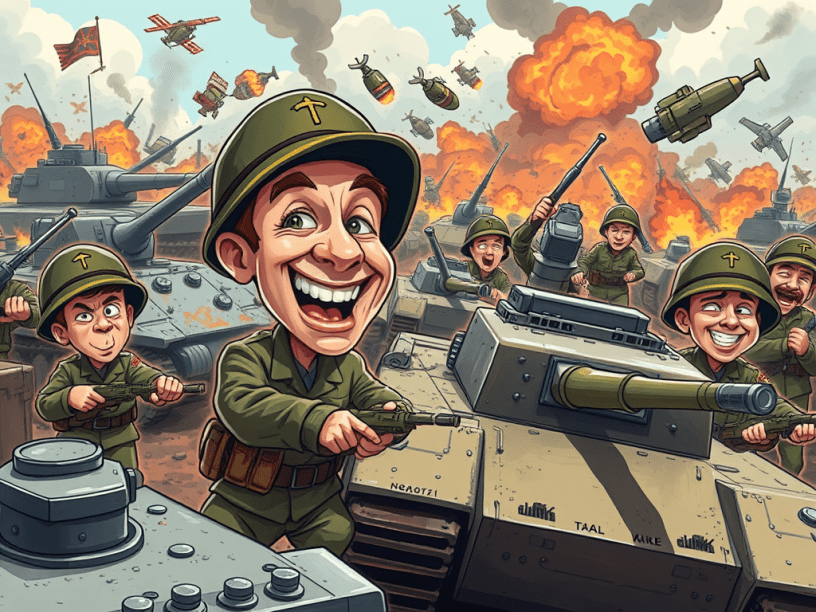
Part 8: The Mid-Century Mess: Bombs, Booms, and Broken Promises (1940s–1960s)
The 1940s open with America still shaking off the Depression’s dust, a nation of 132 million hovering between the New Deal’s shaky lifeline and a world spiraling into flames. Factories hum with half-hearted hope, but jobs are thin, and the South remains a Jim Crow kingdom where equality’s a whisper at best. Across the pond, Europe’s gone completely berserk—again—and Asia’s crumbling under Japan’s war machine. Uncle Sam happily cashes in on guns and grub, offering sympathy on credit while staying safely behind the velvet rope. But history never lets America off easy; what comes next is a stumbling, blood-spattered mess of wars, prosperity, paranoia, and protest, all wrapped up in a star-spangled bow.
The calm façade shatters spectacularly on December 7, 1941, when Japan sucker-punches Pearl Harbor, sinking battleships and killing 2,400 sailors before breakfast. Hitler tosses in his two cents by declaring war, and suddenly America’s deep into the carnage, mobilizing 16 million troops overnight. Factories flip to war mode, drafting women—Rosie the Riveter and friends—to churn out tanks and bombers at an insane clip. From Omaha Beach to Okinawa’s blood-soaked sands, the world war devolves into a contest to see who can stack bodies higher. By the time Truman decides atomic fireworks are necessary to shut Japan down—flattening Hiroshima and Nagasaki, vaporizing 200,000 civilians, and introducing humanity to existential dread—the Allies have won a pyrrhic victory. America struts out of the ashes, now owning half the world’s GDP and a swaggering monopoly on military might, though 400,000 of its sons never return home. Sure, the GI Bill tosses vets a bone—college degrees and suburban mortgages—while the rest of the globe gets a generous helping of rubble.
High on victory, the 1950s arrive as a massive sugar rush: suburbs spring up like weeds fertilized by GI mortgages, Detroit churns out shiny sedans, and television pipes in consumer fantasies straight into living rooms, promising happiness in every fridge and toaster. By 1960, the economy doubles, the middle class balloons, and for a brief shiny second, everything seems swell—provided you’re white and middle class. If you’re Black, you’re redlined out of suburbia and shoved into inner-city slums; if you’re Appalachian, you’re still picking coal dust from your lungs. But hey, who cares? The new refrigerator has an ice maker!
Of course, no good party lasts forever, especially not when Joe Stalin’s looming at the door. The Cold War settles in like a radioactive migraine, with the Soviets detonating their own bomb by 1949 and Korea soon offering a bloody appetizer of proxy warfare—36,000 American lives flushed away for a stalemate by 1953. Back home, McCarthy sees commies hiding behind every typewriter, blacklisting anyone who prefers thinking to saluting. Kids practice duck-and-cover under desks as mushroom clouds decorate Nevada’s deserts. Paranoia, it turns out, sells better than Cadillacs.
Then there’s civil rights—the nation’s ugliest sore finally exposed to daylight. The South clings bitterly to Jim Crow like some beloved Confederate teddy bear, but change won’t be politely ignored. Truman quietly integrates the military in ‘48, and by 1954, Brown v. Board smacks down segregation as unconstitutional—a slap in Dixie’s face that triggers tantrums like Little Rock’s vicious mobs in ‘57. Rosa Parks sits her ground in Montgomery, lighting up a bus boycott and launching Martin Luther King Jr., preacher-turned-rebel, straight into America’s crosshairs. His 1963 “I Have a Dream” speech captures hearts, but reality swiftly corrects optimism: Birmingham bombs a Black church, killing four little girls, and Alabama cops turn clubs on marchers in Selma, leaving bloodstains that even the Voting Rights Act of 1965 can’t fully wash away.
By the ‘60s, the national psyche’s frayed thinner than LBJ’s patience. Kennedy rides into office promising moon landings and bold visions, but the Bay of Pigs belly flops spectacularly, and Soviet missiles turn Cuba into a nuclear piñata for 13 terrifying days in ‘62. JFK’s 1963 assassination punches a hole in the Camelot fantasy, thrusting Johnson into the spotlight with promises of a Great Society—Medicare, Head Start, welfare—but Vietnam slithers in, siphoning cash and credibility like an open sewer. Draft cards rain down disproportionately on poor kids and minorities, while college deferments let the rich skate by. Campus protests boil over, Kent State in 1970 leaves four students dead, and America’s glorious freedom narrative takes a savage beating on nightly news.
The decade’s hopes die publicly and repeatedly: Martin Luther King, Jr. gunned down in Memphis in ‘68; Robert Kennedy follows him two months later in Los Angeles. Nixon, grinning cynically, rides into office on the backlash, channeling a “silent majority” fed up with protests, hippies, and anything resembling progress.
This isn’t the patriotic Greatest Generation montage Ken Burns whipped up in a editing bay—it’s a furious, messy, complicated sprawl of heroism, horror, and hypocrisy. America saves the world, sure, but then promptly guts itself on fear, racism, and imperial overreach. It builds suburbs and moon rockets, but buries civil rights leaders and drafted kids beneath layers of propaganda and denial. And it would only get worse.
 The American Beast