
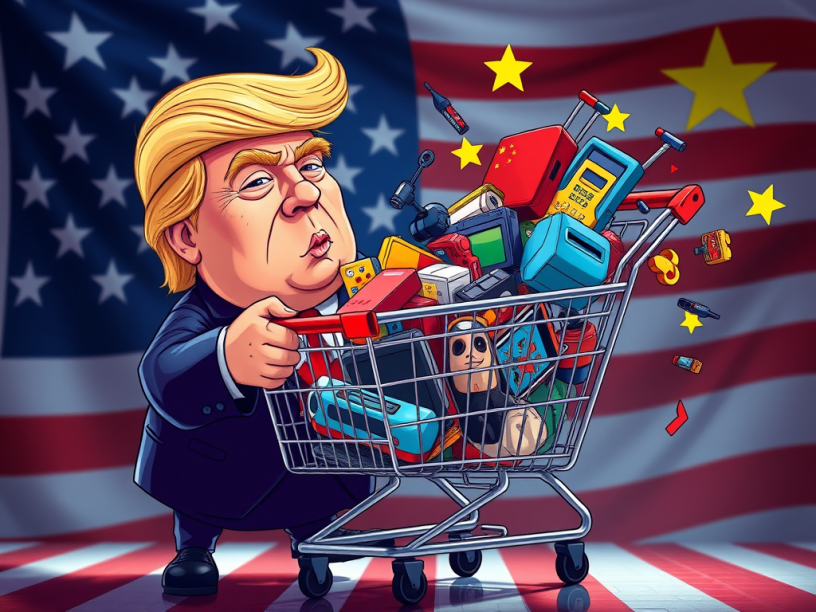
Hold on to your wallets, America: Donald Trump has decided to play economic Russian roulette with the world’s second-largest economy. In a move that screams “I buy bridges in Brooklyn,” Trump has slapped a cartoonish 125% tariff on Chinese goods while giving the rest of the globe a 90-day timeout with a measly 10% reciprocal levy. Why? Because, in his infinite wisdom, Trump believes China’s been screwing us over, and it’s time to make things “fair.” Fair, apparently, means jacking up the price of your $9.99 Made-in-Shenzhen air fryer to the cost of a used Hyundai. Meanwhile, China’s response has been a cool, “Bring it, Don,” with a side of ominous muttering about “other measures.” Cue the collective gulp from anyone who remembers 2020 and wonders if “other measures” includes something nastier than export bans on rare earth metals.
Let’s get one thing straight: when you buy a widget from China—whether it’s a phone charger that’ll die in six months or a rubber Halloween mask that smells vaguely of plastic regret—it’s cheap. Dirt cheap. So cheap you wonder how anyone made a dime getting it from a Guangdong sweatshop to your local Walmart. Trump says this is proof China’s ripping us off, flooding our markets with subsidized junk while we send them nothing but IOUs and soybeans. But here’s the kicker: those cheap goods are the lifeblood of the American consumer economy. You, me, and the guy panic-buying knockoff Nikes at 3 a.m. on Temu—we’re all complicit in this Faustian bargain. So why is Trump singling out China, picking a fight that could torch the global economy faster than you can say “supply chain disruption”? And why are we all sweating the possibility that Beijing’s retaliation might involve something worse than a trade embargo—like, say, a lab leak with a side of apocalypse?
The Tariff Gambit: Economic Machismo or Policy Dumpster Fire?
First, let’s unpack the tariffs. Trump’s logic, as far as anyone can parse it from his Truth Social screeds, is that China’s trade surplus with the U.S.—$367 billion in 2023, give or take—means they’re eating our lunch. He’s not entirely wrong. China’s been playing mercantilist hardball for decades, keeping its currency low, subsidizing state-owned enterprises, and turning a blind eye to intellectual property theft that would make Blackbeard blush. The U.S. manufacturing base? It’s been gutted, with entire Rust Belt towns reduced to opioid dispensaries and Dollar General outposts. Trump’s pitch is that tariffs will bring jobs back, level the playing field, and make America the guy who doesn’t get laughed at in the global cafeteria.
Sounds great, until you do the math. A 125% tariff on Chinese goods doesn’t just hurt China; it’s a blowtorch to the American consumer’s wallet. That $20 pair of sneakers from Target? Now it’s $45, and good luck finding an American-made alternative that doesn’t cost as much as your rent. The Economic Policy Institute, not exactly a bastion of MAGA cheerleading, estimates that Trump’s earlier trade war tariffs (2018-2019) cost U.S. consumers $40 billion a year in higher prices. This new stunt? Multiply that by ten, and throw in some bonus inflation for kicks. Small businesses, already limping from post-Covid supply chain woes, are about to get steamrolled by pricier inputs. And those “reshored” jobs Trump keeps promising? The Cato Institute—hardly pinko commies—says tariffs create maybe one job for every $900,000 in economic damage. That’s not a policy; it’s a protection racket.
So why China? Why not keep the pressure on everyone else—Canada, Mexico, the EU—who also run trade surpluses with us? Because China’s the big, scary dragon in the room. It’s the geopolitical boogeyman Trump can rally his base against, the one country where “tough on trade” doubles as a middle finger to the globalist elites he loves to dunk on. Plus, it’s personal. Trump’s been railing about China since the ’80s, back when he was just a loudmouth with a combover instead of a loudmouth with a combover and nuclear codes. He sees Beijing as the ultimate con artist, outsmarting America while we’re distracted by TikTok dances and oat milk lattes.
China’s Response: “You Wanna Dance? Let’s Dance.”
China, for its part, isn’t exactly quaking in its knockoff Nikes. Beijing’s already hit back with 34% tariffs on all U.S. goods—everything from iPhones to Iowa corn—and slapped export controls on seven rare earth metals critical for everything from EVs to missile guidance systems. And then there’s the cryptic talk of “other measures.” What does that mean? More tariffs? Cyberattacks? Dumping U.S. Treasuries and cratering the dollar? Or—and here’s where your stomach drops—something biological, like a souped-up coronavirus that makes 2020 look like a bad flu season?
Let’s address that fear head-on, because it’s not just you clutching your pearls. The lab-leak hypothesis from Covid’s origin story, still unproven but stubbornly plausible, has left a permanent dent in the American psyche. Could China, feeling cornered, resort to something that unhinged? Here’s the cold water: probably not. Biological warfare is a Pandora’s box even dictators hesitate to open—it’s messy, uncontrollable, and risks blowback that’d make Chernobyl look like a fender bender. But the fact that we’re even entertaining the thought shows how unmoored this trade war’s become. When tariffs start feeling like prelude to dystopia, you know the script’s gone off the rails.
More likely, China’s “other measures” are economic judo—using America’s own weight against it. They could tighten the screws on U.S. firms operating in China, like Apple or Tesla, which rely on Chinese manufacturing to keep their stock prices juiced. They could lean harder into de-dollarization, cozying up with BRICS nations to make the yuan a rival to the greenback. Or they could just sit back and watch America choke on its own inflation, as higher prices fuel voter rage that even Trump’s Twitter game can’t spin. Beijing’s not stupid; they know time’s on their side.
Why Are We Doing This? The Politics of Stupid
So why pick this fight? Beyond Trump’s obsession with looking like the toughest guy in the room, there’s a deeper rot. America’s addicted to cheap Chinese goods, but we hate admitting it. We want the $5 T-shirt and the moral high ground, so we demonize China to square the circle. It’s not just Trump—Biden played the same game, keeping most of Trump’s first-term tariffs and adding his own export controls on tech. The D.C. consensus is that China’s a threat, not just to our economy but to our way of life. They’re the perfect villain: authoritarian, ambitious, and just foreign enough to make jingoism feel righteous.
But here’s the dirty secret: tariffs don’t fix what’s broken. They don’t rebuild factories in Ohio or make us less dependent on Chinese lithium batteries. They just make everything more expensive and give politicians a soapbox to scream from. The real fix—industrial policy, education, infrastructure—takes decades, and nobody in Washington’s got that kind of attention span. So we get tariffs, because they’re loud, simple, and let Trump thump his chest while the rest of us pay the bill.
And what about us, the schmucks stuck in the crossfire? We’re the ones who’ll shell out for pricier groceries, cars, and Christmas presents. We’re the ones who’ll lose jobs when small businesses fold or when China’s retaliation hits exporters. And yeah, we’re the ones who’ll lie awake wondering if this escalates into something uglier—because history’s got a nasty habit of turning trade wars into real ones.
The Bottom Line: Nobody Wins a Pissing Match with a Firehose
Trump’s tariff tantrum is a masterclass in self-ownery. He’s betting he can bully China into submission, but China’s not some flyover state he can charm with a MAGA hat and a McDonald’s photo op. They’ve got the cash, the factories, and the patience to wait us out. Meanwhile, Americans are about to get a crash course in economics—spoiler: it’s gonna suck. And while we’re all praying China’s “other measures” don’t involve hazmat suits, maybe it’s time to ask: why are we lighting this fuse in the first place? We could be rebuilding our own house instead of trying to burn down theirs. But that’d require a leader who thinks past the next news cycle, and good luck finding one of those in 2025.
Personally, I am stocking up on cheap Chinese batteries. I want to be able to power my flashlight when the blackouts hit.
 The American Beast