
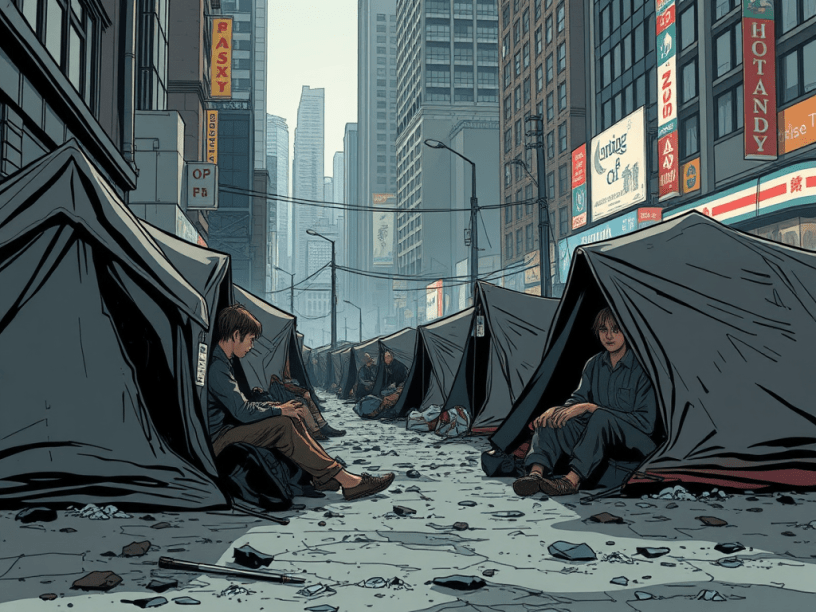
If you’ve walked through any American city lately—assuming you can afford a city with walkable streets and haven’t been priced into the sticks—you’ve probably noticed the tents. Or the makeshift shanties. Or the hundred-yard stare of some guy muttering to a bus bench while rats compete for the crusts of a discarded McDouble. Congratulations, you’re living in a nation that manufactures homelessness the way Wal-Mart cranks out home goods: quickly, cheaply, and in bulk.
Let’s just stop pretending. Homelessness in America is not some accidental byproduct of capitalism’s unfortunate exhaust. It’s not a sad side effect of mental illness or bad choices or addiction, though those play their parts. Homelessness is a policy. It’s engineered. It’s sustained. And it’s wildly profitable for the people who run this flaming strip mall of a country.
You’re not supposed to notice that, of course. You’re supposed to look away, clutch your purse, mutter something about “individual responsibility,” and donate five bucks to a nonprofit whose CEO makes 20 times more than a cardiac surgeon. That’s the script. Stick to the script.
Build Housing, You Say? Cute.
Let’s start with the most insultingly obvious solution: housing the homeless. You know, putting people in homes. Wild, right?
It’s been proven—repeatedly, in red states and blue ones—that “Housing First” programs work. You give someone a permanent place to live, and magically, they stop spiraling. Addiction treatment goes better. Employment becomes possible. ER visits plummet. Jail time drops off a cliff. Not only is it more humane, but it’s also cheaper. Like, taxpayers-save-millions cheaper.
So why aren’t we doing it everywhere? Because homelessness isn’t a glitch. It’s a feature. It is, functionally, a warning to the rest of us: This is what happens when you stop producing.
Just look at the funding priorities. Los Angeles spent over $1 billion on homelessness last year and somehow managed to build a handful of tiny apartments that cost more per unit than a condo in Dubai. San Francisco has a $700 million annual homelessness budget and the highest per capita rate of drug-fueled sidewalk despair in the developed world. New York, Portland, Seattle—same shit, different Starbucks. Cities throw bags of money at “solutions” that look suspiciously like a middle finger in a manila folder.
Meanwhile, real solutions—public housing, rent control, eviction moratoriums, even the ghastly socialist idea of guaranteed shelter—get laughed out of city councils by developers wearing Patagonia vests and holding $40 matcha lattes. “We’d love to help,” they say, while bulldozing another row of rent-controlled apartments to make way for luxury dog spas and vape lounges.
Capitalism’s Sacred Warning Sign
America needs homeless people. Not in a humanitarian sense, but in a Calvinist, late-stage capitalist, whip-the-workers sense. You think Uber drivers are going to strike when they know one missed rent check means pitching a tent under an overpass next to three registered sex offenders and a guy who thinks he’s the reincarnation of Ben Franklin?
The threat of homelessness keeps the labor pool docile. It breaks the will. It’s the boot on your neck reminding you that no one’s coming to save you—not your boss, not your mayor, not your goddamn GoFundMe. It tells you that in the richest country on earth, housing is a privilege, not a right. And that privilege is revoked the second your productivity slips.
It’s economic terrorism, but with more spreadsheets and fewer AK-47s.
“Compassionate” Crackdowns: The Real Estate Solution
So instead of actually solving homelessness, American cities do the next best thing: criminalize it. It’s illegal to sleep in your car, illegal to camp in public, illegal to sit too long on a bench, illegal to loiter unless you’re holding a credit card and a Frappuccino. And just to twist the knife, we fine people for being broke. Tent too big? $500 citation. Urinated in public because there are no restrooms? Arrested. Slept in a doorway? Moved along by a cop with a badge, a billy club, and a grudge.
But don’t worry! Every crackdown comes with a press conference. Mayors call it “cleaning up the streets,” as if people are gum wrappers and poverty is a sanitation issue. It’s not about safety. It’s about optics. About gentrification. About keeping sidewalks clear so your real estate investment doesn’t lose 0.2% of its quarterly growth.
In truth, what these cities are doing is not policing crime—it’s preserving property values. It’s making sure that tourists don’t Instagram a homeless encampment next to the brunch spot. It’s removing the visible evidence of American failure without changing a single goddamn system that creates it.
Nonprofits: The Grift That Keeps on Giving
Now let’s talk about the nonprofit industrial complex. This is the feel-good mafia that shows up whenever the government wants to outsource its guilt. These groups hoover up millions in taxpayer dollars to “serve the homeless,” which apparently means endless “resource fairs,” PowerPoints, and consultants who use the phrase “impact deliverables” while charging $900 an hour.
For a lot of these organizations, homelessness is a growth industry. Solving it would be bad for business. So they nibble around the edges—run a soup kitchen here, hand out socks there, file a few reports, and collect their checks. They hold press events. They print glossy annual reports. They say “unhoused” instead of “homeless” so you know they care. Meanwhile, the number of people sleeping on the street keeps going up.
Ever wonder how a city can spend half a billion dollars a year on homelessness and still have tent cities larger than Burning Man? Easy. Because most of the money never touches the homeless. It vanishes into bureaucratic wormholes, consulting contracts, and administrative “capacity building.” Translation: nothing.
Politicians: Addicted to Housing Chaos
Local politicians love the chaos of homelessness. It’s a great fundraising tool. You can blame it on liberals, on conservatives, on climate change, on fentanyl, on the full moon—whatever your base hates most, homelessness becomes the embodiment of it. Every mayoral campaign is a reboot of the same promises: “Tough but compassionate.” “Enforcement and services.” “Balanced solutions.”
Here’s a fun game: Go back 20 years and read any city’s homelessness plan. Now read today’s. They are functionally identical. We just change the names of the programs, swap out buzzwords, and make the PowerPoint slides more colorful. The results are the same: more poverty, more tents, more jail time for being poor.
Want to know how to identify a fake solution? If it doesn’t piss off landlords, cops, or real estate developers, it’s not a solution. It’s a performance.
A Manufactured Crisis, Not a Mystery
Let’s not pretend this is unsolvable. Finland has virtually eliminated homelessness by—brace yourself—building public housing and treating people like humans instead of human garbage. Vienna has affordable housing for all income levels. Hell, even Utah had a brief flirtation with solving chronic homelessness before someone realized it cut into the prison labor supply and quietly walked it back.
America could do this. Right now. Build homes. Fund mental health services. Cap rents. Ban evictions without cause. Stop treating poverty as a criminal offense. But we won’t. Because homelessness is too useful. It’s a scapegoat, a cautionary tale, a profit center, a prop.
We’d rather create a caste of permanent nomads and blame them for their condition than acknowledge the truth: we designed this system. Intentionally. Cynically. And it’s working exactly as intended.
So next time someone asks, “Why don’t they just get a job?” tell them the truth:
Because the American economy doesn’t want them to. It needs them where they are—on the sidewalk, in the shadows, holding up a cardboard sign that says “Anything Helps”—so the rest of us stay in line.
Homelessness isn’t a problem.
It’s the plan.
 The American Beast