
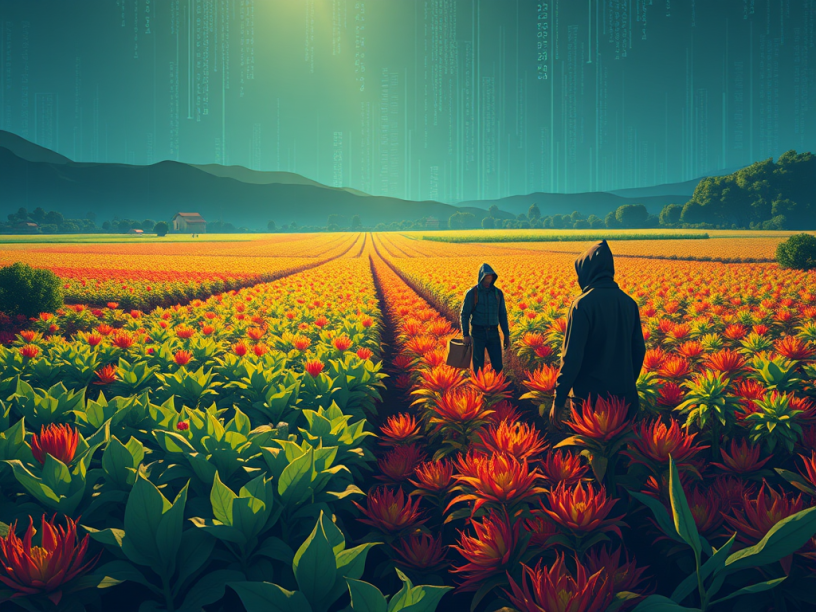
The internet was supposed to be the great equalizer. A place where everyone had a voice, everyone had access, and the gatekeepers of the old media world were replaced by a flat, democratic network of connections. It was going to be a commons. It was going to be free. We were going to own our words, our pictures, our voices. What we got instead was a new form of feudalism: a digital plantation where the crop is you, and the landlords wear hoodies instead of crowns.
The old sharecropping system was brutally simple. You worked someone else’s land, and when harvest came, they took the lion’s share of the crop. You got just enough to keep yourself alive until the next season, and the cycle began again. Digital sharecropping works the same way, but instead of wheat or cotton, you’re producing clicks, engagement, and personal data. Every status update, every “like,” every photo of your dinner is a neat little sheaf of data, bundled up and sold to the highest bidder.
You don’t get paid for this work, of course. You get “access.” A free account, some cloud storage, the privilege of using their tools. You’re not renting the land—you’re living on it for free—but the landlord owns every stalk you grow. And, unlike the old system, you don’t even see the truck that comes to take it away. Your data slips quietly into the great combine harvester of the internet, disappears into an algorithmic mill, and comes out the other side as advertising profiles, predictive models, and behavioral nudges.
The pitch is as old as capitalism: it’s free, it’s easy, it’s convenient. You don’t have to worry about servers, hosting, distribution—leave all that to the landlord. All you have to do is keep the fields alive with your labor. And what a bounty you produce. Your searches, your GPS location, the time of day you’re most likely to buy cat food, the tone of voice you use when you type an email, your political leanings based on which headlines make you stop scrolling—this is the digital equivalent of cotton and corn. It’s the lifeblood of the new economy, and you’re producing it constantly, without even realizing you’re doing it.
The platforms, of course, have perfected the art of extraction. They don’t just take what you give them—they get you to give more, constantly, willingly, happily. The old landlords could only guess at the yield until harvest. Your new ones watch you in real time. The overseer is an algorithm that doesn’t sleep, doesn’t blink, doesn’t get drunk in the middle of the day. It tracks what you do, learns what keeps you in the field, and adjusts the work to keep you producing. It feeds you outrage when you slow down, serotonin when you get tired, and a carefully timed dose of anxiety when it senses you’re slipping away.
In the traditional economy, even a tenant farmer could, in theory, buy his way out. Scrimp, save, purchase a plot, become a landowner. That possibility kept the dream alive. In the digital version, escape is almost impossible. You can delete your accounts, encrypt your communications, self-host your content. You can swear off Facebook and live without Instagram. But the plantation follows you. Your data is still out there, scraped from your friends’ contact lists, mined from your bank transactions, sucked up by advertisers who buy from brokers who bought from someone who bought from the platform you thought you left.
Even resistance is profitable. You can rage against the machine, drag the platform on Twitter, and vow to delete your account—it’s all engagement. It’s all grist for the mill. The more you talk about it, the more it spreads, the more valuable your labor becomes. This is the genius of the system: it monetizes even its own criticism.
It would be one thing if this were just commerce. But it’s also politics. The same techniques that sell you sneakers and energy drinks are used to sell you candidates and ideologies. Your voting preferences are a data point. Your fears are a data point. Your susceptibility to conspiracy theories is a data point. All of it is bundled and sold to campaigns, super PACs, and political operatives who plant the right memes, the right headlines, the right viral videos into your feed at the right time. You don’t even notice you’re being cultivated until you’ve harvested yourself into a voting booth.
This is what democracy looks like now: an endless feed of content tailored to your profile, your habits, your biases, until the only version of the world you see is the one most likely to keep you clicking. It’s a plantation economy with infinite fields, and the crop is human behavior itself.
And soon, the illusion of free land will end. The platforms are already experimenting with pay-to-play models. Want fewer ads? Pay up. Want more reach for your posts? Pay up. Want to actually own the content you produce? That’s a subscription plan. The endgame is you paying rent to the landlord for the privilege of farming your own life for someone else’s profit.
We were promised the internet would liberate us from the gatekeepers of old media. Instead, we got a more efficient system of control—one that doesn’t need to send a man with a whip to your door, because you’ll sit down at your desk and start working willingly.
Welcome to the age of data serfdom. The lords are richer than any robber baron, the fields stretch to the horizon, and the only way out is to log off completely. But let’s be honest—you’re not going to do that. The harvest is too good, the fields too addictive, and the landlord has already made sure you’ve got nowhere else to go.
 The American Beast