
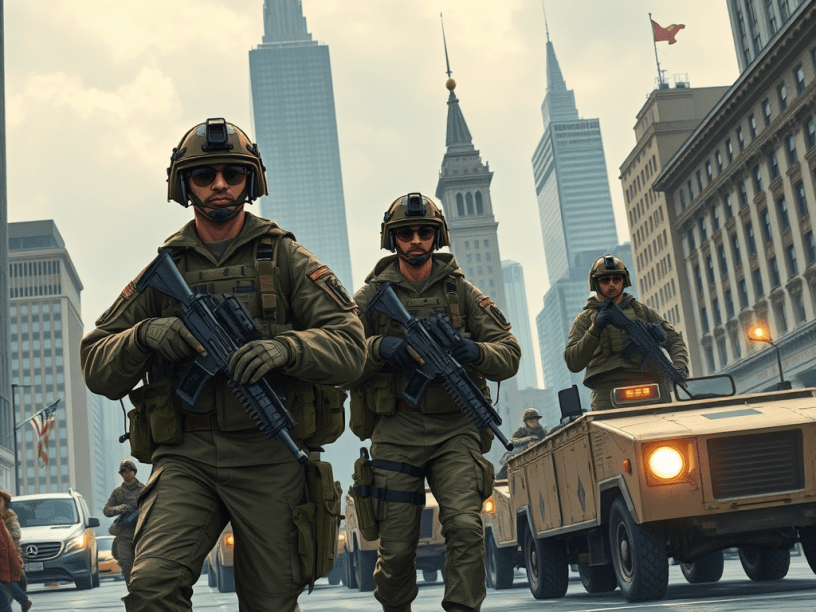
The sight of National Guard troops patrolling the National Mall is the kind of spectacle Americans expect from coups in far-off countries we like to “monitor” from the safety of CNN segments. But here it is in the nation’s own capital—800 troops, armored vehicles, and the sense that this is less about safety than it is about staging. President Donald Trump didn’t just call in reinforcements; he seized control of the D.C. police force from the mayor, using the city’s lack of statehood as the lever. It’s a move that’s legal in the same way pulling the fire alarm during a debate is “justified”—not explicitly against the rules, but fundamentally an act of disruption.
The official excuse is crime. Violent crime, we’re told, is raging unchecked in Washington, D.C., and the only way to protect the city is to flood it with troops. Except the crime stats don’t tell that story—violent crime is actually on the decline. What they do show is an administration looking for a reason to put on a show of force, to turn the capital into a militarized backdrop for the “law and order” narrative. And in D.C., that backdrop comes without the pesky obstacle of a governor who can say no.
It started with the mugging of a Trump appointee, an incident gruesome enough to serve as the pretext. The president posted the hospital photos himself—nothing like using an injured bureaucrat as campaign material—and declared it “Liberation Day.” By nightfall, the chain of command had shifted; Mayor Muriel Bowser’s authority over her own police was gone, and the Guard was mobilized. The move felt less like an emergency response than a political experiment: How far can you go in bending the capital to your will when it isn’t allowed to govern itself?
The troops on the ground aren’t technically making arrests; they’re “assisting” law enforcement, which in practice means detaining suspects until police arrive. But the distinction is academic. In the theatre of authoritarian gestures, soldiers in combat gear on Constitution Avenue send a message loud enough to drown out the fine print. Federal agencies have joined in—DEA, FBI, and others—making the whole thing a jurisdictional soup that’s more about optics than strategy. The point isn’t to fight crime; it’s to look like you’re fighting something, with the visual language of a foreign occupation applied to your own seat of government.
From Test Case to Template
What’s more unnerving is how openly this is being talked about as a model for the future. Pentagon planning documents outline a “Domestic Civil Disturbance Quick Reaction Force,” a roving unit of 600 troops split between Alabama and Arizona, designed to deploy anywhere in the country within an hour. The stated mission is to handle unrest or “terror threats,” but anyone who’s been awake for the last decade knows those terms are elastic enough to cover anything from a mass protest to a teachers’ strike. If you can turn the capital into a military photo op over a single street crime, imagine what you can do with cities that don’t have the national media’s constant gaze.
And the targets won’t be random. Black mayors in cities like Baltimore and Detroit have already voiced concern that D.C. is just the first domino—an easy win thanks to its status, a low-risk demonstration of federal control over local law enforcement. The next time it happens, it might be in a city that can’t fight back politically, or in a moment when a large-scale protest offers the perfect excuse to “restore order” with a military presence. This isn’t a uniform policy; it’s a selective tool, deployed where it plays well to the base and where opposition can be dismissed as part of the problem.
Legally, it’s all built on loopholes. Title 32 lets the president call in the Guard without triggering the Posse Comitatus Act, which limits military involvement in civilian law enforcement. In D.C., the Home Rule Act leaves the mayor with less power than a small-town sheriff when the president decides to act. The administration isn’t breaking the law; it’s showing the law how much abuse it can take without snapping. It’s government by stress test, and the results are encouraging only if your goal is to normalize the sight of troops in American streets.
The soldiers will eventually go home. The Humvees will roll out. But the precedent—an American city’s police taken over, its streets patrolled by troops at a president’s whim—will stick. And like every precedent in this era, it’s less about what happened and more about what it allows next time.
In the end, the National Mall doesn’t need defending from crime. It needs defending from the people who think it’s their personal stage for the next big authoritarian photo op.
 The American Beast