
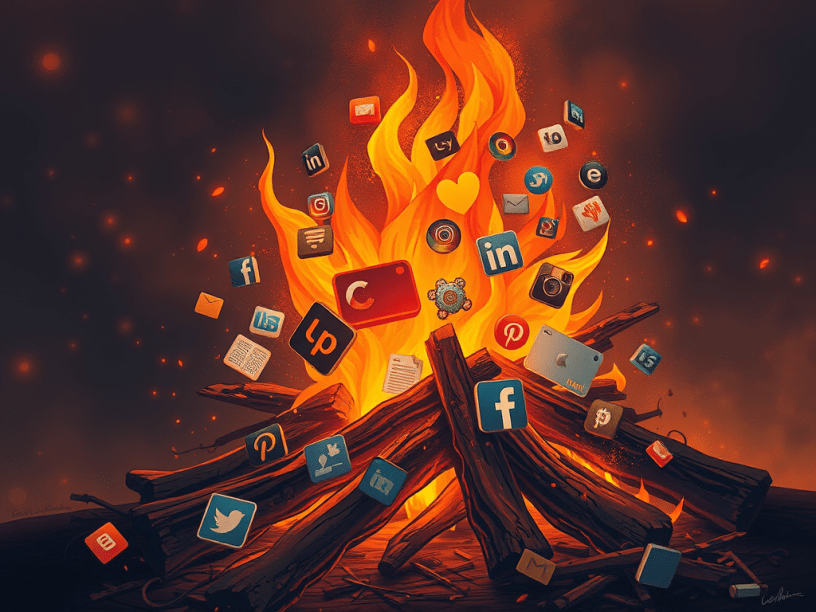
In the early days of the internet, the problem was that nothing ever went away. Drunken MySpace photos haunted job interviews. Old LiveJournal posts about your middle school crush resurfaced in congressional hearings. “The internet is forever” became the unofficial slogan of our digital lives—a constant reminder that every embarrassing tweet, every half-baked rant, every ill-advised sext, was destined to live on in the silicon afterlife, a ghostly reminder of our worst selves.
But in 2025, the problem isn’t that the internet never forgets. It’s that it’s forgetting too much. And, in true late-capitalist fashion, it’s not forgetting the stuff we want gone—your Facebook posts from 2009 about the Black Eyed Peas being the “voice of a generation”—but the stuff we actually need: research archives, public records, court cases, entire sections of history, vanishing into the corporate ether because some MBA decided server space was “not cost-effective.”
We’ve gone from “the internet never forgets” to “the internet has early-onset dementia,” and the results are both hilarious and terrifying.
The Great Digital Purge
The first wave of alarm bells rang when old Reddit threads, news archives, and even parts of Wikipedia started disappearing. Not just being hidden behind paywalls, but truly gone. Search for a story on, say, the Bush administration’s failed war in Afghanistan, and suddenly the link goes nowhere. Try to look up a government report that was hosted on a .gov server, and you get a cheery 404 page that feels like a middle finger.
At first, people blamed sloppy sysadmins, or maybe hackers. But it quickly became clear that something more coordinated was happening: corporations and governments alike were quietly scrubbing the record.
Google, for instance, has quietly deprioritized search results that don’t have “fresh engagement,” which is Silicon Valley speak for “things that still make money.” Translation: that 2014 investigative piece about Goldman Sachs defrauding pension funds? Down the memory hole. But TikTok influencers screaming about kombucha enemas? That’s eternal.
Meta did its part too. In January, they announced that “inactive content” older than a decade would be “archived” (read: shredded) to “enhance user experience.” Unless you’re a paying subscriber, your Facebook albums of your dead relatives are gone. They’re calling it digital spring cleaning. Everyone else is calling it book burning 2.0.
Forgetting Is Profitable
Why is this happening now? Simple: storage costs money, and accountability costs more.
Keeping forty years of archives on the Iraq War or the opioid crisis isn’t just expensive server space—it’s also dangerous. Because someday, somebody might go looking. Somebody might dig up the speech where a senator called opioids “safe.” Somebody might find the video of a general promising Afghanistan was “turning the corner” in 2007, 2009, 2011, and again in 2015. The safest move for the powerful isn’t to keep the receipts—it’s to burn them.
It’s not even necessarily a sinister conspiracy. It’s just the logic of capitalism. If your only incentive is to monetize engagement, why waste resources preserving the boring, unclickable past? Wall Street doesn’t want a history of its crimes. Pharma doesn’t want a library of its fraud. Politicians don’t want archives of their lies. Tech bros don’t want you to remember they once promised the metaverse would replace reality.
So the memory hole grows. And we all get a little stupider, a little more gaslit, every day.
A World Without Receipts
The scariest part isn’t that history is being rewritten—it’s that it’s being erased altogether.
When Nixon said “I am not a crook,” we can still watch the footage. When Dick Cheney swore Iraq had WMDs, the clips are there, archived, waiting for the next documentary. But what happens when those links go dead? What happens when the video is scrubbed from YouTube for “inactivity,” or buried in an algorithmic landfill under a mountain of mukbangs and reaction videos?
We’re entering a world where the only things that survive are whatever is immediately profitable to the platforms. Which means the historical record isn’t going to be curated by journalists, historians, or librarians—it’s going to be curated by 25-year-old TikTok managers who think history began with the iPhone 12.
And once the receipts are gone, the gaslighting goes into overdrive. Imagine a world where Trump’s tweets from January 6th are just… gone. Where the footage of cops brutalizing protesters in 2020 isn’t retrievable. Where Flint, Michigan’s water crisis has no documentary evidence left online. Politicians won’t even have to lie anymore. They can just say, “That never happened.” And without proof, what can anyone do?
The Return of Oral History
Here’s the funny part: we might end up right back where we started. Pre-digital humanity survived on oral tradition. The Iliad wasn’t posted to Substack; it was sung around a fire by bards. For centuries, history was passed mouth to mouth, shaped by memory, bias, and creative embellishment. Then we invented writing, libraries, and archives to preserve the truth. Now Silicon Valley is taking us full circle, except the new bards aren’t poets—they’re podcasters with ad deals for boner pills.
The future of history may not be libraries, but bootleggers. People are already hoarding terabytes of data on personal drives, sharing torrents of old websites like they’re trading Grateful Dead tapes. Pirate archivists are the new monks, keeping knowledge alive while the corporate church sets fire to the scrolls.
And honestly? That might be the only hopeful part of this whole mess. Because as long as there are nerds with hard drives and too much free time, there’s a chance not everything will be lost.
Burning Down the House
Make no mistake: this isn’t just a tech story. This is politics. This is class war.
When billionaires delete the archives, they’re not just saving money—they’re erasing accountability. They’re scrubbing their fingerprints from the crime scene. Every megabyte deleted is another shield for the powerful against the people they’ve screwed.
The internet was supposed to democratize information, remember? That was the pitch: access for all, knowledge at your fingertips, the whole of human history available with a click. What we got instead was Facebook deleting your family photos unless you pay $9.99 a month for “cloud storage,” and Google deciding that the Iraq War is less relevant than an SEO farm selling erectile dysfunction gummies.
This isn’t just the internet forgetting. This is the internet being lobotomized, on purpose, by the very corporations who once told us they’d make us smarter. And if we don’t fight for memory now, the next generation won’t even know what they’ve lost.
History doesn’t repeat itself, but it does delete itself. And when it’s gone, it’s not coming back. We are living through a digital book burning, a bonfire of receipts, and the people lighting the matches are the same people who promised us “Don’t be evil.”
In twenty years, when we ask why nobody remembers that America invaded Iraq, or that Facebook fueled a genocide in Myanmar, or that billionaires torched the planet for profit, the answer will be simple: the files were too expensive to keep.
 The American Beast