
Doughboys, Dope, and the Forgotten Highs of World War I (And, yes, I got this idea from Severance)
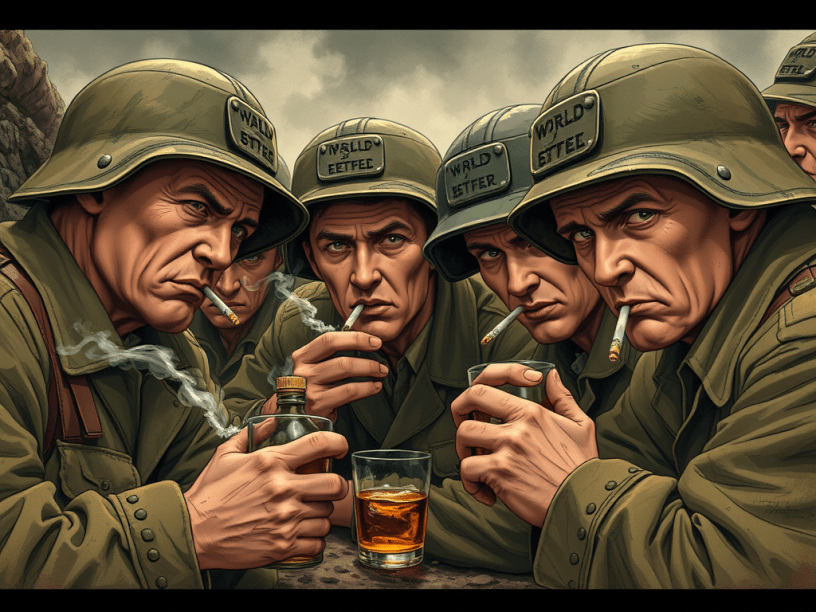
History loves a good lie. The official story of World War I is all brass bands and Norman Rockwell farm boys charging into the fields of France with clean lungs, clean consciences, and a bottomless well of patriotism. It’s a nice bedtime story, but like most things America tells itself, it’s bullshit. The trenches weren’t a proving ground for wholesome manhood — they were an open-air chemistry lab where young men marinated themselves in morphine, cocaine, hash, and whatever cheap booze they could find to make slaughter bearable.
The “War to End All Wars” was also, in no small way, the War to End All Sobriety.
Uncle Sam’s Open-Air Dispensary
The U.S. Army came equipped with bayonets, rifles, and a pharmacy that would make Pablo Escobar blush. Morphine was standard issue. Soldiers carried little morphine syrettes — disposable glass tubes with a needle on the end — in their kit, right next to their rations and bullets. If you got your leg blown off by an artillery shell, you jabbed yourself or begged a buddy to jab you. If you just felt like checking out from the endless mud and terror, well, that was between you and the morphine.
The medical brass also handed out cocaine tablets for “fatigue” and heroin cough syrup for colds, nerves, or what was politely called “war neurosis.” This wasn’t a rogue operation — this was policy. Bayer, the friendly German chemical company, was the source of both aspirin and heroin. They advertised heroin as a “safe, non-addictive” alternative to morphine. The Kaiser’s chemists might have been on the other side of the trenches, but their products were coursing through the veins of American doughboys.
If modern drug warriors had to sit through a single night in the trenches without morphine or laudanum, they’d be begging for a needle before breakfast.
Booze: The Trench Communion
If morphine and cocaine were official medicine, alcohol was the unofficial sacrament. Every army in Europe had its drug of choice. The British were fueled by rum, the French by vin blanc (a paint-thinner-grade white wine), and the Germans by beer when they could get it, schnapps when they couldn’t. Americans, new to the party, improvised: they drank whatever the locals had, bartered cigarettes for brandy, and often brewed their own toxic swill.
The officers made half-hearted attempts at discipline, but no one wanted to lead a battalion of cold-turkey sober men who’d just watched their best friend evaporate under shellfire. A drunk platoon might stagger, but at least they wouldn’t mutiny.
And then there were the moments when booze went tactical. Before some charges, French commanders actually encouraged their troops to get plastered so they wouldn’t hesitate when the whistle blew. It was liquid courage, trench edition: stumble across no man’s land with vin coursing through your veins, a rifle in your hands, and the odds of survival only slightly worse than blackjack at an internet casino.
Hashish and the Desert War
Not every soldier slogged through Flanders mud. Those stationed in the Middle East discovered hashish. Cairo was effectively a giant head shop, and British and American soldiers took full advantage. Veterans wrote about smoky nights in cafes, hitting hookahs stuffed with resin, and laughing themselves into temporary amnesia while the Ottoman Empire crumbled outside.
Cannabis was a novelty for many doughboys — a drug exotic enough to feel illicit but accessible enough to become routine. It didn’t spread far back to the States after the war, but the exposure planted seeds (pun intended) for the jazz-age marijuana culture that bloomed in the 1920s and ’30s.
Imagine the irony: America’s first potheads were soldiers in khaki uniforms, lighting up hash while their commanders scribbled reports back home about “discipline” and “valor.”
The Return Home: Junkies with Medals
When the Armistice came, America’s doughboys came home carrying more than souvenirs and nightmares. Tens of thousands returned addicted to morphine and heroin. The government had spent years training them to self-medicate, then promptly turned around and criminalized the very habits they’d created. The Harrison Narcotics Act of 1914 had already started restricting access, but post-war America doubled down.
So the same government that handed morphine out like Chiclets at the front now threw veterans in jail for using it at home. The hypocrisy was stunning even by Washington standards: “Thanks for your service, son. Here’s a parade, a pat on the back, and a prison cell if we catch you chasing the dragon.”
This hypocrisy birthed a whole “Lost Generation.” Hemingway drowned himself in whiskey, Fitzgerald poured gin into every story, and thousands of nameless vets scrounged for dope in alleys while their country pretended they were heroes.
From Trenches to Opioid Epidemic
The parallels to today are nauseating. Back then, the Army used drugs to prop soldiers up in impossible conditions, then abandoned them. Now, the VA prescribes opioids to manage pain, yanks them away when the PR gets bad, and acts shocked when veterans turn to street fentanyl. We’ve been running the same scam for over a century: use chemicals to keep the troops marching, then scapegoat them when the chemicals become a curse.
The modern opioid crisis isn’t just Big Pharma’s greed — it’s a replay of trench medicine. Purdue Pharma is just Bayer with better lawyers. The Sacklers are the heirs to the Army medics who passed out morphine syrettes in 1918. Different war, same scam, same casualties.
The Real War to End All Wars
Here’s the ugly truth: war is impossible without drugs. Soldiers aren’t built to endure unending terror, gore, and deprivation. They need something — morphine, booze, hash, meth, whatever’s on hand — to get through. The “clean-limbed heroes” of textbooks were, in reality, stumbling through clouds of smoke, booze breath, and morphine haze.
“All Quiet on the Western Front” painted war as mechanized slaughter. The sequel America never wanted to publish was “All Quiet on the Western Blunt”: a generation of high, drunk, and chemically dependent doughboys stumbling through hell with a syringe in one hand and a cigarette in the other.
And maybe that’s the real American tradition. Not liberty, not democracy, not even freedom fries — but a government happy to hand you drugs when it’s convenient, then kick you in the teeth for using them later. A hundred years on, nothing’s changed. The battlefields shift, the drugs evolve, but the pattern remains: get high for Uncle Sam, get punished for yourself.
 The American Beast