
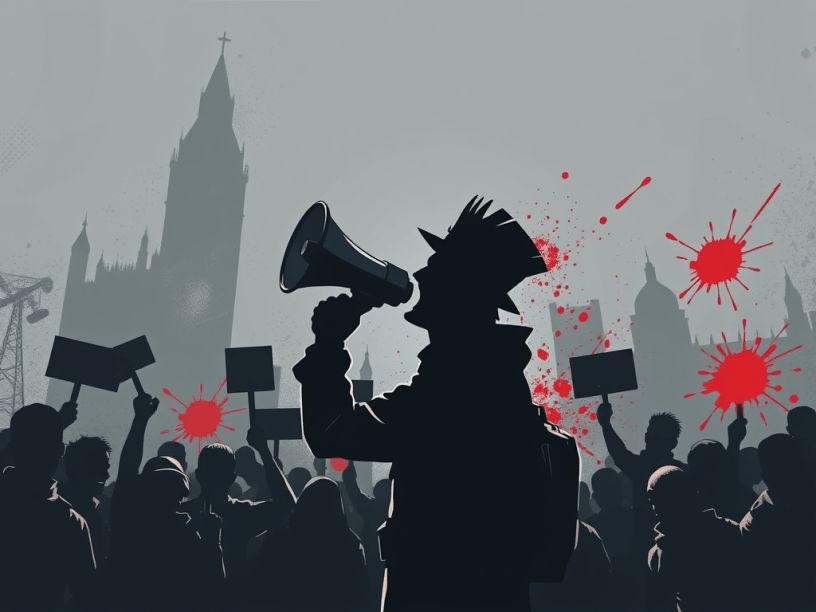
Britain, the country that gave the world Shakespeare, Orwell, and Monty Python, has decided it’s had quite enough of free speech. Too messy. Too noisy. Too many people noticing the bombs falling on Gaza and the smoke curling out of Whitehall’s arse. The Home Office, never one to miss a chance at bad cosplay, has dusted off its counterterrorism wardrobe and started fitting anyone with a megaphone, paint can, or novel into an orange jumpsuit.
Last week, a gaggle of Palestine Action activists—whose chief crime was splattering blood-red paint on Elbit Systems’ offices, i.e., making visible the blood Britain prefers to keep theoretical—were scooped up under “terrorism” laws that were originally designed to stop guys wiring nail bombs in Birmingham. And because the UK never half-asses censorship, they’ve also been floating the idea that public figures who dare say anything sympathetic about Palestinians—say, novelist Sally Rooney—are suspicious, too. Nothing screams “Mother of Parliaments” quite like trying to criminalize Irish novelists.
How Britain Learned to Love Its Thought Police
The story is depressingly predictable. Every time the government runs out of actual enemies to fight, it turns inward and declares war on adjectives. The Terrorism Act 2000, birthed in the Blair years as a way to stomp out al-Qaeda and the IRA’s dying embers, has been repurposed over the decades like a Swiss Army knife made of red tape. Today, “terrorism” apparently includes throwing soup at a Van Gogh, chanting at a protest, or staging a sit-in at a weapons factory that sells drones to Israel.
In other words: terrorism is now whatever the government finds annoying. It’s the legislative equivalent of a toddler sticking its fingers in its ears and screaming until everyone else shuts up.
Palestine Action: The Canary in the Coal Mine
Palestine Action, for those not reading the tabloids, is a direct-action group that stages protests against British complicity in Israel’s military operations. Their tactics aren’t genteel—they occupy factories, pour paint, chain themselves to gates—but let’s be clear: these people are not the Baader-Meinhof gang. They’re pissed-off activists in hi-vis jackets, not suicide bombers.
And yet the government, in a fit of Orwellian enthusiasm, has begun to label their activities as terrorism. Not vandalism. Not trespassing. Terrorism. The sort of word you’re supposed to reserve for people with Kalashnikovs, not cans of Dulux. It’s a classic sleight of hand: by upgrading civil disobedience to “terror,” the state not only criminalizes protest but makes it existentially illegitimate. Once you’re a “terrorist,” you’re not a citizen anymore—you’re an enemy.
Sally Rooney: Poet, Novelist, Terrorist?
Enter Sally Rooney, the Irish writer whose books are responsible for roughly 80% of Instagram bookshelf photos. Rooney has been outspoken in her criticism of Israel, even refusing to let one of her novels be published by an Israeli company. In saner times, this would earn her a debate on the BBC, some angry think-tank op-eds, and a grumpy column from Nick Cohen. In 2025 Britain, it earns her the stink-eye from legislators trying to jam through a new “anti-extremism” package that could put her statements in the same category as ISIS recruitment videos.
Yes, the government that once censored Ulysses is back at it again, this time with terrorism statutes instead of customs seizures. The irony that Britain is criminalizing an Irish writer for supporting Palestine, while handing literal arms contracts to actual war profiteers, is almost too on-the-nose.
The Bi-Partisan Unity of Censorship
Both Labour and the Conservatives are tripping over themselves to look “tough on terror,” which now translates to “tough on dissent.” Keir Starmer, the world’s blandest man in a suit, has been tiptoeing rightward, terrified of losing the Daily Mail readership he will never, ever win. The Tories, meanwhile, are flogging “British values” with all the grace of a pub bouncer on ketamine.
Together, they’re pushing the narrative that anyone opposing UK complicity in foreign slaughter is an extremist. The average Brit, already numbed by decades of tabloid paranoia about immigrants and knife crime, shrugs and nods. And just like that, Britain drifts further into the warm bath of authoritarian consensus.
Terrorism as a Mood
The real danger here isn’t just Palestine Action or Sally Rooney. It’s the elasticity of the term “terrorism.” Once upon a time, terrorism meant actual bombs. Then it meant giving money to people who bought bombs. Then it meant encouraging people who gave money to people who bought bombs. Now it means painting a wall or writing a book the government doesn’t like.
What we’re seeing is the “terrorism mood”—a permanent state of emergency in which the definition expands and contracts based on the government’s insecurities. Today it’s Palestine Action. Tomorrow it’s climate activists. Next week it’s your kid holding a “Free Julian Assange” sign at a campus protest. In a climate where the state’s favorite trick is to escalate rhetoric, every act of dissent can eventually be reframed as an existential threat to national security.
Britain: World’s Polite Police State
It would be funny if it weren’t so pathetic. The UK is not a fascist boot-stomping dystopia—it’s worse. It’s a bureaucracy with delusions of grandeur. Instead of black-shirted stormtroopers, you get police with clipboards. Instead of gulags, you get “counter-extremism workshops.” Instead of outright book burnings, you get publishers nervously ghosting their own writers. It’s authoritarianism with a cup of tea.
And the saddest part? It works. Brits, already trained to queue patiently for everything from fish-and-chips to chemotherapy, accept this creep with barely a sigh. The surveillance cameras outnumber pigeons, every protest permit comes with a leash, and the nation that once exported Magna Carta now imports Israeli spyware to watch its own citizens.
The Canary Stops Singing
The arrests of Palestine Action activists are not just about Palestine. They’re about what Britain is willing to criminalize to maintain the illusion of order. Sally Rooney’s treatment is not just about literature; it’s about what happens when thought itself gets shoved under the terrorism umbrella. And the legislative creep is not about security—it’s about control.
Britain loves to lecture the world about democracy and free speech, but in practice it’s sliding into a state where free speech exists at the leisure of the Home Secretary. Protest is fine, as long as it’s about the weather. Literature is fine, as long as it’s apolitical pap about middle-class affairs in Surrey. Everything else? Borderline terror.
Britain is not fighting terrorism. Britain is fighting reality. And in the process, it’s criminalizing anyone who dares to point out that the empire still has blood on its hands. When writers are suspects, activists are “terrorists,” and paint is a weapon of mass destruction, the only thing left to terrorize is the word “freedom” itself.
 The American Beast