
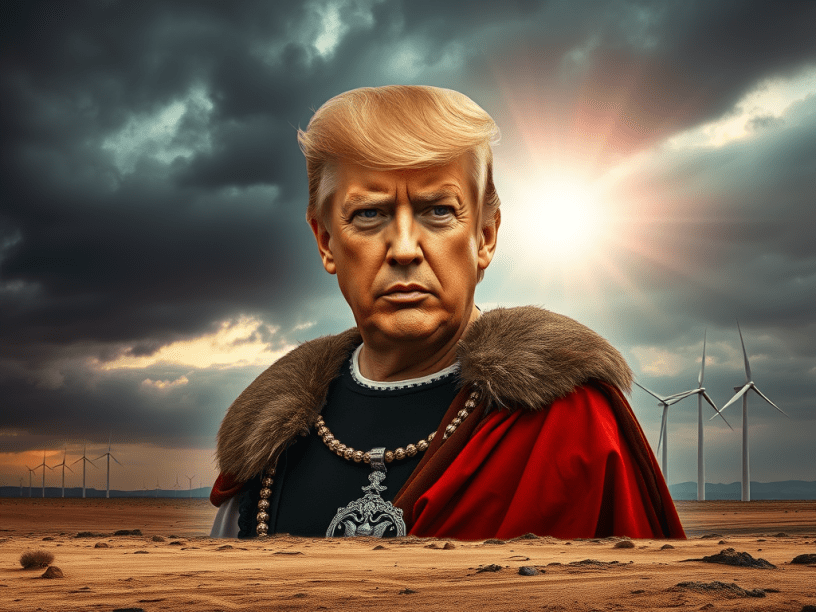
Donald Trump has finally found an enemy he can’t sue, bankrupt, or insult into oblivion: the weather. And since he can’t file a cease-and-desist against rising seas or personally stiff a hurricane on its invoice, he’s going after the next best thing—renewable energy. Wind, solar, geothermal, anything not pulled from the blackened bowels of the earth is now officially part of Trump’s “scam of the century,” a phrase he repeated on Truth Social in one of his many exclamation-studded manifestos.
Trump hates wind turbines the way a medieval peasant hated comets: irrationally, obsessively, with a kind of slobbering fear that says more about him than about the giant pinwheels themselves. He’s been ranting about them for years—how they kill birds, cause cancer, make your lights flicker, give children autism, and probably eat your grandma’s dog. In reality, turbines just spin quietly and make electricity. But in Trump’s skull, wind power is a personal affront, a rival brand, a competitor in the marketplace of attention.
This is the new front line of the Second Trump Administration: a slobbering, full-tilt crusade against clean energy, as if wind turbines personally defrauded him out of a golf course. Offshore wind farms? Halted. Solar incentives? Scrapped. Climate scientists? Purged from their agencies like heretics in a 15th-century monastery. In Trump’s America, the only green energy that matters is the cash in ExxonMobil’s quarterly report.
A Billion-Dollar Project, Nuked from Orbit
The most dramatic example of Trump’s vendetta came in August, when he single-handedly kneecapped Ørsted’s $1.5 billion Revolution Wind project off Rhode Island. The farm was nearly finished—45 out of 65 turbines already built, the rest on the way—before Trump dropped a stop-work order citing vague “national security concerns.” National security? From what? Rogue seagulls? The Danish? It was bullshit, and everyone knew it. Ørsted’s stock cratered 17% overnight, investors fled, and a project that could’ve powered 350,000 homes was left twisting in the salty Atlantic breeze.
This isn’t policy; it’s vandalism. It’s the political equivalent of sneaking into a neighbor’s garage and pissing in their gas tank, then calling it patriotism.
The Grift Behind the Rage
Of course, Trump didn’t suddenly develop an ideological hatred of renewable energy. He doesn’t have ideologies—he has grudges. And for years, wind and solar have been perfect villains in his show. He’s claimed solar panels “don’t work at night” like he just discovered the moon. The man knows less about energy than a sixth-grade science fair judge, but he knows his base: guys who own boats, watch Fox, and believe every turbine is a communist plot to steal their truck.
On Truth Social, Trump called renewables “THE SCAM OF THE CENTURY!” which is rich coming from the guy who tried to pass off Trump University as an Ivy League education. This is a man who sold steaks by mail order and couldn’t make a profit running casinos. If there were an Olympic event for scams, Trump would be Michael Phelps in a gold-plated Speedo.
But now he’s aiming that energy at wind and solar. The grift is obvious: fossil fuel executives bankroll his campaigns, and he rewards them by kneecapping their competitors. That’s the whole deal. That’s the only deal. Climate change, public health, job creation—none of it matters. What matters is making sure Don Jr.’s hunting buddies in West Texas can still afford their third yacht.
The Big Lie About Your Power Bill
Electric bills are rising, mostly because AI data centers are sucking down power like Pac-Man on crack, and because America’s electrical grid is a patchwork of wheezing copper lines built when Eisenhower was still eating steak dinners. But Trump has found a way to turn that into another Big Lie: blame renewables. “Your bill went up because of windmills!” he bellows at rallies, as if the turbines are sneaking into your basement at night and unplugging your refrigerator.
Meanwhile, the states with the most renewable penetration—Iowa, Texas, California—often have lower bills. Iowa, for Christ’s sake, gets 59 percent of its juice from wind. Farmers there lease their land for turbines, pocket steady income, and still grow corn around them. It’s capitalism and climate action in a single swoop. Trump should love it. Instead, he pretends it doesn’t exist, because acknowledging success would screw up his grievance pitch.
It’s a Big Lie strategy applied to your power meter. Tell people their bills are high because of “the scam of the century,” and they’ll believe you—especially if you keep screaming it in capital letters. Meanwhile, the actual scam is right in front of them: the deliberate strangling of a technology that could cut their bills in half.
Iowa Knows Better
Take Iowa, of all places. A state so Trumpy it practically bleeds MAGA red, and yet 59% of its electricity comes from wind. Farmers lease their land to turbine companies, pocket steady income, and still grow corn around the towers. Energy bills are lower than the national average. Small towns have revived thanks to wind-energy jobs. You’d think Trump would parade this as an example of his “America First” economy. Instead, he pretends Iowa doesn’t exist, because acknowledging it would mean admitting renewable energy works.
That’s the quiet scandal: the states that benefit most from renewables are often the same ones voting for the guy trying to kill them. It’s like watching someone torch their own barn while bragging about the fire department being corrupt.
A Global Embarrassment
Trump’s tantrum isn’t just domestic—it’s global. By halting offshore wind and pulling funding from international climate commitments, he’s made the United States the climate clown of the world. European leaders are baffled, Asian partners are irritated, and developing countries are flat-out furious. America had finally clawed its way into semi-respectable climate leadership under Biden. Now Trump has yanked us back into the coal pit, waving a lump of anthracite like it’s the nuclear football.
And make no mistake: this isn’t just bad optics. The U.S. is now on track to miss every meaningful emissions target for the next decade. Extreme weather is accelerating, insurance markets are collapsing, and infrastructure costs are ballooning. But Trump doesn’t care. He sees climate not as an existential crisis but as a branding opportunity: another chance to sneer at elites, punish enemies, and line up donor checks from Houston.
The Real Cost: Jobs and Lives
The tragedy is that renewables aren’t just about the climate—they’re about jobs. Clean energy has been one of the fastest-growing sectors in the country. Solar installers, turbine technicians, battery engineers—hundreds of thousands of new jobs, many of them in red states. By throttling that growth, Trump isn’t just cooking the planet; he’s gutting livelihoods. Every turbine canceled, every solar project killed, is a paycheck erased.
And then there’s the health cost. Fossil fuels don’t just warm the planet—they poison the air. Asthma rates, premature deaths, hospital visits: all higher in fossil-heavy communities. Trump isn’t making energy cheaper; he’s making health care more expensive. It’s a shell game with your lungs as collateral.
The Cult of Nostalgia
At its core, Trump’s war on renewables is about nostalgia. Coal mines, oil rigs, gas guzzlers—the symbols of a past he romanticizes and his voters cling to. Renewable energy represents the future, which to Trump means a world where he’s irrelevant. He can’t bully a solar panel. He can’t license his name to the wind. And so he destroys it, to prove that the future will never come.
This is the pathology of the man: he would rather scorch the earth than admit it can be powered by the sun.
Donald Trump’s renewable-energy crusade isn’t policy—it’s a tantrum. A grudge match against technology, science, and the basic laws of physics. He’s killing jobs, raising bills, ceding global leadership, and torching the climate, all so he can keep coal barons happy and score cheap applause at rallies.
It’s the political equivalent of dynamiting your own house because you don’t like the paint color. And the rest of us are left standing in the rubble, choking on the dust, wondering how much longer we can survive one man’s petty war against the wind.
 The American Beast