
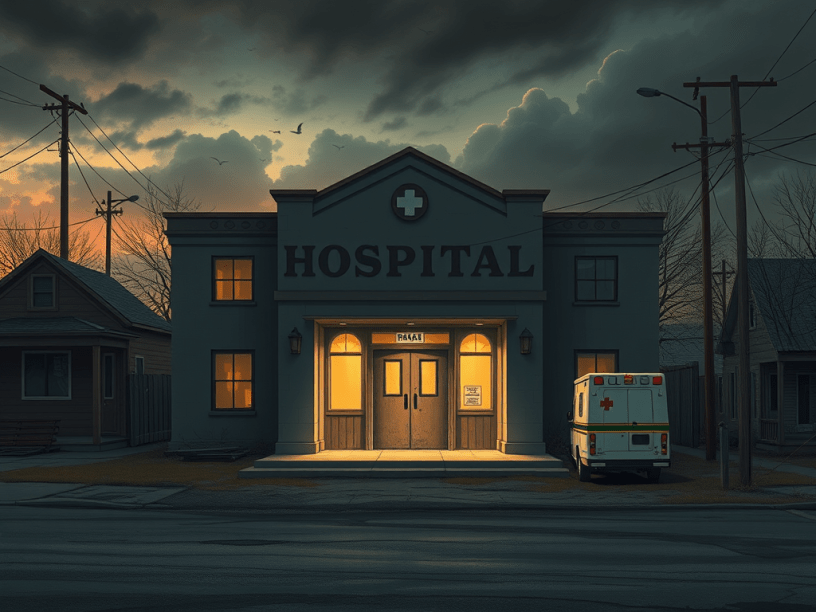
There’s a lot of talk about “forgotten America,” the flat, forgotten rural landscapes where the Wal-Mart is the town square, the high school football team is the only entertainment, and the local newspaper shut down at some point over the last decade. The spiel is typically delivered by some gassy pundit in a red tie or a venture capitalist cosplaying as a man of the people. But if you want to see what “forgotten” really looks like, don’t stop at the shuttered coal mine or the empty main street. Drive past the Dollar Generals and the vape shops, past the grain silos that now store stinky air instead of corn, until you get to the part of town where the lights are out in the one building that actually mattered: the hospital.
In rural America, health care has gone dark. Entire counties have become “maternity deserts,” where women have to drive two hours to deliver a baby, if they make it at all. Emergency rooms are locked, urgent care centers are boarded up, and ambulances are expected to do the work of rolling ICUs, bouncing down country highways with patients bleeding out in the back while the nearest functioning ER is in another state.
It’s not just a crisis. It’s a slow-motion massacre — and one we pretend not to notice, because the people dying aren’t in Brooklyn or Los Angeles. They’re in the places politicians love to name-check on campaign tours but would rather watch rot from a safe distance.
The Emptying Out
Rural hospitals are closing at a rate that would make even Blockbuster blush. Since 2010, over 150 have shut down, and hundreds more are hanging by a thread. These aren’t boutique clinics in rich suburbs — they’re lifelines for entire regions, places where births, broken bones, strokes, and farm accidents were handled by the same overworked staff in a building that smelled permanently of disinfectant and despair.
Now those doors are locked. The reason is brutally simple: money. Running a hospital in rural America is like trying to run a five-star restaurant in Flint, Michigan. The patients are older, poorer, and sicker. They’re more likely to be uninsured or covered by Medicaid, which pays doctors in nickels and lint. Meanwhile, costs keep rising. Private equity vultures swoop in, buy up facilities, and then gut them for parts like an old Chevy. When the numbers don’t add up, they close the place down, and the entire county is left to fend for itself.
The result is predictable: people die. Heart attacks that could have been treated in minutes turn fatal after an hour-long ambulance ride. Women bleed out in childbirth because the nearest maternity ward was shuttered five years ago. Car accidents become death sentences. And the death toll doesn’t show up as one dramatic headline — it trickles in quietly, a slow accumulation of “excess mortality” that gets filed away as just another statistic.
Maternity Deserts and Baby Roulette
One of the most obscene symptoms of this collapse is the rise of “maternity deserts.” In over half of rural counties, there is no hospital delivering babies, no OB-GYN in residence, and often not even a midwife. Pregnancy has gone from a medical condition to a game of roulette. If your water breaks in the wrong zip code, you might be looking at a 90-minute drive to the nearest delivery room — assuming you have a car, gas money, and no snowstorm blocking the highway.
The irony is suffocating. This is the same America where lawmakers scream about “protecting life” and banning abortion in the name of motherhood. But when it comes to actually keeping mothers alive? Crickets. No OB wards, no prenatal care, no neonatal intensive care units. Just platitudes, Bible verses, and the expectation that women will figure it out on their own while politicians cut ribbons at “crisis pregnancy centers” staffed by volunteers with pamphlets instead of doctors with scalpels.
The result is that maternal mortality in rural America has skyrocketed. Women die in childbirth at rates that would embarrass a Third World dictatorship. Babies are born in cars, in bathrooms, in living rooms with panicked relatives watching YouTube tutorials on how to tie off an umbilical cord. And the political response is to shrug and pass another abortion ban, as if forcing women to give birth in deserts is some kind of victory for life.
The Ambulance as a Rolling ICU
In the absence of functioning hospitals, ambulances have become the default health care system for much of rural America. EMTs are now expected to function as mobile emergency rooms, stabilizing patients for long, punishing rides over highways that weren’t designed for high-speed lifesaving. These aren’t sleek city ambulances with fleets of paramedics. These are often volunteer-run outfits with one overworked medic and a driver who doubles as the town’s mechanic.
They carry crash victims, stroke patients, seizing children, and women in labor. They’re forced to improvise in moving vehicles while dodging deer, potholes, and drunk drivers. In many counties, response times are measured in half-hours, not minutes. If you’re unlucky, the nearest ambulance is already busy, and you wait while someone drives in from two towns over. Time is the difference between life and death in medicine. Rural America has lost time.
Ambulances were never meant to replace hospitals. They were meant to deliver patients to them. But now they are the hospital. The back of a van is the ER. And while EMTs perform miracles daily, the system is collapsing under the weight of expectations it was never designed to carry.
The Political Cruelty
If you want to know how America got here, follow the money and the ideology. Expanding Medicaid under the Affordable Care Act could have thrown a lifeline to rural hospitals by covering more patients and pumping in federal dollars. But Republican governors, in a fit of ideological spite, refused the money, preferring to let their constituents die rather than admit Obama might have done something useful.
Meanwhile, both parties have treated health care like a commodity instead of a necessity. For-profit hospitals cherry-pick wealthy, insured patients in suburban corridors, leaving rural facilities to bleed money until they collapse. Politicians of every stripe love to pose with farmers and factory workers, but when it comes time to fund rural health care, they suddenly rediscover the religion of austerity. The same lawmakers who will happily approve a billion-dollar weapons system for the Pentagon will balk at writing a check to keep a rural maternity ward open.
And then there’s the cultural cruelty. Rural America is fetishized as the “real America” every election cycle, yet when hospitals close, the people in those towns are told to tough it out. It’s treated as the natural order of things, as if having a baby in the back of a pickup truck or dying of a preventable infection in a trailer is just part of the rustic charm. Politicians sell nostalgia while people die of neglect.
What It Really Means
The collapse of rural health care isn’t just a regional crisis. It’s a moral indictment of a country that can build drones to bomb weddings halfway around the world but can’t keep a maternity ward open in Nebraska. It’s proof that America doesn’t have a health care system — it has a health care market, and if you don’t live in the right zip code or make the right income, the market has decided you can die.
And it’s not just about medicine. Hospitals are often the largest employers in rural counties. When they close, the economic ripple is devastating. Doctors and nurses leave. Pharmacies shutter. Small businesses that depended on hospital traffic collapse. Young families flee because they won’t risk childbirth in a desert. The town empties out faster. The spiral deepens. What starts as a health care problem becomes an everything problem.
The Flat Line
Rural America is bleeding out on the gurney, and the doctors are in Washington, arguing about tax cuts. The people who love to scream about “forgotten Americans” are the ones who forgot them. The collapse of rural health care isn’t a glitch in the system — it is the system. A for-profit nightmare that treats patients as profit centers, communities as rounding errors, and death as just another line item.
Hospital closures, maternity deserts, ambulances doubling as ICUs — this is what it looks like when a country abandons its own people while pretending to worship them. It’s what happens when ideology trumps compassion, when cruelty is mistaken for toughness, and when “real America” is left to die alone on a highway, in the back of a van, miles from the nearest functioning ER.
The heartland isn’t just forgotten. It’s flatlining. And the people who could save it are too busy fundraising to even grab the paddles.
 The American Beast