
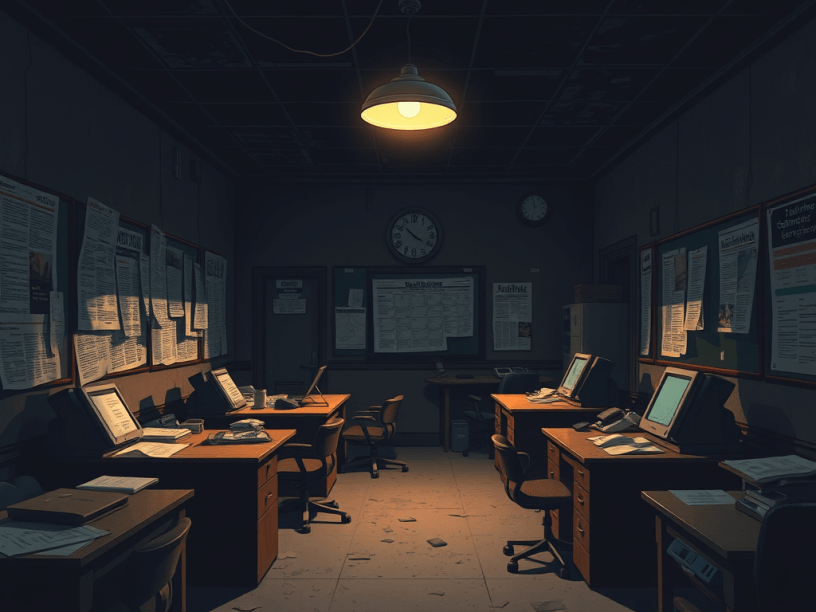
America is starving for news, but not the kind you can scroll past on your phone. Not the endless vomit of opinion blogs, clickbait headlines, and cable panels screaming over each other about Trump’s latest brain fart. No, what’s dying is the news that actually mattered: the local paper, the weekly rag, the hometown beat reporter who knew which county commissioner was on the take and which school board member was a drunk. When the paper dies, the lights go out. And in the dark, the rats come out.
The country is becoming a patchwork of “news deserts,” places where there’s no functioning local newsroom, no watchdog, no one left to keep the powerful honest. The culprit isn’t just the internet or social media, though they poured gasoline on the fire. The real arsonists are private equity firms and hedge fund ghouls who descended on the struggling news business, scooped up papers like scrap metal, and gutted them for parts. They’re not interested in informing anyone. They’re interested in bleeding every last penny out of shrinking ad revenue until the newsroom is an empty office and the presses stop running.
The Hollowing Out
If you want to see the death of local news up close, walk into almost any surviving small-town newspaper office. Where once there were twenty reporters, now there are two, covering everything from city hall to Friday night football to obituaries. Entire beats have vanished. No one is at the school board meeting, no one is sitting in on the zoning commission, no one is digging through public records. The paper still prints, but it’s thinner every week — wire copy, lifestyle fluff, maybe a police blotter if someone remembered to type it up.
The rest of the building? Empty. The editor laid off. The investigative reporter gone. The photographer replaced by stock images. And behind the curtain is some faceless private equity firm, headquartered in New York or Dallas, that owns 200 other papers and has no idea what town this one even serves. The local newspaper has been transformed into a cash-extraction machine: raise subscription prices, cut staff, sell off the real estate, and wait until the product is so hollow no one bothers buying it. Then close it.
The Rise of the News Desert
The result is that entire regions now live in total informational darkness. By 2024, more than 2,000 local newspapers had closed, leaving counties the size of European countries with no local news at all. That’s not just sad nostalgia for ink-stained wretches. It’s catastrophic.
When the paper dies, corruption blooms. City councils suddenly have no one watching. Police departments stop answering questions. County contractors grease palms with no fear of exposure. Voter turnout collapses because no one knows what the hell is happening. Into the vacuum flows propaganda — Facebook groups run by cranks, talk radio blather, and algorithm-fed nonsense that treats conspiracy theories as civic education.
A functioning newspaper was never perfect, but it was at least a spine. It forced accountability. It set the agenda. It provided a common set of facts. Without it, the information ecosystem curdles. People stop knowing their neighbors, stop trusting institutions, stop voting. Democracy rots from the inside out.
The Private Equity Locusts
The villains here aren’t just Google and Facebook, though their ad duopoly siphoned away the revenue that once kept newsrooms afloat. The real predators are the private equity funds that snapped up failing papers under the guise of “saving” them. Companies like Alden Global Capital, GateHouse, and Gannett are less media owners than corporate undertakers. Their business model is simple: buy papers cheap, strip them for parts, squeeze every last drop of profit, and then walk away from the corpse.
They don’t care about journalism. They care about yield. Newsrooms are costs to be cut, not assets to be protected. Investigative reporters don’t generate quarterly returns; they generate lawsuits. City hall reporters don’t bring in revenue; they bring in headaches. The hedge fund answer is simple: fire them all, run the paper on wire copy and unpaid interns, and wait until it’s time to liquidate.
This isn’t an accident. It’s looting. The same vulture capitalists who hollowed out Toys “R” Us and Sears have hollowed out local journalism. And the same people who preached about the “free market” fixing everything have allowed a basic pillar of democracy to be turned into a distressed asset on some quarterly balance sheet.
What We Lose
The death of local news isn’t just about reporters losing jobs. It’s about entire communities losing their voice, their mirror, their memory. When the paper dies, no one chronicles the lives of ordinary people anymore. The obituaries shrink. The little league scores vanish. The high school musical doesn’t get a review. The civic glue dissolves.
Worse, no one keeps watch. Without reporters in the room, power consolidates. Studies show corruption skyrockets when local newspapers close. Municipal borrowing costs even rise, because lenders know cities without watchdogs are more likely to be mismanaged. The costs of darkness are everywhere, from higher taxes to dirtier water to crooked cops. But because it happens slowly, invisibly, people don’t connect the dots. They just feel that life is getting worse, and they don’t know why.
And so they turn to the only voices left: cable pundits screaming about culture wars, or Facebook memes about George Soros and drag queens. Instead of local facts, they get national bullshit. Instead of knowing what’s happening at city hall, they know what’s happening in Mar-a-Lago. Local reality is replaced with national fantasy, and democracy takes another step into the abyss.
The Fake Replacements
Into the vacuum left by dying papers have come cheap counterfeits. Pink-slime “local news” sites, often bankrolled by political operatives, pump out partisan garbage designed to look like legitimate reporting. Sinclair Media buys up local TV stations and pipes in identical scripts written by GOP consultants. Algorithms feed people “news” tailored to their fears and biases. The civic role of local journalism is replaced by propaganda mills and clickbait farms.
It’s no accident that conspiracy theories spread like wildfire in counties without newspapers. It’s not because people are dumber. It’s because they’re starved for information, and into that vacuum pours poison. When the watchdog is dead, the wolves can howl freely.
The Propaganda Parasite
What fills the void left by the collapse of local journalism is not nothing — it’s something much worse. It’s Fox on every bar TV, Sinclair scripts slipped into the six o’clock news, and endless talk radio froth about caravans and vaccines. It’s Facebook “community groups” that start with missing dog posts and end with conspiracy memes about Satanic pizza parlors. In counties without papers, people don’t just lose local information — they become captive markets for nationalized propaganda.
Right-wing operators know this. They’ve built entire pseudo-networks of pink-slime “local outlets” with names like Tri-County Times or The Prairie Voice, which look like community news but are really political spam factories funded by dark money. These sites pump out “stories” about Democratic corruption and cultural decline, algorithmically targeted at people who no longer have a real paper to compare them to. It’s cheap, effective, and corrosive.
The irony is savage: while actual reporters are laid off in droves, partisan hacks funded by billionaires are filling the vacuum with bottomless bullshit. The watchdog is replaced by the attack dog. The void is filled not with silence but with noise, engineered to enrage, divide, and distract. Instead of holding local mayors accountable, people are screaming at each other about drag queen story hours and Hunter Biden’s laptop. The death of the paper doesn’t mean less information. It means worse information, weaponized information. And the people who profit from it — the politicians, the funders, the platform owners — are thrilled.
The Dead Line
The collapse of local news isn’t a niche problem for journalism nerds. It’s a five-alarm fire for democracy. You cannot have self-government if people don’t know what their government is doing. You cannot have accountability if there’s no one to expose corruption. You cannot have a functioning community if no one bothers to record its stories.
Private equity has gutted America’s local newspapers, and in their place, they’ve left deserts — barren landscapes where lies grow like weeds and corruption flourishes in the shadows. The death of the paper is the death of the town square, the death of shared reality, the death of the idea that democracy requires an informed citizenry.
The country is learning, too late, that when the paper dies, everything else dies with it. The watchdog is gone. The lights are out. And in the dark, the scavengers are feasting.
 The American Beast