
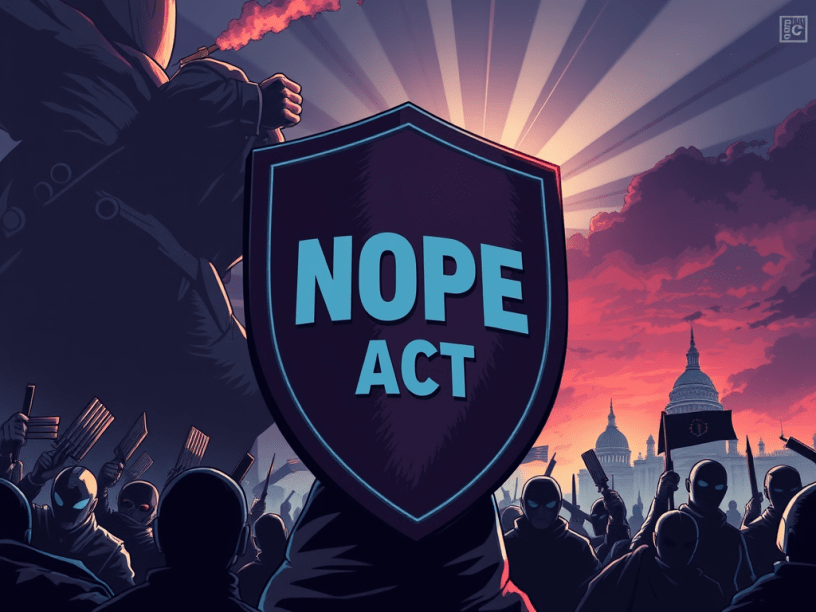
There’s a special kind of American hypocrisy that blossoms whenever power changes hands: the folks who just spent years shrieking about “censorship” suddenly discover the joys of the state’s boot when it’s aimed at their enemies. Enter the moment we’re in now—late-stage performative authoritarianism—where the White House and its appointees threaten critics with regulatory pain while cheering on friendly censors. And enter the Democrats’ counterpunch: the No Political Enemies (NOPE) Act, a legislative firebreak meant to keep the federal government from turning dissenters into targets.
This isn’t a Hallmark card to civics. It’s a guardrail built for a time when the First Amendment is treated like a speed bump. Democratic sponsors rolled it out after a week that made the playbook painfully obvious: late-night television yanked, network affiliates folding under governmental pressure, and administration figures all but promising to make critics pay. The NOPE Act is the answer—an attempt to codify what used to be a shared norm: you don’t use federal power to punish people for their speech.
The bill’s pitch is blunt. It would prohibit using federal funds for investigations or regulatory actions aimed at suppressing protected speech, and it would create enforceable protections so individuals and organizations can push back when the state tries to turn the screws. The sponsors say it’s there to deter abuse, empower targets to defend themselves, and deliver accountability for officials who weaponize the bureaucracy. In other words: a legal “NOPE” when the government reaches for the mute button.
The spark: censorship theater in prime time
The proximate cause wasn’t subtle. After Charlie Kirk was killed, the outrage machine spun up—and when Jimmy Kimmel riffed on that tragedy, federal pressure landed on broadcasters like a sandbag. Affiliates yanked the show; the White House cheered; civil liberties groups screamed that political speech was just silenced on command. You don’t need a law degree to see the problem: private companies made the final call, but the state’s thumb was very obviously on the scale. That’s the scenario the NOPE Act is designed for—when government intimidation launders itself through “independent” decisions.
Democrats responded with cameras and copy: a bicameral podium lineup promising a bill that draws a bright line between public power and private speech. Their pressers weren’t coy: they name-checked Trump, Vance, Pam Bondi, and Stephen Miller as the ones threatening to turn the federal apparatus into a weapon against “left-leaning individuals and organizations.” The NOPE Act is their way of saying: not with federal money you won’t.
What NOPE says it will do (and the fights baked into that promise)
At heart, NOPE is a back-to-basics bill. It reaffirms that the government can’t punish you for protected speech; it tries to bar federal agencies from initiating or funding investigations or regulatory actions whose actual aim is to chill that speech; and it aims to arm targets with clear legal recourse when the state leans on them for political reasons. Supporters frame it as an updated seatbelt for a car we insist on driving into walls: the First Amendment was always there, but the incentives to ignore it are bigger, nastier, and more shameless than ever.
But the devil is in the definitions. “Protected speech” is a constitutional term of art with centuries of case law behind it—and also a thousand convenient escape hatches. Incitement and true threats aren’t protected. Coordinated harassment can slide into illegal conduct. National security exceptions are a mile wide. NOPE’s drafters are trying to slam the door on politically motivated actions while keeping room for legitimate ones, which is exactly where bad actors love to hide. The litigation will be endless by design; that’s both the feature (drag out the abuse into the sunlight) and the bug (the process becomes the punishment).
Another baked-in fight: the jawboning problem—when officials don’t issue formal orders but “urge,” “warn,” or “suggest” outcomes to regulators or license-holders. That’s the soft-pressure ecosystem that got Kimmel axed; it’s also notoriously slippery to police. NOPE tries to shut off the federal-funding spigot for any action aimed at suppressing protected speech, which is one way of saying: if you want to do censorship theater to curry favor with the regime, don’t do it on taxpayer time. Whether that’s enforceable without discovery into back-channel calls is exactly why the bill exists—and why it will make bureaucrats and political operatives sweat.
Why now: from grievance to governance, and back again
The American right spent a decade branding itself as free-speech absolutists—defending odious rallies on principle, suing universities over speaker fees, decrying platform bans as tyranny. But once power shifted, “absolutism” collapsed into “our speech, not yours.” We’re living in the whiplash. The White House threatens media licenses and antitrust pain for critics; favored outlets get soft landings; enemies get loud warnings and quiet visits. The cold part isn’t the inconsistency—it’s the intentionality. The point is to chill, not persuade. The point is to make everyone else watch the punishment and say: y’know what, better not.
Democrats—some on principle, some out of self-preservation—are now trying to put teeth on the old norm. Their argument is simple: a government that can punish critics is not a democracy; it’s a protection racket. And after the last week’s censors-gone-wild spectacle, trying to rebuild a boundary with black-letter law is the only move left.
The stakes: what survives when only fear is left
NOPE doesn’t immunize crime. You can’t launder doxxing campaigns, swatting sprees, or explicit threats through the First Amendment. It doesn’t stop private outlets from making boneheaded choices—networks can still cancel shows—but it aims to stop federal actors from making those choices for them via pressure, threats, or selective enforcement. And it can’t fix the other half of the speech-control problem: ecosystem capture by aligned conglomerates who don’t need a phone call from Washington to know which way the wind is blowing.
But even as “symbol,” NOPE matters. Abusers thrive on ambiguity—on the gray zone where bullies say “we never ordered anyone” while everyone feels the pressure anyway. Putting a black-letter statute on the books changes the power balance: it tells targets they have grounds to fight; it tells agencies their emails might get read aloud in court; it tells appointees that what they say at a podium will show up as evidence. The point of a chill is to make you shut up. The point of NOPE is to make them think twice.
Democracy’s not a vibe; it’s a muscle you keep from atrophying by using it. If people decide that criticizing power will get their show canceled, their grant audited, their nonprofit investigated, they stop lifting. Art gets tamer. News gets safer. Universities self-censor. Faith groups muzzle their sermons. The culture still exists, but it’s taxidermy—posed, cleaned up, and very, very dead.
The NOPE Act won’t fix America’s speech pathologies. It won’t rescue us from platform caprice, billionaire tantrums, or the dreck factories that replaced local news. But it does one necessary thing in a bad season: it turns the constitutional norm back into a rule with consequences. If the state wants to scare you into silence, it has to find a way that doesn’t involve your tax dollars or the cudgel of federal “oversight.” If it can’t, it gets sued.
That’s not a cure. It’s a hard hat and a stun gun. In 2025, that counts as optimism.
 The American Beast