
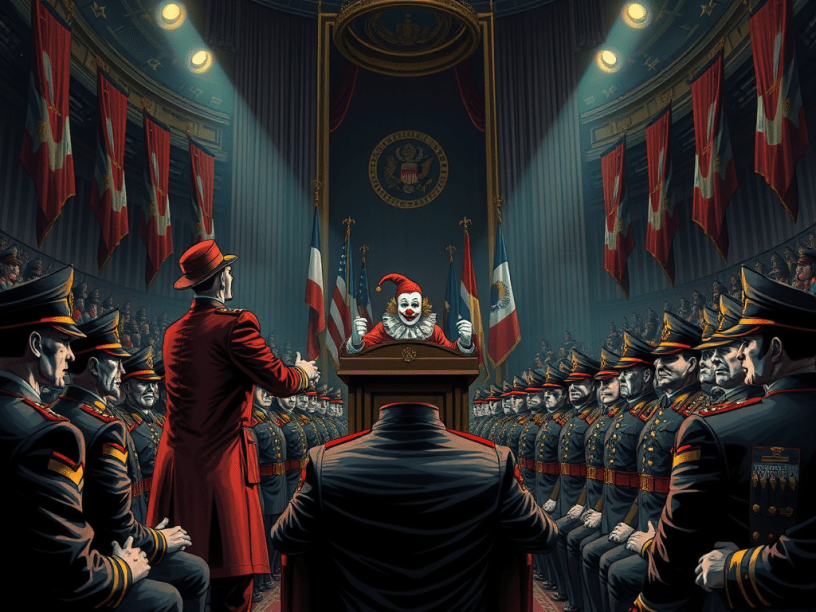
When a Defense Secretary summons every general and admiral in the U.S. military to hear a speech about “warrior ethos,” you know something’s rotten. This week, Pete Hegseth, Fox News alumnus turned Pentagon overlord, pulled exactly that stunt. Hundreds of one-star generals and above were ordered to report to Quantico on short notice—an unprecedented, disruptive flex. The official explanation? He wanted to talk grooming standards and toughness. The real reason? Because Pete Hegseth is an insecure jackass who thinks the armed forces are his personal stage set.
This isn’t leadership. It’s authoritarian theater. And if you want to understand how we got here—how a man better known for leaking secrets in a Signal chat and ranting about “wokeness” on cable TV ended up commanding the most powerful military on Earth—you need the full Hegseth file.
Act I: From Fox Green Room to War Room
Hegseth’s career trajectory is the American Dream, if the dream involves failing upward with a smile. He did serve in the National Guard, deploying to Iraq and Afghanistan, but his true battlefield was the Fox News studio. As a co-host on Fox & Friends, he perfected the art of the culture-war rant: anti-immigrant jeremiads, paeans to “traditional masculinity,” and endless soundbites about the feminization of the military. He didn’t so much analyze policy as perform outrage.
That performance caught Donald Trump’s eye. Hegseth became a regular White House guest during the first administration, whispering in the president’s ear about purging “woke generals” and restoring “warrior culture.” Fast forward, and when the second Trump term arrived, Hegseth was installed as Secretary of Defense—not because of strategic genius, but because he was loyal, loud, and knew how to play to the cameras.
Act II: Confirmation Circus
His confirmation hearings were a carnival of red flags. Allegations of sexual misconduct, financial mismanagement, and drinking binges came up. Senators grilled him on whether he had the temperament for one of the most serious jobs in government. He responded with canned lines about “strength” and “fighting spirit,” dodging questions with the finesse of a frat boy caught with a keg in the dorms.
The final vote was a deadlock, broken only by Vice President JD Vance. From day one, Hegseth walked into the Pentagon as a man without real legitimacy—propped up by partisanship, distrusted by the institution he was supposed to lead. That insecurity would define everything he did next.
Act III: Purges, Panels, and Petty Wars
Once inside the building, Hegseth went full crusader. He dismantled advisory committees on women in service, sneering that they promoted a “feminist agenda.” He gutted oversight offices responsible for testing weapons, meaning soldiers could end up with faulty gear in the field. He fired or reassigned officers he deemed insufficiently loyal, creating a climate of fear at the top ranks.
He also rebranded the Pentagon itself—literally—by restoring “Department of War” signage, an unsubtle bit of cosplay meant to signal toughness while alienating allies and confusing allies abroad. Every move was less about strategy and more about messaging: prove to the base that the military was being remade in the image of Fox News talking points.
Act IV: The Leaker-in-Chief
The most jaw-dropping scandal came when Hegseth was caught sharing sensitive operational details in a private chat. Launch times, troop movements, targeting windows—all spilled in casual messages, defended later as “no names, no units, no targets.” Any enlisted soldier would have been court-martialed for far less. But Hegseth skated, protected by his political patrons.
The episode should have ended his career. Instead, it cemented his reputation: a Defense Secretary who treated national security like gossip at a backyard barbecue. It confirmed what many already suspected: Hegseth is reckless, unserious, and dangerously addicted to attention.
Act V: Quantico, the Climax
Which brings us to this week’s stunt. Ordering every general and admiral to Quantico is not normal. It’s not even remotely safe. Concentrating that much brass in one location creates vulnerabilities the military normally bends over backward to avoid. But for Hegseth, the risks didn’t matter. The point was optics.
He wants the footage: a sea of decorated officers standing at attention while he sermonizes about “warrior ethos.” He wants to show the president, the press, and his base that he can bend the Pentagon to his will. It’s not a strategy session; it’s a loyalty pageant. And the topics—grooming standards, physical fitness, “toughness”—are barely veiled culture-war cudgels. The message is simple: the Pentagon is no longer about readiness, it’s about vibes. His vibes.
What This Really Means
This isn’t just one man’s ego trip. It’s part of a broader project to politicize the military beyond recognition. By turning generals into props, Hegseth is eroding the last thin line between civilian control and partisan abuse. The military isn’t supposed to be a stage for ideology. It’s supposed to be an institution of professional stability, immune to political fads. Hegseth is dynamiting that firewall.
The risks are obvious. Generals resent being treated like extras in a political rally. Younger officers see loyalty tests as corrosive. Enlisted troops will eventually pay the price when oversight is gutted and untested weapons fail in the field. Allies abroad wonder if America’s military is now a political cult. Enemies watch with glee as dysfunction festers.
Pete Hegseth is not a strategist. He’s not a leader. He’s a jackass with a title, a microphone, and a dangerous craving for loyalty. His career is a parade of failures dressed up as victories, his tenure a series of culture-war stunts dressed up as policy.
From leaking secrets to gutting oversight to herding generals into a pep rally, he has proven one thing beyond doubt: he doesn’t respect the military he leads. He treats it like a prop, a backdrop, a brand. And when the Pentagon becomes a brand, soldiers become expendable, strategy becomes irrelevant, and national security becomes just another slogan.
The Quantico spectacle will be remembered not as a moment of inspiration but as a moment of humiliation: the day America’s top brass were reduced to an audience for a Fox News alumnus’s cosplay crusade. If this is “warrior ethos,” then the real war has already been lost.
 The American Beast