
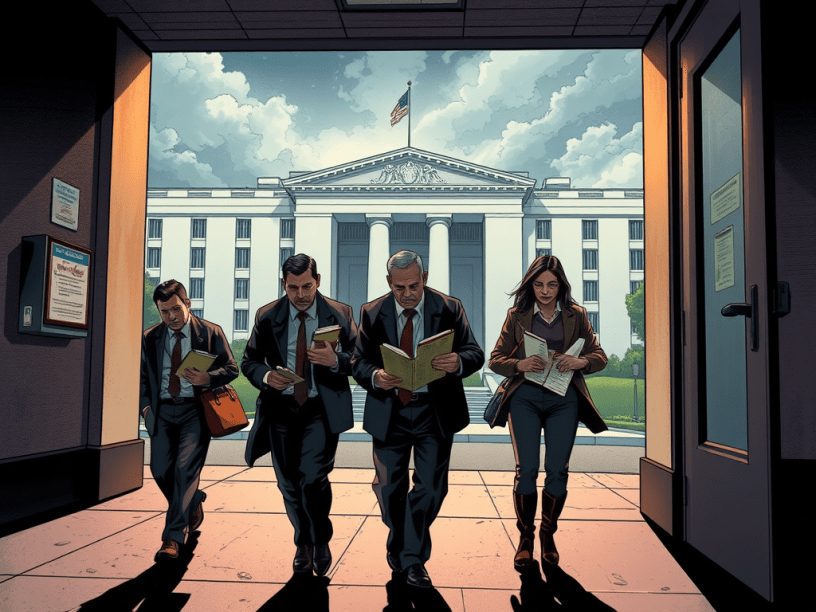
At 4 p.m. in the world’s largest office building, history did something ugly in public. Pentagon correspondents—some who’ve logged decades in those beige halls—lined up at the badging office, turned in their access cards, and walked out carrying notebooks, rolled maps, and dying office plants. They walked because the Department of Defense told them to sign a pledge that rewrites “journalist” as “governmental cheerleader.” The paper leash said: don’t solicit or use “unauthorized” information; accept escorts throughout the building; submit to expanded screenings and vague, discretionary “risk” labels that can nuke your credential if you do your job too well.
Reporters looked down, read the leash, and said no.
If that sounds like a punchline from a banana republic, that’s only because the joke is wearing dress blues. The new rules didn’t “tighten security”; they criminalized reporting as the First Amendment understands it. For a reporter to “solicit unauthorized information” isn’t espionage—it’s literally the core of journalism: ask the questions someone in power would prefer you not ask, verify the answers, and print. Redefine that as misconduct, and you’re not regulating access; you’re installing a gag with a government watermark.
The fallout was immediate and, for once, gloriously bipartisan. Legacy outlets left. Conservative outlets left. Digital, print, broadcast left. “We’ll cover you from the sidewalk,” they said, and handed over the plastic. In an afternoon, the Pentagon emptied its press bullpen and told the country, with the quiet bravado of the perpetually unaccountable: we’ll be fine without you.
They won’t. The military needs scrutiny like pilots need checklists. But this new regime was never about safety; it was about theater and control—another act in a ten-year project to grind the independent press into a choreographed chorus. You’ve seen this show. It started as a candidate bellowing “enemy of the people” and “fake news,” metastasized into bans and blacklists, and now arrives as a loyalty oath with a lamination schedule.
Let’s walk through the wreckage—and the rare courage it produced.
The Paper Leash
The policy, pushed under the current leadership and defended with straight faces, demanded reporters “acknowledge” restrictions that would get laughed out of a high-school civics class:
- No soliciting or using “unauthorized” information—an oceanic catch-all that swallows routine reporting.
- Mandatory escorts everywhere, as if proximity itself is a leak.
- Expanded screenings and a pretext-factory of “security risk” language that can revoke credentials for the sin of asking hard questions.
This isn’t about classified operations. There are already criminal statutes for that. This is about recasting ordinary newsgathering as a disciplinary issue, then punishing it by cutting access. In plain English: “You may not ask for truth unless we’ve pre-approved the truth.” Reporters declined to be deputized into that fiction and turned in their badges.
Photos told the story: coiled power cords, cleared desks, nameplates gone. Walking out was symbolic, but it was also necessary. You cannot sign away your job and pretend you’re still doing it.
The Walkout—And the Line-Crossers
The courage came fast. Reporters from major organizations refused; newsroom bosses backed them. For a press corps routinely balkanized into warring tribes, the harmony was rare: a united “no.”
And yet—fifteen people signed.
Be honest about what that means. If you signed, you didn’t ink a harmless house-rules form. You volunteered to operate under a standard where calling a source who isn’t pre-blessed can cost you your badge. You accepted a definition of journalism that omits journalism. You handed the Pentagon a talking point—“See, the press agrees”—while your colleagues carried their lives to the parking lot. That isn’t pragmatism. That’s collaboration.
Let’s name names. Among the signers were a mix of smaller American and foreign outlets, including the usual propaganda-adjacent suspects—One America News, The Federalist, and Epoch Times—plus a handful of overseas shops and freelancers. One high-profile outlet even did a public backflip: first signed, then reversed when the blowback hit. Translation: solidarity works, and shame still moves needles when spine doesn’t.
If your newsroom rationalized signing as “access,” ask which other professional codes you’d casually surrender. Would a doctor pledge not to ask about symptoms unless the hospital approved the questions? Would a lawyer promise not to request discovery unless opposing counsel pre-cleared the request? If your answer is “we needed to stay inside the building,” you don’t need a building. You need a mirror.
From “Enemy of the People” to “Please Initial Here”
This didn’t appear out of clear blue policy. It’s the logical outcome of a long war on the press—one that began with rallies aimed at reporters penned in a press pit and crescendoed with bans, lawsuits, and the privatization of official truth. The pattern has been relentless:
- Delegitimize: smear journalists as “enemies,” reduce corrections to malice, and recast every question as a trap.
- Punish: yank credentials, blacklist disfavored outlets, invent pretexts to keep skeptics out of the room.
- Privatize truth: replace briefings with pre-edited “updates,” elevate friend-media to quasi-official channels, and starve watchdogs while feeding pets.
- Contractualize silence: govern with nondisclosure agreements and non-disparagement clauses as if the state were a family LLC.
Each step turns the press from coequal institution to house band. This pledge is simply the defense establishment harmonizing with a presidency that prefers applause to accountability.
What the Pentagon Thinks It’s Buying (Versus What It Is)
The official sales pitch is soothing: just “common-sense” protections, modest “security” updates, nothing to see. “Acknowledging” rules, not “agreeing” to them—as if swapping verbs alters the reality that your signature is now a cudgel.
Here’s what they think they’re buying: fewer leaks, friendlier coverage, a press that knows its place, and a back-to-the-’50s vibe where “information” means handouts and staged photos. Here’s what they’re actually buying:
- More leaks, riskier leaks: when you criminalize routine tip-seeking, you don’t stop it—you push it underground, where errors multiply and consequences worsen.
- Less trust: shut the blinds and the neighbors don’t stop looking; they get louder. Coverage doesn’t soften when you evict reporters. It hardens.
- International ridicule: democracies don’t make journalists initial away investigative methods. Autocracies do. The optics are poison.
- Precedent creep: once a pledge exists, it spreads. The path of least bureaucratic resistance is “use that form.”
This is a bad trade. They’re swapping the discomfort of real scrutiny for the delusion of message discipline—and will lose both. Scrutiny won’t stop; the “discipline” will be the story.
The Moral Math of Walking Out
It’s easy to shrug, “They’ll still cover it from outside.” But reporting is relational. The hallway chat, the flinch in a colonel’s eyes, the dead air after a weak answer—that texture is intelligence. Losing the room isn’t fatal. It is costly. These correspondents put profession over convenience. That’s what an oath to the Constitution looks like when you don’t get to wear a uniform.
Solidarity is a force multiplier. One outlet caving is an irritant. A coalition refusing is a barricade. And it worked: the signers list is short, the reversals have already begun, and the reputational price for crossing the line is climbing. Good. Keep raising it.
Name the Pig, Keep the Receipt
If you signed, own it. Explain how watchdog journalism survives under a rule that forbids “unauthorized” information. Explain why your “escort-friendly” access trumps the public’s right to know. Enjoy your escorts and your access to nothing. Your reward for collaboration will be irrelevance. The story will be told without you, but it will include your name.
As for foreign outlets: access is tempting. The Pentagon is a vital beat worldwide. But when you sign a leash, you don’t own access; access owns you. If you already reversed, good. If you haven’t, the exit door swings both ways.
Security Is Not a Magic Word
Yes, secrets exist. Yes, responsible newsrooms protect lives and operations—every day. Editors regularly hold details after good-faith talks with officials. That’s not censorship; it’s ethics. It’s voluntary and accountable.
A loyalty pledge flips ethics into edict: we decide what you can even ask for; we punish you if you ask wrong. That’s not national security. That’s risk management for political careers. It also backfires. Leaks continue. Whistleblowers adapt. What changes is the collateral damage.
If leadership truly cared about safeguarding sensitive operations while respecting the press, it would do the ungodly boring work: frequent briefings that actually brief, answers that actually answer, relationships capable of handling heat. You can’t laminate that. So they reached for the laminate.
What Happens Next
Short term: coverage moves outside and gets sharper. First-person pieces about the walkout, legal analyses, FOIA blitzes, deep sourcing far from the podium. Shut the blinds and people don’t stop looking; they get binoculars.
Medium term: courtrooms and hearing rooms. Lawsuits from press-freedom groups; congressional oversight with officials squirming through euphemisms; internal dissent from uniformed leaders who know the difference between protecting secrets and protecting suits.
Long term: a fork in the road. Either the pledge dies and becomes a cautionary tale, or it survives and migrates—to Interior, to Treasury, to anywhere someone powerful resents questions. If it migrates, buckle up. Journalism will be permitted where it’s least needed and banned where it matters most.
What the Press Should Do (And What Readers Can Demand)
Press corps: stay united. Publish the signers list every time you cover the policy—who stood up, who didn’t. Track and celebrate backflips. FOIA the drafting emails, the edits, the political fingerprints. Pair every sanitized Pentagon video with a “Questions They Refused to Answer” sidebar. Refuse background briefings that come chained to the pledge. Keep your receipts.
Readers: reward the outlets that walked. Subscribe. Share. Tell editors you expect coverage, not choreography. If your preferred outlet signed, demand the reversal in public. Shame is a democratic technology. Use it.
Ten Years to Midnight
What happened in that badging office is the institutionalization of a decade of message-discipline cosplay turned governing philosophy. Call journalists enemies; deputize friend-media; badge the rest like kindergarteners; and when that still doesn’t stop the truth, make them initial that they agree not to seek it. It’s all the same impulse: scorekeeping against the Fourth Estate until it stops acting like one.
The Pentagon thinks it bought silence. What it bought is a bigger audience for the story—and a scandal that will outlast any laminated badge.
A government that demands loyalty oaths from journalists is a government that fears its citizens. The pledge isn’t a harmless checklist; it’s contempt made policy—contempt for the press, for the public’s right to know, and for the messy, adversarial practice that keeps free countries honest.
Credit to the reporters who packed their boxes. They drew a bright line at the end of a dim decade. Credit, even, to the signers who reversed—proof that pressure works. As for the outlets still clutching their signatures: you’ve chosen to be props, not press.
The press walked. The public should run with them.
 The American Beast