
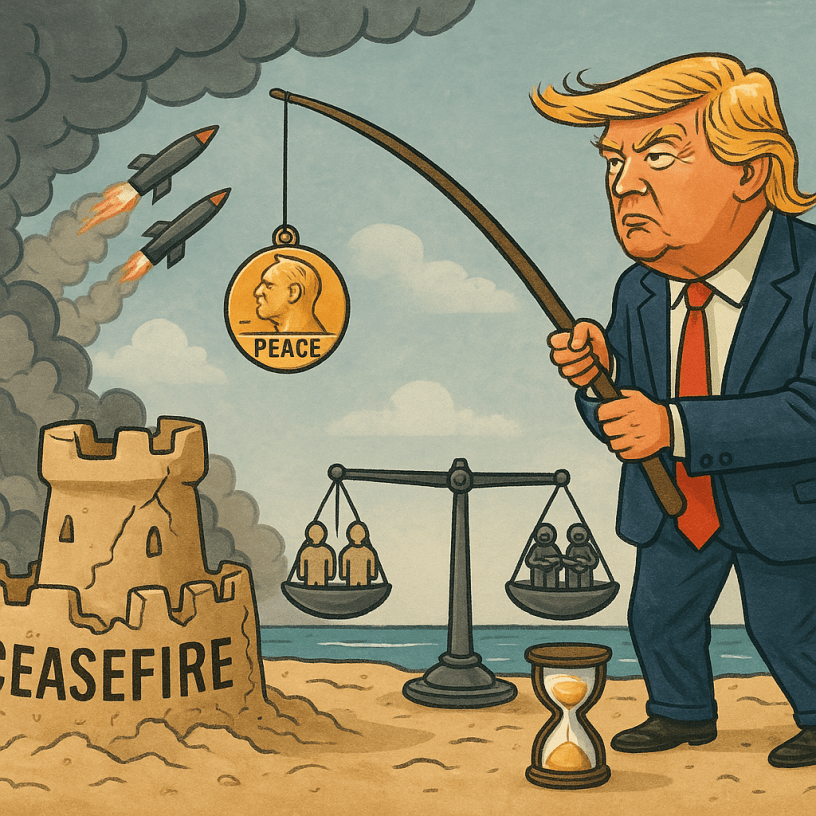
Donald Trump loves the word “peace” the way a real-estate developer loves the word “luxury”—it’s lacquer you slap over plywood and hope no one brings a magnifying glass. Now he’s selling the world a “permanent end” to fighting between Israel and Hamas. Permanent, he says. Historic, he boasts. “Still in place,” he insists, even as both sides trade accusations and the ground shakes with familiar rhythms. The pitch is pure Trump: declare victory, claim the brand, let reality try to catch up.
The problem is that reality already lapped him. The ceasefire, such as it is, looks like every ceasefire in this conflict: conditional, brittle, and one bad night away from shrapnel. The hostages-for-prisoners exchange? Emotional, wrenching, fraught, and old as the map itself. The aid convoys and tactical withdrawals? Necessary, welcome, and never enough. In other words: the work of professional diplomats and military channels that existed long before a Trump press gaggle on Air Force One.
So how much “peace” did Trump initiate? How much did he actually do? And if the goal is something more than a photo-op and a hasty pitch to the Nobel committee, what—if anything—was actually accomplished?
Ceasefire as Soundbite
Let’s start with the word “ceasefire,” which gets used in American politics like a magic spell. It isn’t a treaty. It isn’t peace. It’s a pause with paperwork. A ceasefire in the Israel–Hamas context has historically meant: stop shooting long enough to trade hostages or bodies, rest fighters, reposition units, absorb international pressure, and negotiate via intelligence services and third-party mediators who can speak to people the politicians can’t be seen with.
How long do these pauses last? Pick your year. In 2014, after a 50-day war in Gaza, an Egyptian-brokered ceasefire “held” in the sense that the war ended—but the violence didn’t evaporate; it smoldered, flared, and shaped the next round. In 2021, an 11-day escalation ended with a ceasefire that produced months of quiet followed by the same ricochets: rocket fire, airstrikes, raids, funerals, repeat. Between these headline moments are dozens of micro-truces: 24 hours here, 72 hours there, humanitarian windows, Eid pauses, diplomacy-by-deadline. Some last days; some stretch to months; none solve the underlying problem.
If the question is whether this latest pause is durable, the historical answer is unromantic: it will hold until the next provocation—real or perceived—overwhelms the incentives to keep it. Ceasefires in this conflict are sandcastles in the tide. Sometimes you build them higher, sometimes you use better sand, but the ocean is the ocean.
What Was Actually Achieved (And What Was Inevitable)
Yes, hostages came home. Yes, Palestinian prisoners walked out of Israeli cells. Yes, aid trucks rolled and soldiers redeployed. These are not small things; they are human things. They also tend to happen when international pressure peaks and intermediaries conclude that everyone needs a ladder down. The machine that does this work is old and grimly efficient: intelligence channels, regional services, family negotiators, clerics, medics, and quiet Western diplomats who do their jobs best when nobody knows their names. Politicians give the quotes; professionals do the math.
Trump’s insistence that the ceasefire is “still in place” while conceding that Hamas has been “rambunctious” but somehow not led from the top is a masterclass in rhetorical hedging: pin the medal on yourself, push the mess down the chain. If violations occur, blame “elements.” If it holds, dry-clean the tux.
Did he help? At minimum, he didn’t stop the machinery that always, eventually, tries to stop the bleeding. At maximum, he applied public pressure and turned his campaign microphone into a megaphone for “enough.” That’s not nothing—political wind can stiffen diplomatic spines—but let’s not pretend the wind invented the sail. The exchange lists were not written on Air Force One. The routes for water and medicine weren’t discovered in Palm Beach. The mechanics of turning gunfire down to a murmur are the product of patient, years-long networks that despise press conferences precisely because they ruin deals.
Prisoner Exchanges: The Arithmetic of Grief
What are the ramifications of releasing “all those Hamas warriors” for twenty Israeli citizens? First, language check: not everyone swapped out of Israeli prisons is a fighter, and not everyone traded back is innocent. These lists are always a mix—teen stone-throwers, militant logisticians, convicted attackers, political activists, people held on administrative orders, and men who bear responsibility for murder. Successive Israeli governments have made lopsided trades before, and they always face the same excruciating calculus: the moral obligation to bring citizens home versus the risk of returning future violence to the arena.
History offers a rough, brutal picture. The 2011 Gilad Shalit deal—one soldier for over a thousand Palestinian prisoners—is often cited as a case study. Some of the men released later rose within militant hierarchies; some returned to violence; others disappeared into normal life, age, or exile. Israel’s security establishment knows this pattern intimately, and every cabinet that signs off on a list knows it will be second-guessed by families who bury loved ones later. On the Palestinian side, prisoner releases carry political electricity: they crown the narrative that armed resistance forces concessions others can’t pry loose. That story has a cost—paid by civilians the next time it all explodes.
So the ramifications? Likely the familiar cocktail: short-term relief for hostage families, a propaganda boon for militants, a political migraine for Israeli leaders, a grim satisfaction among Palestinians that the only language Israel heeds is leverage, and then the quiet re-absorption of dozens or hundreds of men into a strip where poverty, rage, factionalism, and surveillance define adulthood. Some will age out; some will fight again; some will try to leave. That’s the ledger. No one likes it. Everyone knows it. We do it anyway because the alternative is leaving people in cages and humming that this time the pain might teach someone a lesson.
Israel Withdraws (For Now): What “Repositioning” Usually Means
Trump trumpeted Israel’s pullback from much of Gaza as if he’d personally waved the brigades home. In reality, these tactical withdrawals often mean repositioning to reduce exposure, lower the temperature, and let aid in without giving up core operational goals. Armies don’t telegraph intent; politicians do. You can pause and still prepare. You can open corridors and still plan raids.
If your yardstick for “peace” is “fewer funerals this week,” you can say there’s peace. If your yardstick is “no more war,” you cannot. A ceasefire is a decision to trade time for space, or space for time. The gun is still on the table.
Why Trump Wanted This So Bad: The Gong, the Gown, and the Gold Medal Fantasy
Let’s say the quiet part loud: Trump covets a Nobel Peace Prize the way he covets everything else with a medallion and a stage. Remember the “historic” Abraham Accords—agreements between Israel and Arab Gulf states whose relationship was already thawing, packaged like a moon landing? The man understands optics. “Pe rmanent end to fighting” reads like the biggest trophy in the case.
Is that motive disqualifying? Not necessarily. Politicians with messianic vanity sometimes deliver real things because the only size win that feeds the ego is the kind other people benefit from. If he wants a gold medal so badly that he’s willing to bang heads together and risk friendly fire from his own coalition, fine: show your work. That means more than sunny briefings. It means sustained, disciplined pressure on both sides’ hard men; it means empowering real negotiators and swallowing credit when they take it instead; it means absorbing the political heat when your base demands purity and you hand them compromise.
This is where Trump traditionally wilts or improvises. He’s excellent at the ribbon-cutting, less so at the scaffolding. “Peace” is a grind—boring meetings, endless follow-ups, humiliations, late-night calls, the patience to hear the same complaint fifteen times because the fifteenth time it arrives in a phrasing you can turn into a clause both sides sign. A Nobel chase without the grind is just a mirror. And mirrors don’t stop rockets.
Did Anything Actually Change?
Let’s inventory what this “peace plan” left behind that wasn’t there before.
- Hostages and prisoners returned. That changes lives. It also happened within a template used repeatedly in this conflict.
- A tactical quiet. That lowers body counts. It’s also delicate, conditional, and already fraying at the edges.
- Aid convoys and humanitarian corridors. These save limbs and calm tempers. They are also a sprint against bureaucratic glue and armed men with walkie-talkies who like to feel powerful at checkpoints.
- Political credit. Trump tried to plant a flag. The question is whether the ground under that flag is concrete or mud.
What didn’t change is the structure. Hamas still governs by mixing social services and coercion; Israel still calculates security through a matrix of deterrence, intelligence, collective punishment, and occasional grand bargains; Gaza still remains a walled human pressure cooker with no obvious exit. If you want to claim a permanent end to fighting, you need to show a mechanism that changes one of those structures. A press statement is not a mechanism.
Ceasefires, Violations, and the Physics of Distrust
Trump’s line that the ceasefire remains “in place” while acknowledging weekend violations is the oldest move in diplomatic poker: pretend the table didn’t flip because acknowledging it flipped gives excuses to walk away. The truth is that ceasefires in this theater crack the way old plaster cracks—first hairlines, then flecks, then chunks. An undisciplined cell fires; a retaliatory raid goes too far; a funeral becomes a riot; an army “clarifies” that certain neighborhoods aren’t covered; a militant commander claims a clause no one else recalls. Before you know it, you’re back where you started with extra funerals layered on the grief.
That’s not because people are uniquely monstrous here; it’s because the incentives are a meat grinder. Hard men get promoted for hardness. Compromise looks like weakness. Intermediaries keep their offices by delivering a headline and protecting their flank. Civilians, crushed in the middle, are asked to provide the “trust” politicians treat like an optional garnish. Then we blame them for rage.
What Would Real Peace Require?
If Trump—or any president—wants more than a week of quiet and a press conference, they need teeth and patience. Teeth: pressure on regional backers to enforce discipline, guarantees that mean something (money, recognition, sanctions’ relief or pain), and a ladder for each side to climb that doesn’t look like public humiliation. Patience: the willingness to keep paying attention once the cameras go home.
That last part is where American politics usually fails. We like “mission accomplished” banners. We’re bored by shepherding. Real peace requires shepherds—dogged, unglamorous, often despised shepherds who know when to yank a leash and when to throw a bone. It requires insulating the process from election cycles and social media dopamine. It requires telling your own political tribe something they hate—because the other side will need a victory to sell to their people, and that victory will feel like surrender to yours.
Trump can do bravado. Can he do pain? The test isn’t what he says on a tarmac. It’s what he’s willing to swallow when his own crowd snarls.
So: How Much Peace Did Trump Initiate?
On the scoreboard of propaganda: plenty. He declared a permanent end, claimed the center seat, and sold the pause like a done deal. On the scoreboard of reality: a pause, not peace. A trade, not transformation. Credit for a chapter that always gets written in these wars and will be written again, by someone else, under a different camera angle.
If you admire the effort because any pause saves lives, fair enough—admire it. If you suspect the Nobel sparkle pulled this effort out of him, you’re probably right—so what? Motivations are a luxury for historians. Outcomes feed children or don’t. The only metric that matters is whether funerals slow and keep slowing. That’s the work. It happens far from microphones.
Trump’s “permanent peace” is a product demo, not a factory. He pitched the quiet like a closing bell and invited the world to a victory lap that the underlying physics won’t support. Ceasefires in this conflict are not miracles; they’re maintenance. Exchanges are not breakthroughs; they’re the bill coming due for choices no one knows how to stop making.
Ask, then, the only questions that matter: Did this pause lower the number of dead children? Did it return terrified people to their families? Did it build even a thin bridge to something sturdier than breathless claims on a plane? If yes, it’s worth something. If it’s just a stage set for a medal fantasy, it will collapse on cue.
Peace is not a press release. It’s the discipline to do boring, painful, daily things that offend your base and save strangers. When Trump can show that—when any American president can—then we’ll talk about “permanent.” Until then, salute the lives spared this week, count the cost of the next round, and keep the trophy case empty.
 The American Beast