
Start with a blunt fact: a nontrivial chunk of Americans now tells pollsters they think a civil war is at least somewhat likely in the next decade. A June 2025 YouGov poll found 40% calling a civil war “very” or “somewhat” likely; only 39% said “not very” or “not at all.” That’s not fringe paranoia; that’s the middle of the bell curve muttering about Fort Sumter on their lunch break.
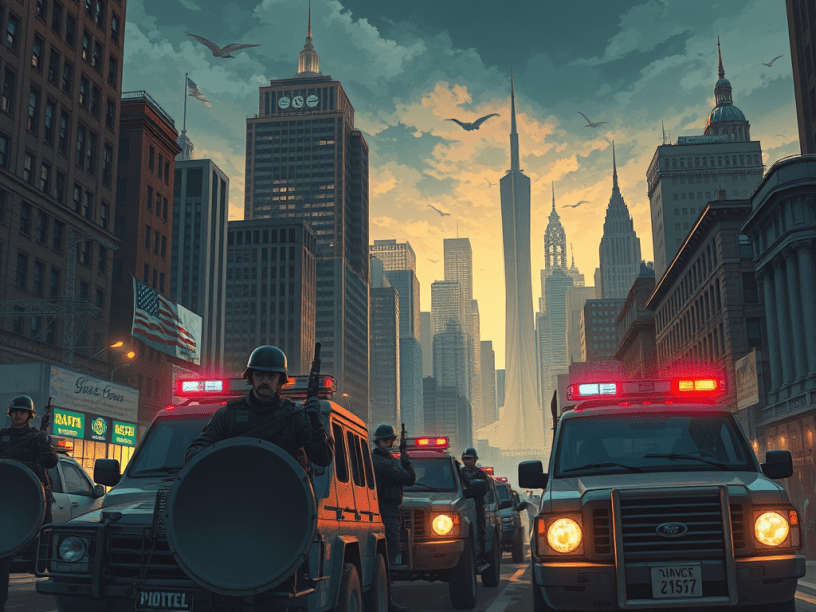
Why are they spooked? Because the headlines keep auditioning for a dystopia miniseries. In the past few months, President Donald Trump has tried to project federal muscle into blue-run cities—National Guard deployments or attempted deployments to Los Angeles, Washington, D.C., Portland, Chicago, and Memphis—wrapped in “law and order” branding and tethered to an expanded federal immigration crackdown via ICE (Immigration and Customs Enforcement). Even court-safe explainers are saying the quiet part out loud: the president’s domestic troop authority is complicated, but he’s been testing its edges in highly political theaters.
Chicago’s mayor preemptively ordered city agencies not to collaborate with any such federal push, framing it as a constitutional rights defense—meanwhile the White House signaled an ICE surge and Guard authorization. This isn’t rumor; it’s a documented policy knife fight.
Memphis is the case study in miniature: September 15, 2025, Trump signs an order to deploy Guard forces there “to combat crime,” roping in alphabet-soup federal partners (FBI, DEA, ICE, U.S. Marshals) even as local data showed crime trending down and the mayor said he didn’t ask for troops. If that sounds like theater colliding with federalism, that’s because it is.
Now add a border-war layer: in Congress, Republicans advanced proposals to authorize military force against Mexican drug cartels—selling it as a cross-border self-defense move. Analysts warn the legal scope is so broad it could sprawl into operations across dozens of countries where cartel networks operate. It’s a global permission slip disguised as a domestic fix—foreign policy gasoline splashing onto a home-front tinderbox.
With that as the backdrop, the civil-war storyline writes itself: a president asserts maximal domestic security authority; blue cities resist; federal police and NG troops become the stage props; and somewhere, some over-amped militia or lone extremist decides to “accelerate history.”
But does any of this add up to an actual civil war?
What “Civil War” Means in 2025 (Spoiler: Not Gettysburg)
If you’re picturing uniformed armies meeting on farm fields, put that Ken Burns VHS tape back in the box. Scholars who study civil wars—Barbara F. Walter is the unavoidable name here—stress that modern civil conflicts in developed states don’t open with formal declarations. They bleed in from the edges: decentralized attacks, regionally clustered insurgencies, security forces split by jurisdiction and politics, a blizzard of disinformation, and lawfare that turns every courthouse into a trench. Walter has spent years translating the CIA’s own risk indicators into plain English for American audiences: once a wealthy democracy starts sliding toward factional “anocracy,” polarized into identity-stacked parties with elites fanning grievance, you watch for a slow uptick in political violence, radical networks, and government overreactions that validate extremists’ narratives. Sound familiar yet?
What the data actually says about political violence in America is ugly and specific. Right-wing extremist violence has been more frequent and deadlier than left-wing violence over the past decade—this isn’t a moral equivalence exercise; it’s what the numbers show. Recent overviews (PBS/NewsHour summarizing multiple datasets; CSIS breaking it down by fatalities since 2016) show asymmetric lethality, even as both sides produce threats and sporadic attacks. That asymmetry matters when you’re gaming out pathways to escalation.
Add the perception gap: people wildly overestimate how violent “the other side” is and underestimate their own camp’s capacity for harm. The Economist, looking at 2025’s grisly incidents, framed it plainly—there’s a rising pattern of political killings, and everyone’s propaganda machine is working overtime to claim the body count proves the narrative they already liked. Reality doesn’t care. Dead is dead.
So if our next civil war happens, it won’t look like 1861. It’ll look like a country of 330 million with a militarized police-state toolbox, saturated firearms, cheap drones, encrypted chats, and a media system that can spin any footage into sainthood or devilry in fifteen minutes. It will look like federal authority colliding with local sovereignty, and like paramilitary cosplay occasionally transitioning into actual paramilitary behavior.
Why People Think It Might Happen
- Performative Federalism. The presidency asserts the right to drop NG units into blue cities over the objections of governors and mayors, often tied rhetorically to immigration crackdowns or “cartel” threats. Even when the legal authority is arguably there, the political framing fuels a “foreign occupation” vibe that is rocket fuel for polarization. Chicago telling city employees not to cooperate with federal agents is a page from the immigrant “sanctuary” playbook, now repurposed as a general anti-incursion stance. That type of standoff is the constitutional amber alert for the civil-war-obsessed.
- Border War Creep. An AUMF aimed at cartels feels domestically cathartic to people grieving fentanyl deaths—but operationally it blurs “criminal syndicate” into “military target,” inviting mission creep, cross-border reprisals, and a security climate where “enemy combatant” language migrates back home. Walter and other conflict researchers warn that leaders leaning on external wars to unify fractious domestic politics often get the opposite.
- Asymmetric Violence + Symmetric Fear. When one side’s extremists kill more, the other side insists that rhetorical violence (doxing, harassment, mob intimidation) is just as dangerous. Everybody feels imperiled; nobody feels illegitimate. Fear is the bipartisan civic religion now. The more you marinate in fear, the more “preemptive self-defense” starts to sound noble. The data is clear about lethality patterns, but fear doesn’t do nuance.
- The Propaganda Panopticon. Every phone is a broadcast studio. Every incident is clipped, context-stripped, captioned in blood-red font, and fed into adversarial algorithms. That doesn’t start a war by itself. It does make it very easy to misinterpret a chaotic episode as a massacre or a massacre as “crisis actors.”
- Institutional Muscle Memory is Getting Weird. We’ve normalized government by injunction. Every controversial move is instantly met with a lawsuit and a temporary restraining order, which half the country then declares illegitimate because the judge was appointed by the other team. That’s not a cause of civil war, but it’s a map of how rule-of-law hardens into trench lines.
But Does Any of This Mean We’re Actually Going to War?
Short answer: “war” is a dramatic word for what’s more likely—a long, jagged plateau of sporadic political violence, jurisdictional confrontations, and occasional spectacular terror attacks, punctuated by elections that function more like stress tests than resets.
The experts’ checklist matters here. Walter’s predictive framework doesn’t say “America will go to civil war.” It says we’re checking uncomfortable boxes (polarization, identity-based parties, anti-pluralist elites), but we also have big guardrails: a massive, still-functioning bureaucracy, independent courts that—however politicized—still bite, federalism that allows pressure to vent locally, and a military establishment deeply allergic to domestic deployment politics. Those guardrails are not invincible, but they’re not made of tissue paper either.
And public opinion—paranoid as it is—still has a sizable “no thanks” camp. The same YouGov surveys that show a lot of dread also show a big bloc that thinks civil war is not likely. The fact that a plurality fears it doesn’t mean they want it. Which matters, because civil wars require not just grievance, but organization, logistics, leadership, and a willingness to shoot neighbors at scale. The U.S. has plenty of grievance; it’s much thinner on the other three.
What It Would Actually Look Like (If It Happened)
Let’s be clinical and grim for a minute.
1) The Opening Notes Aren’t Bugles—They’re Drones, Ambushes, and Arsons. Forget columns of troops. Think soft-target bombings, grid attacks, rail sabotage, and drone drops on police staging areas. Think coordinated “days of rage” built on encrypted channels. Think a wave of “leaderless” hits claimed by anonymous labels rather than organizations. If you want a preview, look at the spate of infrastructure plots and sporadic extremist shootings we’ve already had—then imagine a higher tempo and better kit. The lethality skew we’ve seen (more deadly attacks from right-wing networks) would likely persist at first, but you’d get counter-radicalization on the left in response. That’s not balance; that’s escalation.
2) Jurisdiction Wars. The real battle lines are institutional. A White House tries to federalize or pressure states’ NG units. Blue governors slow-roll, sue, or refuse. Mayors order “non-cooperation” with ICE or any federal task force they say violates civil rights. A federal judge enjoins a deployment in Portland; a different judge green-lights one in Memphis; the Supreme Court is asked to bless a vague theory of executive necessity. By then, the fight is less about patrols and more about precedent.
3) Sanctuary Cascades. If cities can be “sanctuaries” from immigration enforcement, red counties can be “sanctuaries” from gun regulation or federal election directives. A sheriff refuses to carry out a state AG’s order. A state legislature threatens to defund a “rogue” city. You get onion-layered nullification, where every disputed policy becomes a multi-level standoff.
4) A Border “Externality.” If Congress hands an AUMF to a president eager to swing at cartels, you can expect retaliatory violence and smuggling counter-moves that spray back across the border—in Texas and Arizona first, then farther afield via networks. The more “global” the cartel footprint, the more diffuse the blowback. Domestic political entrepreneurs will feast on the chaos.
5) The Market Panics Way Before the Tanks Roll. Insurance, logistics, and capital are allergic to uncertainty. A persistent drumbeat of political shootings, NG street footage, and dueling injunctions will do more immediate harm to American livelihoods than any fantasy of territorial secession. The “war” would start as an actuarial event.
6) Media as Battlespace. Each incident is instantly mythologized. Hero/villain edits metastasize before the police report is filed. The first casualty of war isn’t truth—truth died years ago. The casualty now is coherence.
Trump, The Guard, ICE, and the Theater of Control
Let’s address the Trump-specific trigger the chatter keeps orbiting: the use (and threat) of domestic force in urban jurisdictions over local objections. There are real legal tools here—the Insurrection Act, task-force authorities, federal deputizations, DC’s unique status—but the politics are louder than the law. The pattern in 2025 has been to frame blue cities as crime-ridden, promise Guard deployments, and yoke that to immigration enforcement or “antifa”-ish unrest, then dare local leaders to fight back. Chicago went as far as ordering non-cooperation ahead of any deployment; Memphis’s mayor basically said, “If you’re coming, I’m going to try to shape it.” Governors howl. Lawsuits fly. Everyone fundraises. That is not a precursor that forces civil war—but it is the sort of spectacle that cues extremists to believe history requires their “help.”
The deeper danger isn’t a single Guard convoy. It’s normalizing the idea that partisan presidents should dispatch out-of-state troops into opposition jurisdictions as a branding exercise—and normalizing retaliatory non-cooperation by cities any time federal agents show up with clipboards. That loop feeds itself until the only language anyone respects is force, and the only legitimacy test is which judge you’ve forum-shopped.
The Merit—and the Nonsense—in Civil-War Talk
Merit: We are seeing more political killings, and the distribution is not symmetrical. Law-and-order theatrics that pit “federal” against “local” raise the risk of escalatory episodes. The border policy war is importing a paramilitary grammar into domestic politics. And large swaths of the public now expect breakdown. If you think expectations don’t matter, you haven’t priced a housing market during riot season.
Nonsense: The United States is not two cleanly separable territories with contiguous front lines. It’s a purple-speckled mega-economy whose fiercest culture-war enemies share kitchens, companies, churches, and group chats. Logistics of an actual territorial civil war are absurd—supply chains would shred; energy, food, and capital would run for the exits; the first secessionist governor would discover that corporate counsel is a faster deterrent than the 101st Airborne. Our doomers are importing the wrong metaphors.
What Would Stop It
This isn’t a morality play; it’s mechanics.
1) Don’t Federalize a Culture War. If the White House wants to reduce violence risk, it needs fewer “shock and awe” deployments and more unglamorous joint task-forces that are locally requested, scoped, and sunsetted. Even SCOTUS-blog court-nerds are telling you the domestic troop question is constitutionally fraught. You don’t flex a fraught power unless you must.
2) Narrow Any Cartel AUMF Like You’re Handling Uranium. If Congress insists on an AUMF, it should be tightly drafted, geographically bounded, sunsetted, and coupled with iron-clad guardrails about domestic use of military intelligence. If you don’t do that, you are writing the screenplay’s Act II yourself. Responsible Statecraft’s warning about global over-breadth is not hippie hand-wringing—it’s a practical map of unintended consequences.
3) Starve the Grievance Machine of Easy Wins. Prosecute political violence swiftly and publicly, without theatricality. If the lethal asymmetry keeps pointing to one camp, say so in plain language and show your work. The CSIS and PBS roundups are helpful precisely because they’re data-forward. Don’t launder reality to “both sides” it; that’s gasoline for fantasists.
4) Build Cross-Partisan Fences Around Elections and Policing. There is no substitute for elite-level, bipartisan agreements that certain tools are off-limits: no federal deployments without governor request (absent clear, statutory triggers), no deputization stunts for press conferences, no “gotcha” prosecution drops timed to news cycles. You don’t de-weaponize institutions by winning; you do it by tying your own hands.
5) Treat “Perception Management” as a Public-Safety Function. A country where 40% expects civil war is a country that will overreact to every viral clip. Governments should pre-bunk sensational claims during planned operations—tell the public what’s happening before the grifters do. (And yes, that means creating the boring kind of content that doesn’t rage-farm.)
The Most Likely Future: A Slow Grind, Not a Break
So, will America have another Civil War? If by “war” you mean states seceding and armies trading cannon fire, probably not. If you mean a chronic condition—episodic political terror, rolling jurisdictional warfare, and one or two “national panic” weekends per year—then we’re already living in the prequel. The risk isn’t that tomorrow a brigade from Texas shells Chicago. The risk is that next month a drone hits a police command center, next spring a Guard convoy gets ambushed on a highway during a deployment standoff, and the summer after that a courthouse bombing collapses a major prosecution—each incident nudging the Overton window toward “normal.”
And if the people in charge are reckless or cornered enough to launch a cross-border “cartel war,” they’ll add jet fuel to the domestic fire while handing would-be insurgents a military-grade narrative: “We’re at war, and war has come home.” The AUMF pen stroke is small. The consequences rarely are.
If You’re Betting the Over/Under
- Under on territorial secession. The practicalities are fantasy-novel stuff.
- Over on intermittent extremist attacks, with lethality still skewed right of center unless and until counter-radicalization on the left scales in ugly ways.
- Over on courtroom trench warfare. Judges as human sandbags.
- Over on “non-cooperation” orders from blue cities and “sanctuary for guns/elections” ordinances from red counties.
- Under on sustained NG occupations—most will be brief, legally contested, and politically expensive.
One Last Inconvenient Hope
There’s a perverse upside to how loud, litigious, and annoying American pluralism is: it dissipates energy. We sue instead of shoot. We filibuster instead of flank. We circulate petitions like they’re Molotov cocktails and restraining orders like they’re bayonets. That’s not nobility; it’s friction. But friction stops slides.
The smart money says America’s “civil war” will remain a phrase that sells books and cable slots while we stagger through a bruising era of mini-crises that never quite cohere into Armageddon. The dumb money says “nothing will ever happen here” as it keeps normalizing the steps that make something happen. Which wallet are you holding?
If you want the responsible-adult answer, it’s this: cool it on the domestic troop theater unless you have a truly exigent case; draft any cartel AUMF like it can—and will—be abused; punish political violence without fanfare; and teach citizens to recognize when they’re being harvested for engagement. The people warning about “civil war” aren’t crazy. They’re reacting to signals our leaders keep sending and our extremists keep amplifying. The way out isn’t mystical. It’s boring. And if we still have the patience for boring, we still have a country.
 The American Beast