
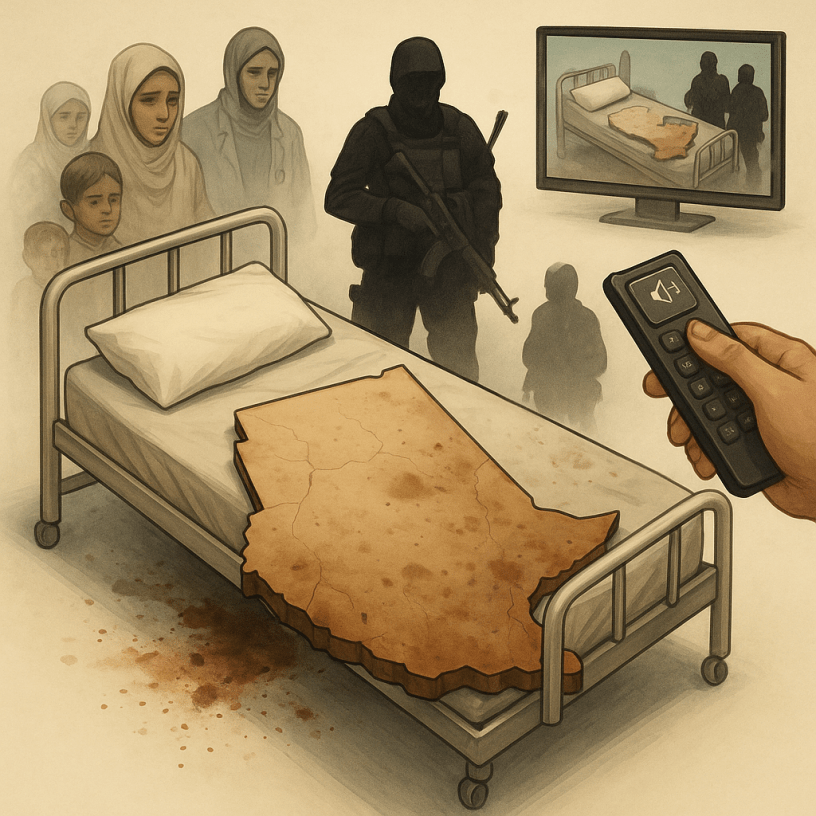
For eighteen months, El Fasher was a slow-motion nightmare: a city of mostly non-Arab civilians—Zaghawa, Fur, Masalit, Berti—ring-fenced by the Rapid Support Forces like cattle in a kill pen. Food strangled, medicine gone, aid convoys bombed, hospitals picked off one by one while the world argued about meeting formats and “stakeholder engagement.”
Then last month the RSF stopped pretending this was a siege and just did what everyone knew they were there to do. They overran the city, blew through its last defenses and turned the place into a live-streamed crime scene. Reports now talk about house-to-house executions, ethnically targeted killings, and entire neighborhoods leveled.
On October 28, they hit one of the last functioning hospitals—the Saudi Maternity Hospital—and, according to the World Health Organization and medical reports, slaughtered more than 460 patients and their relatives, abducted health workers, and left a building full of the dying and the dead.
The UN Human Rights Council has now ordered a probe into “appalling abuses” in El Fasher and the surrounding areas, which is the bureaucratic way of saying: We’re commissioning a very serious PDF about people who are already dead.
And America—land of “Never Again,” “Responsibility to Protect,” and a thousand Darfur bracelets clogging a million junk drawers—has somehow managed to be both present and absent at the same time.
Meet the Killers You Paid Attention to Once
The RSF isn’t some mysterious new horror. It’s a rebranded franchise. The same way you can take a failing fast-food chain, slap on new signage and pretend it isn’t the same greasy heart attack, Omar al-Bashir took the janjaweed—the Arab militias accused of genocide in Darfur in the 2000s—and turned them into the Rapid Support Forces in 2013.
New logo, same playbook:
- Terrorize non-Arab communities.
- Burn villages.
- Use sexual violence as a weapon.
- Drive people off their land.
- Get rich off gold, smuggling and Gulf money.
Since April 2023, the RSF has been at war with the Sudanese Armed Forces (SAF) in a nationwide power struggle that turned Sudan into a live-fire demolition derby. Tens of thousands dead, over 14 million displaced, famine in multiple regions, and now El Fasher—Darfur’s last holdout—has fallen.
El Fasher wasn’t just another city. It was the last fragile shield where hundreds of thousands of already-displaced people were corralled under siege, surviving on animal feed and wild plants while RSF fighters closed the noose. Satellite imagery showed 30-plus kilometers of earthworks and barriers—literally a man-made kill box.
The U.S. Holocaust Memorial Museum was warning as far back as May 2024 that an attack on El Fasher would likely involve genocide: the same communities, the same perpetrators, the same patterns as the original Darfur atrocities.
Everyone saw this coming. That’s what makes it obscene. Genocide isn’t a surprise twist here; it’s the sequel nobody tried to cancel.
America, the Concerned Bystander With a Rewards Card
So what has America actually done while all this was building?
To be fair—and we should be fair, before we’re unfair—Washington has written checks. The U.S. has been the largest humanitarian donor in the Sudan crisis, dropping over a billion dollars in aid in FY2024 and effectively keeping what’s left of the relief system on life support. Meanwhile, the UN’s 2025 response plan is only around 13% funded.
We’ve also played Sanctions Pokémon. In late 2024 and early 2025, the U.S. slapped sanctions on both RSF commander Mohamed “Hemedti” Dagalo and SAF leader Abdel Fattah al-Burhan under an executive order targeting people undermining Sudan’s democratic transition.
There have been sanctions tied to alleged chemical weapons use, export restrictions, and plenty of sternly worded statements from Congress about external actors—especially the UAE and other partners—funneling weapons and money into the RSF via gold smuggling and arms shipments.
So yes, there’s a paper trail of effort. But it’s the kind of effort you make when you want credit for trying without actually changing the outcome.
America’s Sudan policy is basically the gym guy who walks around holding a protein shake and telling everyone how important leg day is, while never actually touching a weight.
We issue statements. We “welcome” UN probes. We “urge” ceasefires. We “call for accountability.” We “recognize the gravity of the situation.” The verbs are all very emotionally available. Meanwhile, people are executed in hospital wards.
Why This Is Our Problem, Whether We Admit It or Not
You can make the easy moral argument: genocide against trapped civilians is bad, and the self-anointed champion of human rights should probably try to stop it. But let’s be honest: that pitch hasn’t moved the needle in Washington in a long time unless there’s a cable news angle or a domestic constituency ready to scream.
So here’s the cynical, realist argument—which somehow still can’t get traction either:
- Regional meltdown: Sudan is Africa’s third-largest country, sitting next to Egypt, Chad, South Sudan, Ethiopia and the Red Sea shipping lanes we just discovered we care about again. A failed, partitioned Sudan with competing militias and foreign clients is a long-term security disaster.
- Foreign patrons: Reports have flagged weapons and material flowing to the RSF from the UAE via Chad and other routes—drones, armored vehicles, and more—while other outside players feed the SAF. This is proxy-war cosplay with real corpses.
- Terror and trafficking: Collapse means more smuggling corridors, more extremist havens, and more people willing to join whoever pays and feeds them. You can’t starve 30 million people and expect everyone to respond with mindfulness and yoga.
And then there’s the reputational piece. We said “Never Again” about Rwanda. We said it about Srebrenica. We said it about Darfur the first time. We sponsored “Responsibility to Protect” resolutions. We staged college rallies. We renamed streets. We did everything except the one thing that matters: preventing the next one.
When the UN, human rights groups, and even our own genocide-prevention institutions are literally using the word “genocide” in advance, and we still let it happen, what we’re really declaring is: “Again is fine, actually—just not where the cameras are.”
What Will America Actually Do?
Short answer: the bare minimum, plus a press release.
If you look at the pattern so far, and at how this administration and the last half-dozen handled similar crises, you can make a pretty safe prediction:
- More sanctions at the margins. We’ll add a few more names to the sanctions list—mid-level RSF commanders, maybe some SAF intelligence types—and crank out another Treasury press notice nobody reads.
- More rhetorical escalation. “Atrocities,” “war crimes,” “crimes against humanity,” “ethnic cleansing,” “acts of genocide”—we’ll climb the vocabulary ladder while very carefully sidestepping any legal triggers that might obligate action under the Genocide Convention.
- A few more aid pledges. After enough horrifying photos leak—mass graves, burned-out clinics, starving kids with those haunted eyes—you’ll see a donors’ conference, some hundreds of millions of dollars pledged, and then very little of it actually disbursed in a way that reaches people inside RSF-controlled zones.
- UN process worship. We’ll back more UN investigations, resolutions, fact-finding missions, and special rapporteurs. The UN Human Rights Council has already ordered an investigation into El Fasher. Wonderful. By the time the report lands, there will be new mass graves needing annexes.
What we almost certainly won’t do is anything that looks like serious coercive leverage on the people actually supplying the guns, cash, and political cover. We may wag a finger at the UAE in private, maybe sanction a minor front company or two, but the odds that we truly crack down on gold laundering, weapons flows, or the airlines and logistics chains feeding this war are slim.
We need Abu Dhabi for ports, real estate money, and the next climate summit photo op. Sudanese civilians do not own condos in Manhattan. You can do the math.
What Should We Do, If We Meant Any of What We Say?
Here’s the part where people roll their eyes and say, “Okay, tough guy, what’s your plan? You want another Iraq?”
No. But there is a wide, sunlit space between Doing Nothing and Bomb Everything, and it’s amazing how often we manage to stand exactly nowhere.
If we took our own slogans seriously, we’d at least do the following:
- Treat El Fasher as a test case for “Never Again” 2.0.
Publicly recognize what’s happened there for what it is: a pattern of atrocities that meets the threshold for genocide or at minimum genocidal acts, grounded in the same ethnic targeting, same perpetrators, same region as the Darfur campaign 20 years ago. Then admit we knew it was coming and failed to stop it. Start with honesty for once. - Sanction the enablers like we mean it.
That means not just RSF and SAF leaders, but foreign networks moving weapons, drones and cash into Sudan, and the companies laundering conflict gold out of Darfur. We have names, routes and evidence from groups like Amnesty and from congressional letters already begging the administration to act. Put teeth behind it: secondary sanctions, real enforcement, public naming and shaming. - Enforce a genuine arms embargo.
On everyone. SAF, RSF, their proxies and patrons. Push for a UN arms embargo knowing Russia and China will play spoiler, but then build a coalition anyway—EU, UK, Canada, maybe some African and Latin American states willing to sign on. Track shipments, seize cargo, choke off drone components and ammunition. You know, the stuff we do instantly when someone threatens shipping lanes or a European border. - Open real humanitarian corridors—by air if we have to.
If RSF and SAF both insist on starving civilians as strategy, we should be willing to organize and escort air drops and land convoys along routes where we have buy-in from neighboring states. That doesn’t necessarily mean putting U.S. troops on the ground in combat roles, but it does mean accepting a bit of risk to deliver food and medicine rather than just sending strongly worded condolences. - Back the ICC and other accountability mechanisms without hedging.
The International Criminal Court is already looking at crimes in Sudan; we should provide intelligence, satellite imagery, financial-tracking support, and diplomatic cover. No more “we support accountability but also, please don’t subpoena anyone who ever had lunch with us.” Name perpetrators, freeze their assets, make it impossible for them to travel without fearing arrest. Collect evidence now, not in five years when everyone has torched their hard drives. - Take in refugees like their lives matter as much as anyone else’s.
That means resettling Sudanese fleeing this horror at a level proportional to the scale of the crisis, not a couple of symbolic plane-loads we point to in campaign ads. If we won’t guarantee protection where they live, the absolute least we can do is give them a place to live that’s not under artillery fire.
None of this is magic. None of it requires an invasion. It just requires confronting the fact that right now, the cost of enabling genocide—in Darfur, Gaza, anywhere—is mostly reputational, and even that barely registers because there’s always another crisis to move on to.
The Real Reason We Don’t Act
At the deepest level, America has an attention-span problem and a constituency problem.
Darfur had a moment in the 2000s: campus rallies, celebrity advocates, “Save Darfur” t-shirts. It briefly became fashionable to care. This time around, El Fasher is competing with ten other fires, a fractured media environment, and a domestic political class that treats foreign policy as a spin-off series they don’t really watch.
There’s no bloc of El Fasher voters. There’s no Sudanese lobby with a PAC big enough to scare anyone. There’s just a pile of warnings from genocide experts, human rights groups, UN officials, and the occasional outraged op-ed, all screaming into a void already crowded with other screams.
In that void, the default policy wins:
- Do enough to say you did something.
- Don’t do enough to actually change the calculus of the people pulling the triggers.
- Pray that by the time the worst massacres are fully documented, everyone’s moved on to the next thing and the phrase “lessons learned” can do its usual heavy lifting.
El Fasher is what happens when “Never Again” becomes a tagline instead of a commitment. It’s what you get when you let a genocidal militia rebrand, rearm and reinvent itself as a “partner” while quietly outsourcing the dirty work of arming and funding it to your friends. It’s what happens when the richest, loudest country on Earth decides that the main risk of genocide is sounding insufficiently grave about it.
What will America do? Sanctions, statements, and a tasteful moment of silence.
What should America do? Treat this as the line in the sand where we finally admit that letting genocidal projects run their course while we debate phrasing is not a foreign policy; it’s complicity dressed as caution.
And if we can’t even say that out loud while the blood is still wet on the floor of a maternity hospital, then maybe the most honest thing we could do is retire “Never Again” from the slogan rotation and replace it with what we really mean:
“Again, but hopefully off-camera.”
 The American Beast