
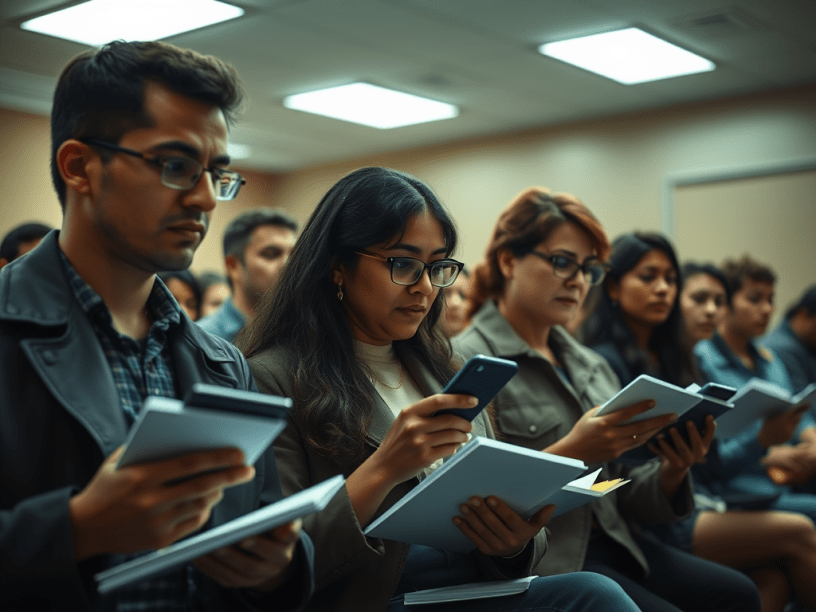
The great menace to American law and order, it turns out, is not a cartel, a terror cell, or a militia stockpiling AR-15s in a pole barn. It’s a handful of overcaffeinated New Yorkers sitting in fluorescent-lit immigration courts with notebooks and Signal chats, trying to make sure the government doesn’t quietly disappear their neighbors.
So naturally, the FBI treated them like a national security threat.
Newly released law-enforcement records show that the Bureau got inside a private, invite-only Signal group used by immigration-rights activists in New York City who organize “courtwatch” shifts—volunteers who sit in on federal immigration hearings at the big Manhattan court buildings, write down what actually happens, and occasionally take pictures of the cops and agents who enjoy operating in the shadows.
Despite Signal’s end-to-end encryption, the FBI’s New York office somehow obtained live access to the chat. In an August 28, 2025 “joint situational information report” shared with the NYPD and other agencies, they quoted from conversation inside the group and described its members as “anarchist violent extremist actors” supposedly “targeting law enforcement officers and federal facilities.”
Their “evidence” of extremism? People talking about which floor of a courthouse to go to, how to tell a clerk you’re there for a 9:30 hearing, and why it’s useful (and perfectly legal) to write down badge numbers and take video when ICE and court officers shove people around.
In other words: they infiltrated a glorified rideshare and note-taking collective and called it terrorism.
Welcome to Terror Club
The memo reads like parody if you’ve ever actually seen immigration court. These are not glamorous spaces. They’re beige holding pens where people in cheap suits mumble through translators while judges process deportation cases like warranty claims. Hearings are supposed to be open to the public; you don’t need security clearance to walk in, just the ability to find the right floor and look like you belong there.
That’s basically what the Signal group was for: “instructions on where to go and what to say in order to gain access to federal courtrooms,” as the FBI memo breathlessly puts it. The big subversive tip? Tell them you’re there to observe a hearing. It’s the legal equivalent of sharing a Google Maps pin.
But because the group also encouraged volunteers to “collect media” of law-enforcement behavior—faces, badges, license plates, the inside of federal facilities—the Bureau framed it as hostile reconnaissance. In the memo, they claim a “sensitive source with excellent access” had joined a Signal debrief call where people discussed how to “improve future activities near federal facilities,” by which they meant… better documenting what cops and agents were doing to immigrants in public spaces.
No bombs, no plots, no diagrams of air ducts and weak points—just ordinary people saying “we should be filming this more systematically.” The FBI saw citizen oversight and decided it was step one in an insurgency.
To make that work on paper, they dropped the magic phrase: “anarchist violent extremists.”
In the FBI/DHS domestic terrorism manual, “anarchist violent extremism” is supposed to mean people using force or the threat of force to pursue anti-government or anti-authority goals—bombings, arsons, assaults, that sort of thing. In this case, the memo offers no actual examples of violence by the courtwatchers. None. It just asserts that the organizer has, somewhere in other “private encrypted online chats,” encouraged violence against law enforcement, without explaining when or where or how that has anything to do with sitting in court and writing stuff down.
That’s all it takes now: some unnamed source mutters “they’re anarchists” and suddenly the Bureau has discovered a fresh front in the War on Terror, inside a Signal thread where the scariest sentence is “I can take the 9:30 shift at Varick.”
COINTELPRO With Push Notifications
If this feels familiar, it’s because it is. This is the same country where the FBI wiretapped civil-rights leaders, infiltrated antiwar groups, and ran an entire program—COINTELPRO—dedicated to “exposing, disrupting, misdirecting, or otherwise neutralizing” anyone they considered “subversive,” whether or not they’d actually committed a crime.
Back then, they were busting open letters and planting informants in meetings. Now, they’re piggybacking into encrypted chats and writing “situational reports” about people using the public seating in a courtroom. The mechanism has changed; the target hasn’t. It’s always whoever insists on being physically present when the state does something ugly.
The timeline is especially telling. Courtwatch in New York and around the country took off because ICE started treating court buildings like hunting grounds—grabbing people who showed up for routine hearings, staking out stairwells, turning “come resolve your case” into “walk into an ambush you can’t escape.”
One presidential directive opened the door for courthouse arrests; a later administration partially walked that back out of basic concern for due process—if your courtroom looks like a trap, people stop showing up and the system collapses. Now the same apparatus is back to quietly normalizing the idea that you can be arrested in the very building that’s supposed to adjudicate your rights.
Courtwatchers became a problem because they insisted on standing next to the trap door with a notebook.
The FBI didn’t just surveil them; it distributed the memo to other agencies and fusion centers, embedding the idea that “people who show up to watch immigration court and film ICE” equals “anarchist violent extremist actors.” It’s the kind of label that tends to follow you around. It’s also a convenient pretext for harassment, extra scrutiny at airports, or getting your name popped into whatever big data cauldron the government is using this week to algorithmically sort the citizenry into “safe” and “maybe shoot first.”
Surveillance First, Justification Later
Pressed to explain why this wasn’t insane, an NYPD spokesperson tried to distance the department from the actual content of the FBI memo and instead gestured at a broader, scarier-sounding probe into “weapons training, violence against law enforcement, property damage and destruction, and discussions about bomb-making.”
The problem is that none of that appears in the document the public gets to see. No bomb recipes. No field manuals. Not even a doodle of a stick of dynamite. Just the same mundane stuff: which courthouse, which floor, what time, and don’t forget to film the badges.
This is how modern security theater works: you throw around vague references to some other investigation where somebody somewhere might be talking about something scary, and then you staple your unrelated annoyance—say, immigrants’ rights volunteers—to the same bulletin. The lack of specifics isn’t a fuck up, it’s the point. “National security” is the black Sharpie you draw over the part where you admit you’re mad that people are watching you at work.
Meanwhile, the rest of the security state hums along. At the border, Customs and Border Protection runs automated license-plate readers that feed a massive database tracking millions of drivers, including citizens who’ve never done anything more subversive than visit their relatives near the line. Throw that together with “sensitive sources” in encrypted chats, and you get the skeleton of a system where the government knows who you’re talking to, where you drove last week, and whether you’ve ever sat in the wrong courtroom at the wrong time with the wrong people.
And if you combine enough of those datapoints, it stops mattering that you never threw a rock or skipped a toll. You’re in the wrong cluster. The model says you have “extremist ties.”
The Chilling Effect Is the Point
Immigration court is public by law, but it’s not public by design. Everything about it—windowless corridors, security theater at the entrance, lawyers sprinting between courtrooms with overstuffed files—screams “you’re not supposed to be here.” The only people who regularly bother to sit through hearings are families, lawyers, journalists, and activists.
If the activists start worrying that just being in the building, or in the Signal chat that gets them there, might land them in an FBI file as violent extremists, some of them will stop going. That’s the point.
Courtwatch works by being boringly persistent. You show up, you sit in the back, you write down what you see, and then you publish the numbers: how many hearings are rushed, how often detainees show up in shackles, how frequently interpreters are missing, how many families get blindsided by stealth ICE arrests. One city official who has regularly done this kind of observing in New York even ended up getting arrested by ICE inside an immigration courthouse while accompanying a constituent—a perfect snapshot of how hostile these spaces are to oversight.
From the government’s point of view, the last thing you want is a spreadsheet of your cruelty.
So you don’t outlaw courtwatch. You don’t need to. You just normalize the idea that people who coordinate it are extremism-adjacent. You start dropping that phrase—“anarchist violent extremist actors”—into bulletins and briefings. You let local cops know these people are on your radar. You plug their license plates into the border database and their names into the no-fly watchlist blender. You quietly raise the cost of participation.
The chilling effect isn’t collateral damage. It’s the whole ballgame.
Who’s Afraid of Transparency?
If you step back, the absurdity is kind of breathtaking. On one side, you have immigration courts long accused of railroading people through complex proceedings in a language they don’t speak, with limited access to lawyers and arcane rules that can turn a missed hearing or a typo into a deportation order. On the other, a tiny army of volunteers whose radical demand is: “Let us sit here, in this public room, and watch.”
This is the great extremist threat: witnesses.
Not saboteurs, not insurgents, not foreign agents. People who think democracy involves showing up in person when the state holds life-altering hearings about your neighbors, and then talking about what they saw in a group chat.
Unable—or unwilling—to distinguish between someone planting a bomb and someone filming a badge, the FBI collapses both into the same category: people who “target law enforcement,” which now includes “point a phone camera at them while they shove a woman to the ground in a courthouse hallway.”
It’s almost funny until you remember the power imbalance. The people being surveilled here aren’t billionaires laundering money through shell companies; they’re immigrants and their friends trying to navigate a system designed to make them disappear quietly. The courtwatchers don’t have lobbyists. They have Signal and subway cards.
And yet somehow, in this heroic war for national security, it’s the note-takers who get filed under “violent extremism,” while the system they’re documenting goes on chewing through families like it always has.
Counterterrorism for Cowards
The whole episode tells you something bleak about where “counterterrorism” has landed after two decades of mission creep.
When the tools built to hunt actual terrorists start getting pointed at people whose big innovation is “sit in court and post about it,” that’s not just overreach—it’s an admission of bankruptcy. Instead of rolling up bomb plots, you’re writing internal fan fiction where the real villains in America are the ones watching you work.
It’s cowardice wrapped in jargon: a security state that’s terrified of transparency, a law-enforcement culture that feels more threatened by cameras and clipboards than by, say, an unaccountable deportation machine grinding away behind closed doors.
And it’s a preview. If they can define immigration court volunteers as “anarchist violent extremist actors” today, tomorrow it’s people filming traffic stops, or parents live-tweeting a school board meeting, or tenants logging every time a cop shows up to “assist” a landlord with an illegal eviction. Once the category is “anyone who systematically observes us,” it fills up fast.
The lesson is brutally simple: in the eyes of the American security apparatus, the real red line isn’t violence. It’s visibility.
You can be as cruel as you want in a courtroom, a detention center, a border crossing, a traffic stop, as long as no one is there to take notes. The moment someone pulls out a notebook and a phone—and worse, brings friends—that’s when the memos start, the labels appear, and the word “extremist” gets stapled to the people trying to keep democracy from happening in the dark.
 The American Beast