
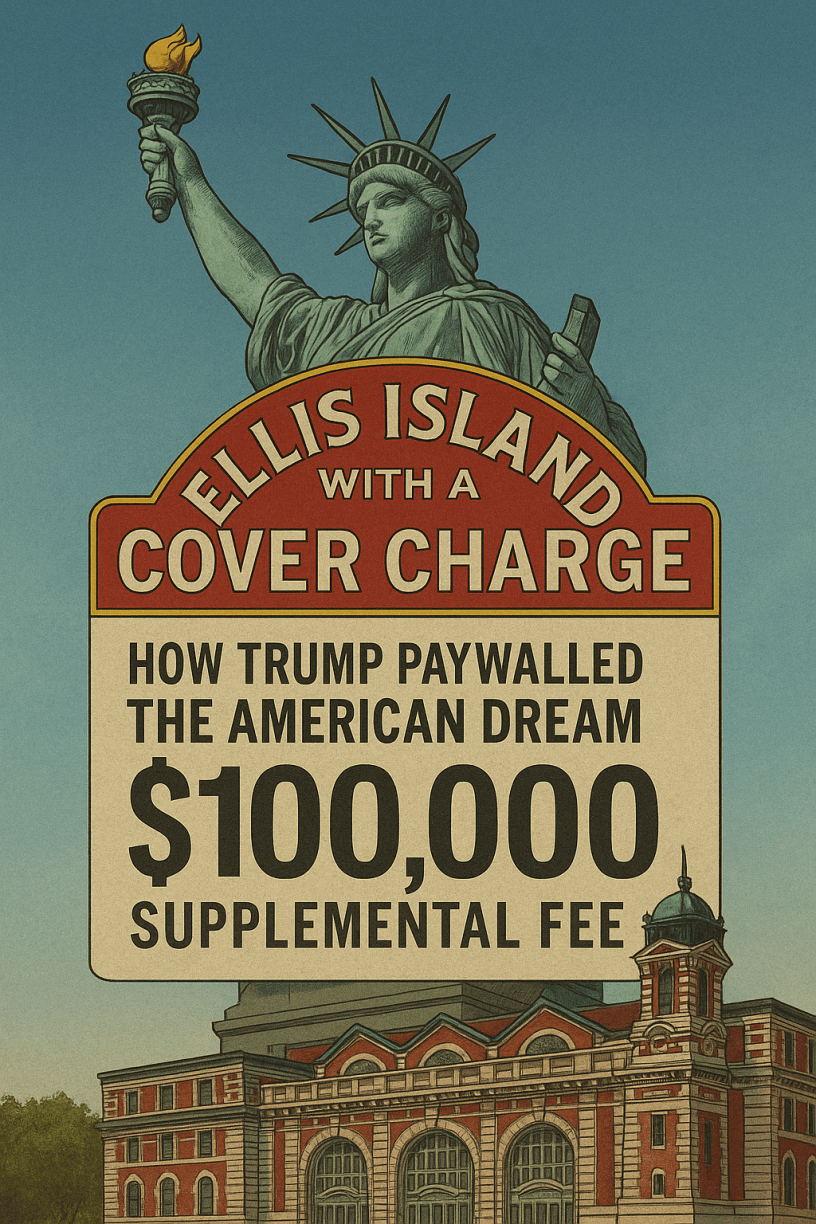
The Trump-Vance administration has finally solved the great immigration “crisis” the only way a casino developer knows how: by slapping a cover charge on the front door and calling it patriotic. Under a shiny new presidential proclamation, a huge chunk of new H-1B visa petitions for skilled workers now need to be stapled to a $100,000 “supplemental fee” if the worker is outside the country. No fee, no decision, no entry. The golden door is still there, technically. It’s just got a bouncer and a six-figure minimum.
You have to admire the simplicity. For decades, the political class has ranted about “merit-based immigration,” pretending they’re trying to recruit the world’s best and brightest. Now Trump has cut the act. The real “merit” is whether your potential employer can light a hundred grand on fire just to get your paperwork read in the first place.
The administration’s lawyers and trade groups can parse the footnotes all day—this only hits new petitions, mostly for workers abroad; renewals with the same employer are exempt; some categories slip through a loophole if the stars align just right. The big picture is obvious: if you’re rich enough, the line gets shorter. If you’re not, you’d better invent teleportation or settle for watching America from LinkedIn.
And this is just the cover charge tier of Trump’s Second Term Immigration Package. While corporate America is being presented with a six-figure VIP menu, everyone else is getting hit with the other half of the scheme: punish immigrants for asking this country for anything except the privilege of being exploited.
Because at the same time he’s putting the velvet rope around skilled visas, Trump is reviving and juicing up the “public charge” rule—the ancient idea that immigrants who’ve used things like Medicaid, food aid, or housing assistance should be treated as leeches and maybe booted or denied a green card. The new proposed rule, rolled out in November, would give immigration officers broader authority to deny lawful immigrants permanent status if they dare dip into the safety net, even temporarily, and even when they’re fully eligible under every other law on the books.
So the message is clear: if you’re a foreign worker, you can come—if your employer can drop $100K like they’re ordering bottle service. If you’re already here and not rich, you can stay—if you quietly starve and pay cash at the clinic.
Welcome to Meritocracy Land, where the only unforgivable sin is being poor in public.
Trump has always hated the idea that anyone gets something he thinks they didn’t “earn.” It’s why he’s raging at union workers, SNAP recipients, and college kids in debt while simultaneously spraying tax breaks at donors like a malfunctioning champagne hose. The immigration version of this is almost too on the nose.
Start with the H-1B scheme. For years, Silicon Valley and the corporate lobby have insisted the program is about plugging “skill gaps” and bringing in top engineers, doctors, and researchers. There are plenty of legitimate criticisms—that companies use H-1Bs to drive down wages, that workers get tied to abusive employers—but the official story is all about “global competitiveness” and “innovation.”
Trump looked at that and saw a luxury good that wasn’t priced correctly.
So now, if you’re a company that wants to bring in a specialized worker who happens to be outside the U.S., you don’t just file your petition and wait. You wire an extra hundred grand to Uncle Sam for the privilege. It’s a proclamation fee, the bureaucratic equivalent of a Mafia street tax: nice little global talent pipeline you’ve got there, shame if anything happened to it.
The fee doesn’t suddenly make the system fairer. It just shifts the advantage from “companies willing to navigate a lottery” to “companies rich enough to treat immigration policy like a bottle of Dom at Mar-a-Lago.” They’re not picking the best coders or surgeons; they’re picking the employers most willing to bribe the doorman.
Meanwhile, Trump’s allies can still go on TV and talk about “legal immigration done the right way.” This is the right way, in their minds: people with capital buy a key. Everyone else can go back to shouting at consulates from the sidewalk.
If you’re not in the H-1B crowd, don’t worry—the cruelty trickles down.
The proposed public charge rule is Trump’s favorite old toy pulled out of the attic and fitted with sharper nails. For more than a century, U.S. immigration law has had some version of a rule letting the government treat people as a “public charge” if they’re likely to end up dependent on the state. But in practice, it spent decades as a dusty threat mostly reserved for extreme cases.
Trump wants to make it the main event. Under this new proposal, an immigrant lawfully in the country could be denied a green card or other status if they—or in some formulations, their family—use certain benefits, including Medicaid and food or housing assistance. The wonks talk about “negative factors” in a “totality of the circumstances” test. Translation: if you’ve ever needed help in a system rigged to make sure you need help, you’re a problem.
Advocates are already warning what this will do, because we’ve run this sad experiment before: families will pull out of health care and nutrition programs they’re plainly eligible for, afraid that a pediatrician visit or food aid will get their future ripped away. Kids will go without checkups and asthma meds because mom’s lawyer heard “public charge” and told her not to touch anything with a government logo on it. Mixed-status households—one U.S. citizen kid, one noncitizen parent—will stay sick and broke in silence. And then some DHS flack will brag about “savings” while pretending those savings aren’t literally the difference between care and no care for people who live and work here.
In the American imagination, “public charge” conjures a cartoon freeloader, someone sneaking over the border to raid the benefits buffet. In reality, it slams people who are already doing the most American thing possible: grinding away in low-wage jobs in a country that refuses to pay them enough to survive without help. The state creates a class of workers it knows will need assistance—then punishes them for taking it. It’s like tossing someone in a pool with their hands tied and then screaming “no swimming” when they try to breathe.
But the point isn’t logic. It’s deterrence. You’re supposed to be so terrified of losing your future that you’ll never ask for anything now—not health care, not housing, not food. The administration gets fewer benefit rolls and more leverage to deport people while claiming they “only enforce the law.”
What they’re really enforcing is the rule that poor people should suffer quietly, especially if their birth certificate has the wrong flag on it.
And while the federal government is busy shaking immigrants down at the border and the benefits office, it’s also decided that letting undocumented young people pay in-state tuition is an affront to the natural order of things.
The Justice Department has launched a lawsuit against California for offering in-state college tuition, state scholarships, and financial aid to undocumented students who grew up there—roughly eighty thousand of them, raised in California schools, now being threatened with a federal legal sledgehammer for having the audacity to want a degree without paying out-of-state ransom rates.
California’s rule is basic: if you went to high school here and meet the same residency requirements as everyone else, you qualify. The Trump argument is that this “discriminates” against citizens from other states and “encourages illegal immigration.” Apparently, an Iowa kid paying more to go to UCLA is a constitutional crisis, but an 18-year-old from Los Angeles being priced out of college altogether is just good character-building.
It would be funny if it weren’t so naked: the same party that chants “learn to code” wants to take college away from the kids they’ve already shoved to the margins. And they’re not stopping at California—similar laws in Minnesota, Texas, and other states are already under attack or rolled back, part of a coordinated campaign to make sure that undocumented students stay permanently stuck in the low-wage jobs the economy silently reserves for them.
So picture the full pipeline:
Grow up in U.S. schools. Get told your entire childhood that education is the ticket out. Hit 18 and find out you’re not eligible for federal aid, your state is being sued for helping you, and the Justice Department thinks you’re an affront to the republic. Then try to navigate a labor market where employers can pay six figures to import someone else over you—while your own government calls you a “lawbreaker” for wanting to sit in a college classroom without going bankrupt.
The official line is “we must not reward unlawful presence.” The real policy is “we must not let you climb the ladder we’re busy kicking out for everyone else.”
None of this is happening in a vacuum. While Trump is throwing a hundred-grand checkpoint on the front door and slamming the safety net on the people already inside, his agencies have been busy turning courthouses into ambush points again—reviving the earlier practice of ICE staking out hearings and pouncing on people who show up to resolve their cases. New York passed a law to stop this; Trump’s Justice Department sued; a federal judge just told them to pound sand and upheld the state’s right to keep immigration agents from turning court buildings into open-air traps without a judge’s warrant.
So at one end of the system, the feds are furious that they can’t grab you at the courthouse door. At the other end, they’re trying to make sure you never get in the college door, can’t safely use the clinic door, and—if you’re an engineer overseas—can’t get through the border door unless your boss throws a hundred-thousand-dollar envelope over the transom.
The through-line isn’t “law and order” or “merit” or “fiscal responsibility.” It’s pay-to-play authoritarianism. If you’re rich, you can pay to smooth things over. If you’re poor, your very existence is rebranded as a moral failure.
And because this is America, the people selling you this system will insist it’s about fairness.
What makes this especially grotesque is how thoroughly it guts the national mythology while pretending to defend it.
We’ve spent more than a century flogging the story that the U.S. is a place where, if you work hard and keep your nose clean, you can move up. Ellis Island is supposed to be the symbol: the tired, poor, and huddled masses showing up with nothing but a suitcase and hope, getting processed by a bored clerk, and stepping into a new life.
Now imagine updating that plaque for 2025.
Give me your tired, your poor,
Your huddled masses yearning to breathe free—
Plus a wire transfer of $100,000 and a notarized promise never
to so much as look at a Medicaid application.
If you’re a high-skilled worker abroad, your fate depends less on your talent than on how badly your would-be employer wants you versus how badly they want to keep their cash. If you’re already here and struggling, your fate depends on whether you’re willing to gamble your family’s future on a gamble with the benefits office. If you’re an undocumented kid in California, your fate depends on whether the federal government wins the right to throw you back into the low-wage shadow economy instead of letting you get a degree.
None of this is an accident. It’s class war with a border component.
The $100,000 H-1B fee isn’t about stopping immigration; it’s about reserving immigration for the wealthy. The public charge rule isn’t about encouraging “self-reliance”; it’s about making sure immigrants live one medical bill away from disaster, scared to death of asking for help. The tuition lawsuits aren’t about the constitution; they’re about telling a generation of undocumented students: “You’re good enough to mow our lawns, but don’t you dare sit in our lecture halls.”
America always had a price. Trump just put it on the menu in big bold numbers.
And if the rest of us don’t like living in a country where citizenship is a subscription service and basic dignity is a luxury upgrade, we might want to start asking why the only people who ever seem to get “welcomed” anymore are the ones who can afford the cover charge.
 The American Beast