
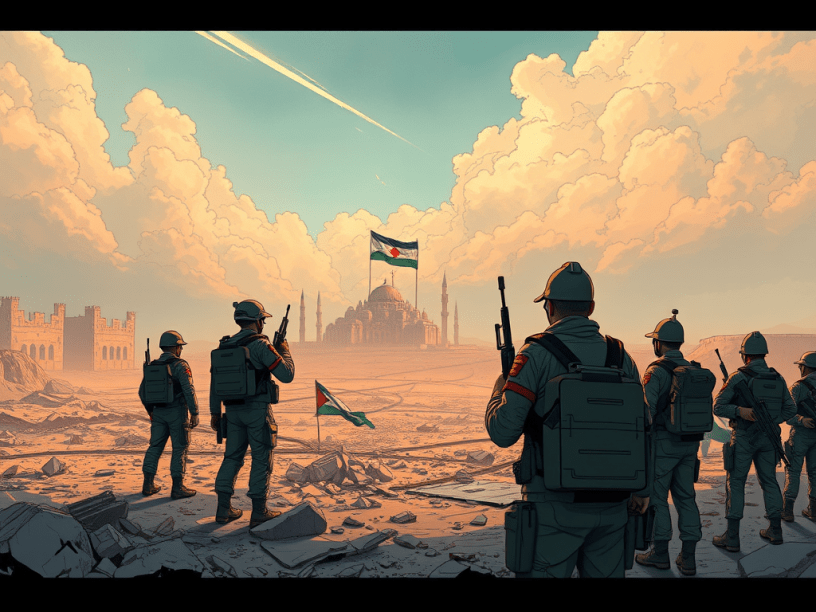
Trump’s Gaza “Deal” and the Forever Stabilization Force
The people who keep inventing peace plans for Gaza always seem to have the same job description: professional landlord for other people’s land. They show up with a white paper, a map covered in arrows, and a flowchart of “phases.” At the end of the process, Palestinians are still penned in under somebody else’s guns, and the only thing that’s actually changed is the font on the letterhead.
Trump’s new Gaza plan is that, but with more branding.
On November 17, the U.N. Security Council approved a U.S-drafted resolution endorsing his 20-point blueprint and authorizing an International Stabilization Force—a 20,000-strong foreign garrison with a two-year mandate, renewable like a Netflix subscription.
The sales pitch: this will “end the war,” “demilitarize” Gaza, free the remaining Israeli hostages, and lay out a “pathway” to some carefully hedged version of Palestinian statehood, someday, if everybody behaves and the Board of Peace—yes, that’s the real name of the new temporary governing body—decides they’ve earned it.
In other words, Gaza is getting a probation officer with tanks.
The Green Zone on the Mediterranean
Strip away the fireworks and what you get looks less like “peace” and more like Iraq’s Green Zone, coastal edition.
U.S. planning documents and leaks describe Gaza carved into color-coded chunks: a “green zone” where Israeli and international troops will sit on top of the rubble, guarding reconstruction projects and a hand-picked transitional administration, and a “red zone” left on the far side of the ceasefire line, still under hostile control, where reconstruction is explicitly not on the agenda.
If that sounds like partition with some extra steps, congratulations, you’re ahead of most cable news panels.
The ISF’s job list reads like every occupation playbook of the last twenty years:
- Train and “vet” Palestinian police.
- Patrol borders and choke points so no weapons get in that the wrong people control.
- Supervise the flow of humanitarian aid so the population doesn’t starve or revolt at an inconvenient time.
- Guard the offices and villas of the new Board of Peace technocrats, the latest cast of “responsible partners” imported to manage the rubble.
The forces themselves will mostly be drawn from a grab-bag of “friendly” states—Azerbaijan and Indonesia are already volunteering boots, with others like Egypt, the UAE, Qatar, Turkey, Pakistan and Malaysia hovering on the edges of the roster, arguing about who’s willing to bleed for this thing and under whose terms.
It’s an old trick: get non-Western uniforms to stand between Western policy and the people who hate it. From a distance it looks multicultural. Up close it’s still foreign rifles on Palestinian streets enforcing someone else’s plan.
And just like every other “temporary” mission, the numbers are suspiciously neat. Two years of mandate, ending in late 2027, with all the usual language about “review,” “extension,” and “conditions on the ground.”
If you’ve watched international forces before, you know what that means: the term “temporary” will last exactly until the first time somebody suggests a hard exit date, at which point a chorus of Very Serious People will explain that now is the worst possible time, the region is too fragile, we need “just one more extension,” and suddenly you’re celebrating the tenth anniversary of your two-year stabilization force.
Peace by Committee, Sovereignty by Permission
The genius of this plan is how it turns basic human rights into performance targets.
Gaza’s future, we’re told, will be managed by the Board of Peace—an unelected transitional body with seats for a “reformed” Palestinian Authority and whichever “civil society” figures pass background checks from the same governments that helped flatten the Strip.
They get to run ministries, hand out aid contracts, and nod solemnly over blueprints. Israel keeps ultimate veto power on security; the U.S. holds the money and the timetable; the ISF holds the guns. Palestinians get the right to queue for permits, apply for jobs in the donor-funded reconstruction industry, and maybe vote for something later if the Board likes the polling.
The plan even throws in a conditional reference to eventual Palestinian statehood, buried under a shitload of caveats. Statehood is now a reward, not a right—a dangling carrot for “good behavior” measured by how quiet the ruins stay, how effectively local security forces throttle dissent, and how reliably nobody in the “green zone” fires a rocket.
If you squint, you can see the colonial lineage peeking through. Once upon a time, empires called this a mandate or a protectorate: we’ll run things for a while, civilize the natives, and leave once they’re ready. The Trump-era version just swaps out the language. It’s not a mandate, it’s “international guardianship.” It’s not a protectorate, it’s “stabilization.” The Board of Peace is basically a board of trustees for a country that’s been involuntarily put into receivership.
Hamas, unsurprisingly, has rejected the whole structure as foreign rule in nicer suits. Israel’s hardliners hate the faint whiff of Palestinian statehood in the text. Arab capitals are trying to pretend that signing up troops for this mission isn’t the diplomatic equivalent of volunteering to be the bouncer for a party everyone hates.
The Lebanon Preview
If you want to know what Gaza’s “stabilized” future looks like, take a quick drive north to Lebanon, where the ceasefire from last year’s 14-month war is still limping along under a set of conditions only an arms dealer could love.
There, too, the magic word was withdrawal. After the Israeli ground campaign pushed deep into the south in 2024, a U.S.- and French-brokered truce promised a pullback and the restoration of Lebanese sovereignty “through coordinated security mechanisms.” UN peacekeepers would help the Lebanese army take over; Hezbollah would ease back; Israel would eventually leave. Everyone claimed victory.
Fast-forward. Israel did not fully withdraw. Instead, it kept soldiers dug in on five strategic hills hovering over border communities, arguing that these are vital vantage points and not really the kind of territory one simply vacates just because one signed an agreement saying you would.
The hills became the physical embodiment of the fine print: “We will leave… except where we won’t.”
Now Lebanon’s president is offering to negotiate a deal that would finally end the daily Israeli airstrikes and get those troops off the high ground, while Lebanese officials talk bravely about disarming Hezbollah and the army “securing” the border instead. Israel, predictably, is in no hurry. Its prime minister has said withdrawal is possible if Hezbollah is disarmed first; Hezbollah’s answer is that it won’t disarm while Israeli soldiers are still camped on Lebanese soil.
It’s a perfect little Möbius strip of preconditions: we’ll leave when you disarm, we’ll disarm when you leave. In the meantime, the five hills, like the Gaza green zone, sit there as monuments to “temporary” arrangements that somehow never quite end.
Meanwhile, the long-running U.N. peacekeeping mission in Lebanon has been put on a ticking clock. Under pressure from Washington and Jerusalem, the Security Council voted to wind the whole thing down by the end of 2026—after nearly half a century on the job. Decades of “stabilization,” a carved-up border, new permanent facts in the highlands, and exactly zero actual peace.
That’s the model being exported to Gaza under a glossier logo.
Occupation, Rebranded
One of the neat tricks of modern diplomacy is how it turns occupation into an accounting problem.
Instead of asking “who actually controls this place,” you’re invited to focus on troop rotations, legal mandates, revenue-sharing formulas, and whether the uniforms on the street have the right patch on the shoulder. If you can find a configuration where there are technically fewer Israeli soldiers inside Gaza’s boundaries, you get to call it the “end of occupation”—even if those same soldiers now sit on the perimeter, controlling every crossing, airspace, and supply route, while a ring of foreign troops and local proxies keep the lid on inside.
The ISF is essentially a firewall between Israel and responsibility. If a protest turns into a clash, it’s Azeris or Indonesians on the receiving end, not Israeli conscripts. If an aid convoy gets turned back at a checkpoint, it’s because “security conditions” aren’t met, not because the blockade is still there in everything but name. If someone asks why reconstruction hasn’t reached the red zone, the answer is that Hamas hasn’t fulfilled its obligations under the demilitarization chapter of Section Whatever, Phase Three.
At the same time, the plan very carefully keeps Israel’s core strategic demands intact. Missiles and heavy weapons must go. The strip remains under tight external security coordination. Any “Palestinian” forces are vetted and trained under foreign tutelage. And the Board of Peace’s mandate just happens to line up with the period when Gaza will be most dependent on outside aid, guaranteeing that the people who control the purse will also control the politics.
On paper, this looks like order. On the ground, it looks like the same old cage with some of the bars subcontracted out.
What Peace Actually Looks Like
The defenders of this plan will insist it’s the best anyone can do right now. After two years of war, thousands dead, and whole neighborhoods erased, you’ll hear that something had to be done. You’ll be told that there is no alternative to an international force, because someone has to guarantee Israel’s security while the rubble is slowly rearranged into condos and industrial parks. You’ll be scolded for failing to appreciate how historic it is that the world has agreed, in theory, that Palestinians might one day be allowed to call what’s left of their land a state.
But you can’t bomb a place half to death and then declare yourself a peacemaker because you’ve hired new guards.
Real peace would look boring by comparison. It would mean ending the siege instead of outsourcing it. It would mean actual sovereignty instead of phase charts. It would mean no more foreign soldiers on anyone’s streets, hills, or rooftops—not Israeli, not “international,” not branded with some invented acronym that sounds like a cellphone plan. It would mean a border that is a line on a map, not a militarized funnel where every loaf of bread needs three signatures.
And crucially, it would mean that when people in Gaza or southern Lebanon look up at the high ground, they don’t see somebody else’s flag.
Instead, we’re getting the opposite: another elaborate system designed to manage an injustice, not resolve it. Gaza will be “stabilized” the way a prison is stabilized—with new guards, revised regulations, and an upgraded surveillance system. The five hills in Lebanon will still loom over villages as proof that even when the world says “withdrawal,” it means “except where it matters most.”
Trump gets to declare a foreign policy win. The Security Council gets to congratulate itself on “ending” a war it helped arm. The ISF troop contributors get a line in the brochure about their commitment to international peace and security.
And the people who actually live in these places get to find out, once again, that in the age of forever wars and forever peace plans, “peace” is what happens when the shooting slows down enough for the landlords to redraw the lease.
 The American Beast