
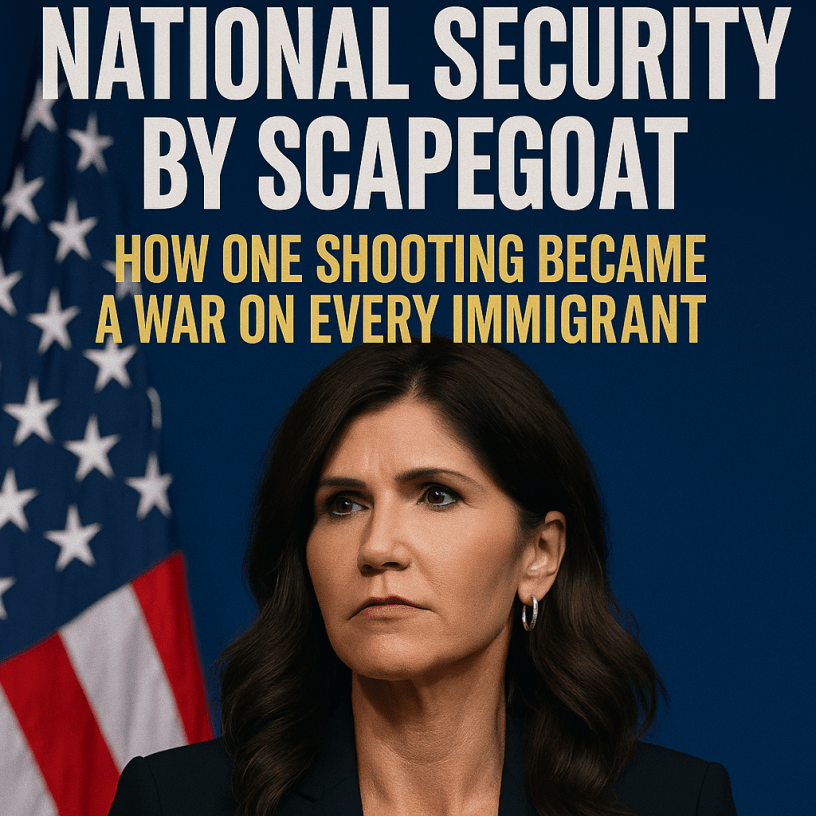
How One Shooting Became a War on Every Immigrant
The flowers are still fresh on the sidewalk where it happened.
A few blocks from the White House, wedged between a Metro entrance and a Pret A Manger, there’s a makeshift memorial for two West Virginia National Guard soldiers who were standing on a D.C. street corner and suddenly weren’t. Twenty-year-old Specialist Sarah Beckstrom is dead. Staff Sergeant Andrew Wolfe, twenty-four, is lying in a hospital bed, barely out of surgery, learning how to move his toes again.
The accused shooter is Rahmanullah Lakanwal, a twenty-nine-year-old Afghan national who fought in a CIA-backed Afghan unit, came to the U.S. in 2021 under a Biden-era resettlement program, and was granted asylum earlier this year under Trump. He passed every background check the national-security state could dream up—biometrics, interviews, vetting by multiple agencies—and still, at the end of that conveyor belt, he allegedly picked up a gun and opened fire on two young Americans who thought they were in the safest zip code in the republic.
It is a tragedy in the most literal sense: inexplicable, devastating, and specific. One man, one gun, one moment. Any sane country would grieve, investigate how he slipped through the cracks, and figure out whether the system that cleared him actually failed or whether human beings remain unpredictable lumps of meat and trauma no matter how many databases you throw at them.
Instead, the Trump administration is using it as the launchpad for a national policy pogrom.
Within days of the shooting, the government announced that it was halting all asylum decisions nationwide—not just for Afghans, but for everyone. Officers at U.S. Citizenship and Immigration Services got an internal directive: all asylum adjudications are frozen “until we can ensure that every alien is vetted and screened to the maximum degree possible.”
In the same breath, officials paused all immigration processing for Afghan nationals, from family petitions to work permits, and stopped issuing visas for people traveling on Afghan passports. It doesn’t matter if you’re a translator who saved American soldiers, a kid trying to join your parents, or a scientist coming for a conference; your paperwork just hit a brick wall because some asshole who shares your nationality shot two people in Washington.
Then came the big number. A leaked memo showed the administration ordering a full re-vetting of roughly 200,000-plus refugees who were admitted during the Biden years—case-by-case reviews to see if any of them can be kicked out based on “derogatory information” that didn’t disqualify them the first time. Green-card applications for those refugees are on hold until the review is done.
One shooter, two victims, and suddenly an entire country’s worth of desperate people are standing in line to have their lives re-adjudicated because Donald Trump needed “decisive action” for the cameras.
And that’s before you get to the rhetoric.
Homeland Security Secretary Kristi Noem, sudden top prospect to top the next “Most Loathsome” list, responded to the shooting by demanding a “full travel ban” on “every damn country” she claims is “flooding us with killers, leeches, and entitlement junkies.” She didn’t bother naming which countries those are, because the point isn’t policy, it’s blood-and-soil improv for the base. The message is clear enough: if someone with the wrong accent hurts an American in a high-profile way, everyone with that accent becomes a suspect, forever.
This isn’t national security. It’s national security theater, staged for an audience of one.
Governing by Exception
Every authoritarian project needs its founding myth. For this White House, it’s the story where one crime justifies collective punishment.
The asylum freeze is a perfect example. According to Trump officials themselves, asylum officers were told to stop making decisions because the government supposedly needs time to re-evaluate its vetting procedures in light of the D.C. shooting.
But asylum decisions aren’t some loosey-goosey vibes check. They already involve interviews, background checks, corroborating evidence, and years of bureaucratic limbo. People who applied in 2019 are still waiting in 2025, drifting from one cramped apartment to another while the government decides whether the gang that tried to kill them counts as “persecution” or just a colorful feature of the local culture.
Slamming the brakes on all asylum determinations doesn’t “make us safer.” It just turns the slow torture of the system into an outright freeze. There is no world in which a woman fleeing domestic violence in Honduras is suddenly more dangerous because a guy from Afghanistan snapped in downtown D.C. The only logic is guilt by category: immigrant hurt American, therefore all immigrants pause.
The Afghan-only measures are even more naked. USCIS publicly announced that “all immigration requests relating to Afghan nationals” are stopped “indefinitely,” pending a review of security protocols. That includes people who already went through hell to help U.S. forces, then went through hell again to escape when the U.S. bailed on Afghanistan, then went through a third hell being vetted for resettlement.
If the system failed with Lakanwal—and that’s still an if, because investigators haven’t finished sorting out whether he radicalized after arrival or imploded under untreated PTSD—that’s on the system that processed him. Re-traumatizing an entire population of evacuees by freezing their families’ cases and treating them like sleeper agents doesn’t fix that. It just spreads the blame around until it covers everyone.
Then there’s the Biden-era refugee review. Internal memos and public statements put the number somewhere north of 200,000 people, every single one of whom already passed layers of screening under a program that is famously among the slowest and most conservative in the immigration universe.
These are not people who strolled across a border. They spent years languishing in camps and cities, waiting for interviews, health checks, security clearances, and final approval. Now, because it’s politically useful to imply that Biden “flooded” the country with foreign menaces, they get to live under the threat that some analyst will find a social-media post or a mis-translated detail and yank the floor out from under them.
Noem and Trump don’t have to prove that any of those 200,000 did anything wrong. They just have to keep repeating that they might, and that the only responsible thing is to treat them all as ticking bombs until proven otherwise.
That’s how you govern by exception: you turn one off-the-charts crime into a permanent emergency, and then you pass whatever you wanted to pass anyway, insisting your hands are tied by events.
The IRS, the Address Book, and the Line a Judge Wouldn’t Cross
If you want to see how far this was supposed to go, look at the plan that didn’t make it.
Right before the shooting, the administration quietly set up a data-sharing pipeline between the Internal Revenue Service and Immigration and Customs Enforcement. The idea was simple and horrifying: let ICE mine tax records—including home addresses—to track down undocumented people for deportation.
There’s something almost poetic about it. For years, immigrant advocates have begged people without status to file taxes anyway, to show “good moral character” and a paper trail in case an opening appears in the law. Then the government decided to use that good faith as a targeting database.
Immigrant taxpayers were about to discover that the address they wrote on a 1040 form in good faith was now a GPS marker for the deportation squad—until a federal judge stepped in and slapped an injunction on the whole scheme, ruling that the IRS can’t just hand over sensitive taxpayer data to ICE because someone in the West Wing is bored and angry.
The ruling didn’t stop the rest of the crackdown, but it exposed the mindset. This isn’t about smart intelligence work or precision targeting. It’s about turning every interaction immigrants have with the government—court, clinic, tax office—into a potential trapdoor.
Seen from that angle, the D.C. shooting is less a cause than a pretext. The asylum freeze, the Afghan processing halt, the mass refugee review, the attempted tax-data dragnet: these are not careful tweaks. They’re blunt instruments looking for an excuse.
Now they have one.
The Human Cost of Being a Talking Point
The administration loves to talk about numbers and “countries of concern.” Officials boast about re-examining green-card applications from people in 19 nations whose passports look suspicious on a TV chyron. They throw around figures like “233,000 refugees” and “paused indefinitely” as if these are just metrics on a dashboard, not the population of a medium-sized city whose residents are now wondering whether they’re about to be deported for the crime of arriving under the wrong president.
Take Orange County, California, where local reports describe Afghan families visiting immigration lawyers in tears because their asylum interviews have vanished into the void. They did what they were told: trusted the U.S., boarded the planes when the Taliban closed in, sat through the screening, enrolled their kids in school. They signed leases. They bought cars with terrible interest rates. They tried to pretend that the worst was behind them.
Now, thanks to a man with a gun in D.C. they’ve never met, their futures are back on the bargaining table.
Or look at the refugees admitted under Biden who are mid-stream in the green-card process. Many have finally hit the point where they can stop worrying about being shipped back to the countries they fled from. Some have bought homes, started businesses, taken out loans, or made plans that assume they’ll still be here in five years. The Trump memo ordering their cases reopened and re-vetted turns all of that into a maybe.
Imagine sitting at your kitchen table reading that story on your phone: every promise the U.S. made you is now conditional on a new round of scrutiny you can’t see and can’t respond to. Your name is no longer “approved.” It’s “pending further review.”
None of this will show up in the press conferences. You won’t see Kristi Noem doing B-roll in an Afghan grocery store, explaining to the owner why his mother’s visa is on hold. You won’t see Trump at the memorial service for the refugees who get killed because they were sent back to the situations they escaped from.
You will see them at rallies, telling crowds that they are finally “getting tough” and “protecting American families.”
Bite me.
The Security State Finds a Scapegoat
The grimmest part of this whole spectacle is that none of it would have saved Beckstrom or Wolfe.
The man who allegedly shot them already went through the gauntlet. He was vetted as a CIA ally. He passed security screening to enter under a resettlement program. He later won asylum under the very president now screaming that Biden “let him in.”
If there was a failure, it wasn’t that the bar was too low. It was that the people running the show don’t understand that no bar is high enough to predict the future behavior of every traumatized human being they relocate to a new country.
You cannot legislate away randomness. You cannot abolish lone-actor violence by tightening the screws on vast categories of innocent people. You can’t stop every ticking time bomb—if that’s even what this was—by refusing to grant asylum to a domestic-violence survivor from Guatemala or re-vetting a Congolese family that’s already been here for three years.
But you can use those people as evidence that you’re doing something.
That’s the real function of this crackdown: it gives the national-security state a reassuring storyline in which every atrocity is a problem of insufficient control. If a vetted refugee commits a crime, the answer is never “maybe our systems and our occupation policies and our wars generate more chaos than they solve.” It’s always “more vetting, more surveillance, more bans.”
The D.C. shooting is awful. It is also an opportunity—for a White House that has never met a crisis it couldn’t turn into a hammer.
Permanent Emergency as Policy
What you’re seeing in the wake of this shooting is the blueprint for a permanent emergency state, one that can be rolled out whenever someone with the wrong passport does something monstrous.
A man from Country X commits a high-profile crime? Freeze asylum. Halt visas from Country X. Re-screen every refugee who ever arrived from anywhere remotely similar. Try again with the IRS data. Float a new travel ban. Let the Secretary of Homeland Security spit bile about “leeches” on social media. Rinse, repeat.
It doesn’t matter that most terrorism on U.S. soil is homegrown. It doesn’t matter that mass shooters are often citizens radicalized in their parents’ basements. It doesn’t matter that this particular shooter passed the very filters now being sold as too loose.
What matters is that the system has found a scapegoat that can’t fight back.
The memorial on the sidewalk will eventually be cleared away. The candles will burn down. The news trucks will go home. Trump will move on to the next tantrum, the next shiny outrage. The only thing that will last is the new normal he’s trying to build: a country where the rights of millions of immigrants can be suspended overnight because one man committed a crime.
That isn’t security. It’s collective punishment wrapped in a flag.
And if the rest of us don’t push back now—when the policy is still fresh enough to smell like gunpowder—then we’ll be told, the next time someone with an accent pulls a trigger, that all of this wasn’t a one-off response to tragedy.
It was precedent.
 The American Beast