
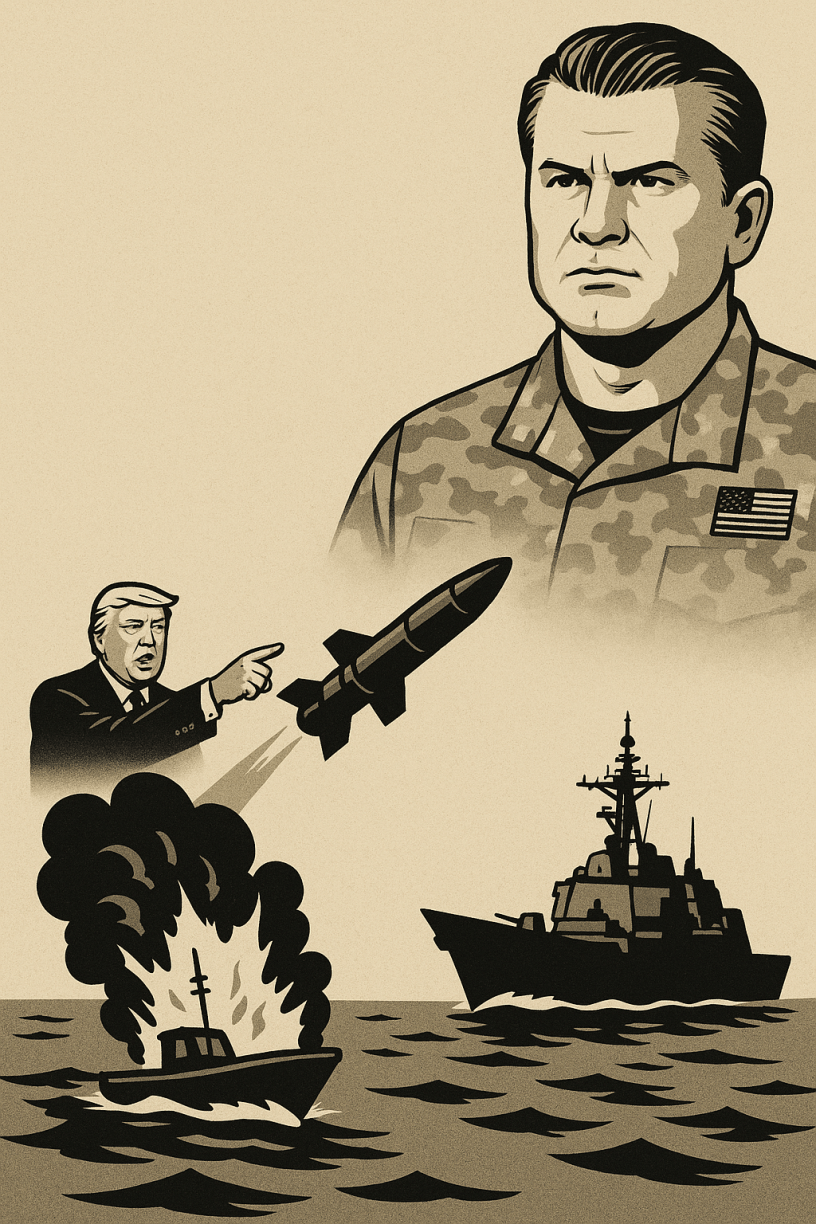
Somewhere in the Caribbean or the eastern Pacific, there’s a grainy black-and-white feed on a Pentagon screen: a speck of a boat, a flare of light, then the familiar blooming cloud when high explosive meets fiberglass and human beings.
Under Operation Southern Spear, that little movie has played at least 22 times since September, killing about 87 people on boats the Trump administration swears are “narco-terrorists” linked to Venezuelan President Nicolás Maduro and assorted cartels. There’s no declaration of war, no congressional authorization, and very little evidence released that any of these boats were carrying more than brown dudes and diesel. The White House simply sent Congress a memo declaring that the United States is now in a “non-international armed conflict” with drug cartels, rebranded as terrorist armies, and started blowing ships out of the water.
It’s gunboat diplomacy with a Netflix interface: click to confirm the target, tap to launch the missile, wait for the battle-damage assessment and the press release about keeping American kids safe from fentanyl.
And right in the middle of it stands Pete Hegseth, Fox-News-host-turned-Defense-Secretary, whose main credential seems to be that he never met a war crime allegation he couldn’t blame on the “fog of war” or the woke left.
The problem is that the fog keeps burning off—and what’s underneath looks less like counter-narcotics and more like a live-fire ethics seminar.
On September 2, U.S. forces hit a small vessel in the Caribbean, killing 11 people on board. That alone would have been controversial, given that international law normally treats drug smuggling as a law-enforcement matter, not an excuse for Hellfire diplomacy. But this one didn’t end with a single blast. According to reporting by the Washington Post and others, two survivors clung to the wreckage—until a second strike hit the disabled boat, killing them too.
The Pentagon’s own law-of-war manual, which is not exactly a hippie newsletter, explicitly forbids attacking shipwrecked survivors; we supposedly learned that lesson at Nuremberg. Legal scholars, former JAGs, and even some serving officers have been unusually blunt: if the U.S. knowingly killed those survivors, that second strike is a textbook war crime.
The administration’s story keeps flopping around like a fish on the deck. Early leaks said Hegseth told subordinates to make sure “no one walks away” from the boat. Hegseth denies ever giving a “kill them all” order and says he thought the job was done after the first missile. Admiral Frank Bradley, the commander on scene, has admitted ordering the follow-up shot, while insisting he didn’t realize two humans were the only thing left to blow up.
Lawmakers who’ve seen the classified video came out looking like they’d just watched a snuff film. Democrat Jim Himes says the victims were plainly incapacitated; Republican Tom Cotton squints at the same footage and sees a continuing threat to America’s teenagers and their right to overdo Percocet in peace.
Through it all, Hegseth has done what he does best: double down on TV. At a Cabinet meeting he shrugged off questions about the second strike with a line that will probably be etched on his eventual Hague indictment: “This is called the fog of war.”
Apparently the fog is thick enough to obscure two humans waving for help from a flaming hull, but not thick enough to block a second missile.
If you think maybe the man in charge of this live-ammo morality play isn’t the best steward of “rules of engagement,” the Pentagon Inspector General has some news for you.
An 84-page IG report just dropped concluding that Hegseth violated Defense Department policies by using his personal phone and a non-approved Signal group chat to share details of an earlier strike in Yemen—timing, number of aircraft, the whole nine yards—with assorted Trump officials, plus, by accident, a journalist. The chat later expanded to include his buddies and family. It was like a group text for bragging about fantasy-football scores, except the scores were bomb tonnage.
The IG said Hegseth probably didn’t spill formally classified info, but still “put U.S. forces at risk” and broke multiple rules about operational security. In a sane universe, a defense secretary caught live-blogging strike plans in a group chat would be immediately polishing his résumé and practicing the phrase “I take full responsibility.”
In Trumpworld, Hegseth declared himself “exonerated” and went right back to posting macho memes about “narcoterrorists” from the same phone.
This is the guy insisting we trust him when he says that double-tapping shipwreck survivors was totally legal, bro.
The legal theory behind Southern Spear is a masterpiece of creative writing.
Rather than treat drug trafficking as what it is—crime for cops and coast guards—the administration simply declared a war where none existed. A notification to Congress announced that the U.S. is in an armed conflict with various cartels and gangs, newly designated as foreign terrorist organizations and “unlawful combatants.” That pseudo-war status is then used to invoke the laws of armed conflict: if you squint hard enough, every fast boat in the Caribbean is a military target, every guy in a balaclava is an enemy fighter, and every missile is an act of self-defense against an invading army of coke dealers.
Only one small problem: Congress never authorized any of this. The U.N. human rights chief has already called on Washington to stop the strikes, pointing out that there’s no recognized armed conflict here and no legal basis for treating random smugglers as battlefield combatants. International law is pretty clear: if someone isn’t an imminent threat to life, you don’t get to vaporize them on the high seas just because they might be hauling some dope.
Even if you bought the “we’re at war with the cartels” line, intentionally hitting survivors would still be illegal. The rules of war don’t say “don’t shoot the wounded unless they look like good B-roll.” They say you protect people in distress at sea—even if they were trying to bring booger sugar to Miami half an hour ago.
The administration’s answer to all this has been breathtakingly on brand: don’t fix the policy, immunize the perpetrators.
Reports out of Washington say Trump’s team is pushing for legal shields—both in U.S. law and via diplomatic promises—that would make it nearly impossible to prosecute American personnel or allied forces involved in these strikes, no matter what comes out of the investigations. It’s a preemptive get-out-of-The-Hague-free card, stapled to every missile.
Hegseth’s public line is that everyone killed so far were hardened “narco-terrorists” who got what was coming to them. The administration has released essentially no evidence for that claim—no cargo photos, no wiretap transcripts, not even a token baggie on a PowerPoint slide. You’re supposed to take it on faith that every body floating in the wake was a cartel soldier and not, say, a desperate fisherman subcontracted to move a few kilos because there are no jobs left on shore.
If that feels familiar, it should. It’s the drone-war logic of the Obama years—“signature strikes,” “military-aged males,” pattern-of-life analysis—dressed up in MAGA merch and exported to the Caribbean. The main difference is that Trump and Hegseth are less embarrassed about it.
Meanwhile, the same administration turning the Caribbean into a free-fire zone is busy slamming every door it can find in the faces of the people fleeing the fallout.
Last week, Homeland Security chief Kristi Noem announced that Temporary Protected Status for roughly 350,000 Haitians in the United States will end on February 3, 2026—never mind that Haiti is currently a failed-state horror show where armed gangs control major neighborhoods and more than a million people are displaced. TPS was created for exactly this kind of catastrophe; Noem’s official finding is that there are “no extraordinary and temporary conditions” preventing return. Maybe she should get out of the Fox green room sometime and visit Port-au-Prince.
Haitian TPS holders have built lives here for years. Kids, mortgages, businesses—the whole “do it the right way” package. Now they’re being told to self-deport or line up for ICE, while the Supreme Court helpfully cleared the way for terminations by letting earlier injunctions expire.
Venezuelans, meanwhile, are getting a two-for-one special. On land, Trump has used the Alien Enemies Act and various terror designations to deport hundreds of them to El Salvador’s CECOT mega-prison, where they vanish into indefinite detention without charges. At sea, his jets and drones are dropping ordnance on any vessel that can plausibly be diagrammed as part of “Tren de Aragua’s logistics network” on a PowerPoint slide.
So if you’re Venezuelan, you’re either a gang member who needs to be bombed, or a gang member who needs to be deported and jailed without trial. If you’re Haitian, you’re a security threat if you stay and an afterthought if you go. Either way, your life is raw material for somebody’s tough-on-crime chyron.
This is what the War on Drugs looks like in 2025: not rehab budgets, not regulation or treatment, not a serious attempt to crack down on U.S. banks laundering money for the cartels, but a spectacle of exploding boats and mass deportations sold as “protecting American families.”
The drugs themselves? They’ll be fine. They always are. As policy analysts keep pointing out, even massive interdiction campaigns barely nudge the street supply; cartels treat lost loads the way Amazon treats damaged packages—annoying, but baked into the cost of doing business.
What does change is who dies and who disappears.
Fishermen and low-level smugglers die in the surf, legally rebranded as “unlawful combatants.” Caribbean communities wake up to the sound of U.S. jets and the sight of foreign warships parked on the horizon, just like the last century all over again. Families in Miami and New York lie awake wondering if they’re about to be sent “home” to countries their kids barely remember, or whether Dad’s TPS will quietly flip from “protected” to “expired” while Hegseth does another TV hit about Franklin the Turtle fighting narco-terrorists.
And back in Washington, the architects of all this go on cable news to insist that any criticism is an insult to the troops.
Here’s a thought: if you really care about the troops, maybe don’t put them in the position of carrying out legally dubious missions that could haunt them for the rest of their lives. Maybe don’t have a defense secretary who leaks strike plans over group chat and then tells them the law of war is for suckers. Maybe don’t ask them to kill men clinging to wreckage and blame it on “fog.”
But that would require admitting that the real “war” here isn’t against fentanyl or cocaine. It’s against the people who are easiest to demonize: poor, brown, stateless, or all three.
Operation Southern Spear isn’t about making America safer. It’s about turning the Caribbean into a shooting gallery so a fragile government can look strong on television, and then building legal force fields around itself in case anyone tries to hold it accountable.
From the vantage point of the people on those boats, and the families about to be dumped into collapsing countries with a pat on the head, this isn’t a war on drugs.
It’s just war.
 The American Beast