
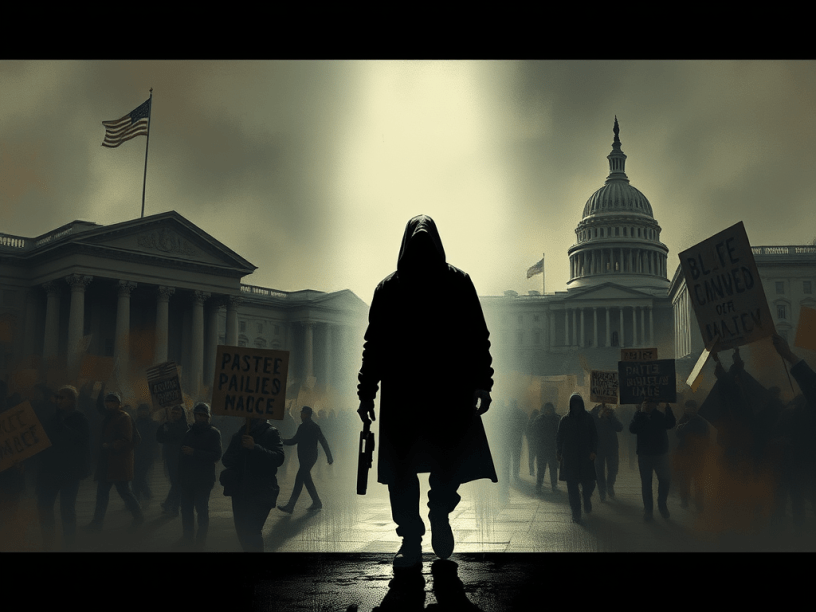
Pam Bondi’s Domestic War on Dissent (and Your Nonprofit Newsletter)
The Trump administration has finally solved the problem of defining “domestic terrorism”: it means whoever they were mad at this week.
With National Security Presidential Memorandum-7, Trump created a new domestic-terror framework that lumps together assassination attempts against him, attacks on federal buildings, clashes around ICE facilities, and a broad, amorphous category of “anti-fascist extremism.” In the hands of Attorney General Pam Bondi, that memo has turned into something more concrete: a blueprint for treating whole categories of political belief as a national security threat.
Not violent plots. Not bombings. Belief.
Opposition to ICE. Radical gender politics. “Anti-capitalism.” “Anti-Americanism.” Skepticism about “traditional views on family, religion, and morality.” In Bondi’s directive implementing NSPM-7, these aren’t just opinions. They’re listed as indicators of possible domestic terrorism, side by side with talk of weapons, training, and attacks on “critical infrastructure.”
The underlying message is simple: if you are too far left of Fox News on immigration, gender, or the economy, the government reserves the right to put you in the same investigative bucket as someone wiring a bomb.
From “Terrorism” to “Wrong Politics”
The original NSPM-7 is already a political document pretending to be a security policy.
It starts with real events: assassination attempts against Trump, shootings targeting law enforcement, and a genuine problem of political violence. Then it pivots into ideology, arguing that the central domestic threat comes from a loose world of “anti-fascist” actors—Antifa and anyone near them—and folding virtually any resistance to federal immigration enforcement into that narrative.
The distinction between what people do and what people believe gets blurred on purpose. The memo doesn’t just call for investigating crimes; it calls for mapping out networks based on “shared ideology,” “anti-fascist platforms,” and “hostility to American institutions.”
That’s where Bondi comes in.
Her directive to the FBI, U.S. Attorneys, and Joint Terrorism Task Forces takes the most elastic parts of NSPM-7 and operationalizes them. Federal agents are told to prioritize “Antifa and similar groups,” and to compile a formal list of “domestic terrorist organizations” that fit an ideological profile: anti-law-enforcement, pro-mass-migration, anti-capitalist, “anti-Christian,” “radical gender ideology,” and so on.
You don’t need to plan an attack to end up in that orbit. You just need to organize around the wrong set of ideas.
On paper, the targets are people who “advocate violence” or “provide material support” for attacks. In the body of the directive, the definition sprawls. A group that organizes protests outside detention centers, argues publicly for a world without immigration prisons, and raises money to bail out arrested demonstrators suddenly has several boxes checked: opposition to immigration enforcement, support for mass migration, hostility to traditional norms.
Once those boxes exist, they will be filled.
Turning the Security State Inward
Civil liberties groups saw the risk immediately: NSPM-7 and Bondi’s directive aren’t just about street clashes. They invite the machinery of counterterrorism to move fully into domestic political policing.
For two decades, “terrorism” has been a magic word in U.S. law. Invoke it and you get enhanced surveillance tools, looser standards for watchlists, broader information sharing, harsher penalties, and fewer questions from judges. Those powers were built for foreign threats—Al-Qaeda, ISIS, transnational networks—and justified by images of mass casualty attacks.
Bondi’s move is to treat that whole tool set as available inside the United States for anyone whose politics match a certain profile. The line between an immigration-rights organization and a “terror-adjacent network” becomes a matter of interpretation.
Her memo pushes agencies to:
- Feed regular reports up the chain on groups and individuals who fit the ideological criteria.
- Look for tax and financial charges against organizations with “extremist indicators,” with an eye toward revoking nonprofit status.
- Expand “domestic terror” case classifications to include property damage and infrastructure disruption linked to those movements.
The result is a map, not just of threats, but of political enemies.
You don’t need explicit instructions to “spy on climate activists” or “target sanctuary churches” when the criteria already tell you what to look for: anti-fossil-fuel direct actions that block pipelines; congregations that publicly shelter undocumented people; mutual-aid groups that support migrants or protest ICE raids. Once the system is built, all of them fit.
And they fit under a label that is designed to terrify juries and chill support: domestic terrorism.
Selective Blindness
It’s worth noticing what doesn’t get the same treatment.
For years, the government’s own data has shown that the bulk of deadly political violence in the U.S. comes from the far right: white supremacists, neo-Nazis, militia types. That continues to be true. None of that violence disappears under NSPM-7 or Bondi’s memo. But it is no longer central to the story.
Instead, the narrative is reoriented around “left-wing extremism”: Antifa, abolitionists, anti-capitalists, anti-ICE networks. The Trump White House and Bondi’s Justice Department talk about these movements not as one threat among many, but as the primary source of “organized political violence.”
The practical effect is to pull investigative resources toward one side of the spectrum and away from the other. When you tell field offices that “anti-fascist networks” are a top priority and that opposing immigration enforcement is itself a suspicious marker, you are telling them where to look—and where not to look.
You also send a message to the public: a protest against an oil pipeline or a blockade outside an ICE field office is no longer just a demonstration, even if it’s nonviolent. It’s a potential terrorist incident in the making.
That’s the point. The label does the political work before any case is filed.
The Nonprofit Trap
One of the least flashy but most dangerous parts of Bondi’s plan is the focus on tax law and nonprofit status.
Classic COINTELPRO tactics—illegal wiretaps, break-ins, planted informants—were designed to disrupt movements directly. The updated version adds a financial lever: if you can’t arrest an organization outright, you can bankrupt it.
By tying “extremist indicators” to tax enforcement, Bondi is effectively telling the IRS and Justice Department to treat certain political nonprofits as suspect by default. If a 501(c)(3) immigrant-rights group protests ICE, runs know-your-rights trainings, and uses language about “abolishing detention,” it now sits in the overlap between “legally protected advocacy” and “ideological support for domestic terrorism” in the Bondi framework.
It doesn’t mean every such group will be indicted. It does mean they can expect audits, investigations, and the constant threat that one bad interpretation of their rhetoric or donors could cost them their legal status and funding.
That pressure doesn’t have to result in prosecutions to be effective. Most organizations don’t have the resources to fight the federal government in court. A credible threat is enough: change your language, scale down your activity, avoid certain alliances, or risk being labeled a terror front.
The punishment is built into the process.
Expanding the Battlefield
The rhetoric around all this is framed in terms of “defending federal facilities” and “protecting law enforcement.” ICE offices, courthouses, police stations—these are now treated as potential front lines in a domestic war, with Bondi positioning her department as the shield against “violent extremists.”
Once federal buildings and contractors are cast as war-zone infrastructure, it becomes easier to justify extraordinary measures in their vicinity. Protest outside an ICE detention center can be packaged as “threatening critical infrastructure.” Block a road used by Border Patrol buses and you’re flirting with the same national-security language that used to be reserved for attacks on power plants and airports.
All of this is happening at the same time the administration is expanding military-style operations elsewhere: National Defense Areas along the border, naval campaigns in the Caribbean, increasingly aggressive use of federal forces around immigration facilities. The logic is consistent: where the government defines a threat, it also reserves the right to redefine the legal terrain.
NSPM-7 and Bondi’s directive extend that logic to the interior of the country. The “battlefield” is no longer just the border or foreign war zones; it’s anywhere a movement challenges the state’s coercive machinery too effectively.
What This Actually Does
Strip away the slogans and Bondi’s domestic-terror regime does three concrete things:
- Normalizes the idea that ideology, not conduct, triggers counterterrorism tools.
You no longer need specific evidence of a plot to call in the national security state; you just need a cluster of beliefs that political leadership dislikes. - Builds a durable apparatus for mapping and monitoring left-leaning civil society.
Nonprofits, mutual-aid networks, student groups, unions, church coalitions—anyone working in contested space around immigration, policing, or capitalism can be swept into a permanent gray zone of “terror-adjacent actors.” - Shifts the Overton window on repression.
Once it becomes normal to discuss “anti-capitalism” or “radical gender ideology” in the same breath as terrorism, the bar for criminalizing those positions drops. What starts as a memo becomes, over time, a commonsense assumption: some ideas themselves are security threats.
This is how liberties erode in a “democratic” system. Not usually with a single law that bans opposition parties, but with a slow expansion of categories: more people counted as extremists, more groups reclassified as risks, more surveillance justified, more police powers handed to agencies whose budgets depend on finding threats.
Why It Matters
There will be people who say this doesn’t matter, because they don’t like Antifa, or they don’t care what happens to people who chain themselves to fences outside ICE detention centers. There will be liberals who tell themselves this is a Trump-era aberration that will disappear when he does. There will be centrists who mutter that “both sides” need to calm down and that perhaps a little extra scrutiny on the “far left” isn’t such a bad thing.
They are missing the point.
A domestic-terror framework built on ideology is not a scalpel. It is a net. Once it exists, it can be widened, tightened, and thrown in new directions with minimal political effort. Today’s “extremist indicator” is opposition to immigration enforcement; tomorrow’s is a general strike, a debt boycott, or a mass refusal to serve in an unjust war.
Pam Bondi will not hold this office forever. The apparatus she is building—the lists, the criteria, the data pipelines, the habit of seeing domestic politics through a counterterror lens—will outlive her. It will be available to the next administration, and the next one, with new enemies to slot into the same framework.
“Everyone’s a terrorist now” is not just a punchline. It’s a warning label.
Once you accept that the government can classify movements by belief and then aim national-security weapons at them, the line between dissent and crime is no longer fixed. It moves every time a president signs a memo, every time an attorney general issues a directive.
And sooner or later, it moves to you.
 The American Beast