
Bulgaria’s 8th Election and the Oligarch Who Wouldn’t Leave
On the official scorecard, Bulgaria looks like a success story.
The European Union (EU) has ticked all the boxes: inflation is tamed, the budget deficit is within the Maastricht limits, and the exchange rate is locked in. The European Commission has signed off, the European Central Bank (ECB) has signed off, and finance ministers are already practicing how to say “welcome to the euro area” in Bulgarian. On January 1, 2026, the lev is supposed to vanish and the euro coins with the little lion are supposed to slide smoothly into vending machines across Sofia.
At the same time, on the ground, the country looks like it’s coming apart at the seams. Tens of thousands of people have been in the streets protesting corruption and a hated budget. The prime minister has resigned. Parliament has collapsed again. Bulgaria is heading into its eighth national election since 2021, because nobody can keep a government standing long enough for voters to remember who was in charge. An oligarch under U.S. and U.K. sanctions is still the most reliable power broker in the room.
On paper, Bulgaria is “converging” with the eurozone. In reality, it’s converging on a different model: a state where the numbers impress Brussels, the institutions serve the same small circle of players, and the public keeps being asked to pick a new cast for the same rigged show.
Eight Elections and a Funeral
Prime Minister Rosen Zhelyazkov’s government lasted just long enough to be blamed for everything.
He took office in January, promised to shepherd Bulgaria into the euro on January 1, 2026, and then managed to unite the country in the only way modern politicians can: by proposing a budget so hated it triggered a nationwide allergic reaction.
The 2026 budget plan jacked up taxes and social security contributions to fund higher spending, including defense, while inflation was already gnawing through people’s paychecks. Protesters looked at the numbers and saw exactly what you’d expect in Europe’s poorest EU member: they were paying for the party, while the same old networks feasted.
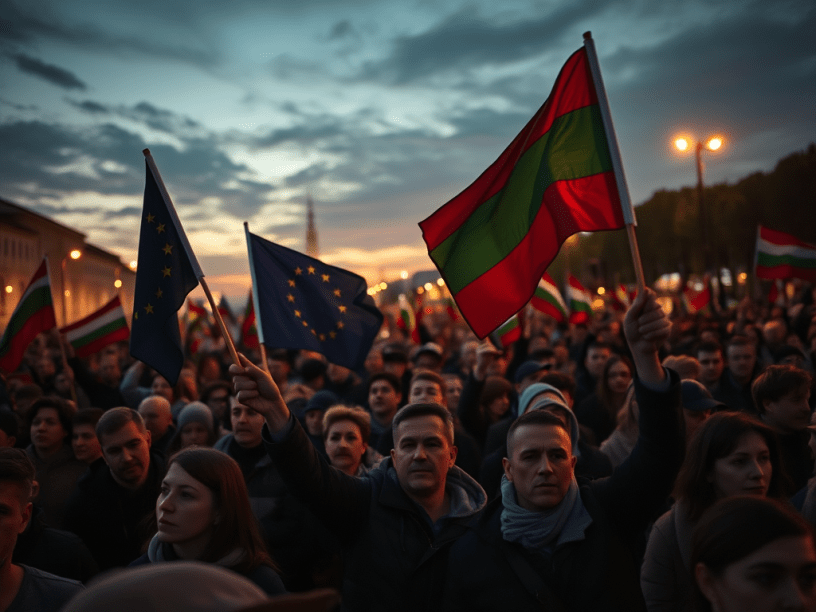
So they hit the streets. Sofia, Plovdiv, Varna—tens of thousands of people waving Bulgarian and EU flags, chanting against “mafia rule,” blocking intersections, and demanding two things:
- Kill the budget.
- Kill the government that thought this was a good idea.
They got both. On December 2, the cabinet yanked the budget. Ten days later, with a no-confidence vote looming and the protests getting bigger instead of smaller, Zhelyazkov went on TV and quit.
Now President Rumen Radev is doing the same thing he’s done after every other political pileup: calling party leaders to his office, pretending they might form a coalition, and preparing yet another caretaker government when they don’t.
This will be Bulgaria’s eighth election in four years. It’s less a political system than a repeat customer punch card.
The Man Behind the Curtain (and the Sanctions)
If you want to understand why people are this angry, look for the man whose name is on every protest sign: Delyan Peevski.
Officially, Peevski is the leader of the Movement for Rights and Freedoms (MRF) – “New Beginning” and an MP from Blagoevgrad. Unofficially, he’s the guy everyone in Bulgaria talks about like urban legend: the oligarch who owns half the country, the media mogul who ran newspapers and TV, the power broker who never leaves the room even when he’s not in the government.
The U.S. Treasury sanctioned him under the Global Magnitsky Act in 2021 for corruption, bribery, influence peddling—the full deluxe menu. The U.K. followed with its own sanctions. Reporters Without Borders has described him as a one-man press-capture industry.
Bulgaria did not respond by sending him into exile. It responded by making him more central than ever.
Peevski is now party leader, head of a formation whose votes in parliament quietly keep governments alive. His MRF–New Beginning outfit wasn’t formally in Zhelyazkov’s coalition, but backed it from the outside—just enough to get its fingerprints on everything and responsibility for nothing.
So when the budget protests exploded, Peevski became the logical target. The demonstrations weren’t just against higher taxes or euro anxiety; they were explicitly against state capture—the sense that no matter who the prime minister is, Bulgaria is run by a permanent deep state of businessmen, prosecutors, and Peevskis.
An NGO write-up of the “Winter Protests of 2025” puts it bluntly: Bulgaria’s maladies are “mainly personified” by Peevski, the oligarch whose party “supports the cabinet” while staying technically outside it.
He is the constant in a political equation that otherwise changes every six months.
Brussels’ Favorite Failing State
From the EU’s perspective, this is all very awkward.
On one hand, Brussels has spent years wagging its finger at Bulgaria over corruption, judicial independence, and media freedom. The country consistently ranks at or near the bottom of EU corruption indices and rule-of-law scorecards.
On the other hand, every important European institution just signed off on letting that same country into the eurozone. The European Commission and ECB said the convergence criteria are fulfilled; the Eurogroup and Ecofin gave their unanimous thumbs up; the European Parliament voted 531–69 to welcome Bulgaria as the 21st member of the euro area.
Inflation? Tamed just enough at 2.7%. Budget deficit? Exactly 3.0% of GDP in 2024—like someone studied the rules and decided to hit them with a ruler. Debt? A saintly 24% of GDP. Currency alignment? The lev has been surgically glued to the euro since the late ‘90s.
If you’re a technocrat, this is heaven. Who cares if half the political class is under some kind of investigation; the numbers are in line.
But the optics are brutal. Bulgaria is marching into the eurozone under the shadow of:
- A collapsed government.
- No adopted budget for the coming year.
- Mass protests over graft and vote-falsification.
- An oligarch, sanctioned by the very West that’s blessing its euro entry, acting as kingmaker in parliament.
If the EU was trying to shred its own credibility on rule-of-law conditionality, it couldn’t script this better.
You don’t need to be a eurosceptic to see the contradiction. Bulgaria is told that its courts and prosecutors are too politicized, its media too captured, its elites too corrupt. Then those same institutions are told: here, have the euro, access to the ECB, and a bigger role in Europe’s financial system. We trust you.
It’s like handing the keys to the family car to the cousin who just scored a DWI on his scooter.
Vote-Buying as a Service
The protests aren’t just about budgets and Peevski. They’re also about the same old election rot that never seems to go away.
By the time people hit the streets in December, they were already warming up for yet another snap vote. Protesters weren’t just complaining about corruption in the abstract; they were accusing parties of buying votes, manipulating counts, and falsifying results in the last seven elections.
Bulgaria’s political parties have turned early elections into a kind of subscription model. Every few months, citizens are invited to choose which unstable coalition will disappoint them next, while local vote-brokers roam poor neighborhoods handing out cash, food, or firewood in exchange for IDs and signatures. Ballot secrecy becomes a theory; business-as-usual becomes farce.
You’d think that after seven rounds of this, the system might produce something approximating a consensus. Instead it produces cabinets like Zhelyazkov’s: fragile, stitched together, and dependent on Peevski’s bloc—or on nationalist parties that think the real threat to Bulgaria isn’t corruption but the euro itself, which they claim will destroy the country through price hikes and Brussels mind control.
The far-right Revival (Vazrazhdane) party is already trying to capitalize, calling for delays to euro adoption and staging protests that occasionally veer into trying to storm EU offices in Sofia.
So the menu Bulgarians get in their eighth election will likely look familiar:
- The old center-right that couldn’t push a budget without detonating.
- The “new” anti-corruption parties that keep failing to govern together.
- The Peevski machine.
- The pro-Russian, anti-euro right that answers every question with “NATO bad.”
All of this under the approving gaze of Europe’s finance ministers, who are mostly interested in whether the conversion tables for ATMs are ready by New Year’s.
Euro Adoption as Reality TV
The really bleak joke is that joining the euro might actually be the least dramatic thing happening.
Economically, Bulgaria has been halfway in for years. The lev is already pegged; euro prices are already printed on restaurant menus; big contracts and mortgages mentally translate everything into euros anyway. The transition is less “jumping into the unknown” than doing a software update you’ve postponed too long.
That’s one reason why the euro anxiety is less about the currency itself and more about who gets to profit off the chaos.
When Croatia joined the euro in 2023, prices for basic goods mysteriously crept up as businesses “rounded” in one direction only. Bulgarians have watched that movie. They see a political class that treats rules as suggestions and assume—reasonably—that the conversion will be another chance for the connected to skim, jack prices, and “manage” the changeover in ways that land them a new villa.
The euro is supposed to symbolize permanence and order. In Bulgaria, it’s arriving in the middle of a rolling brawl over whether the country is even governable.
On January 1, 2026, the lev will disappear. There may be no regular government in place, no budget, and another election coming. Somewhere in Sofia, a caretaker cabinet minister will cut a ribbon and announce that Bulgaria has finally “completed its European journey,” while outside, students are still chanting that the state has been hijacked by crooks.
Brussels will tweet congratulations. Credit-rating agencies will nod approvingly. Delyan Peevski will still have a reserved parking spot at parliament.
Eurotrash, or Something Better?
None of this is uniquely Bulgarian. It’s just a brutally concentrated version of the modern European story:
- Do the homework on the macro indicators.
- Stall on the things that actually affect everyday life—courts, prosecutors, media capture, vote-buying.
- Hope that euro membership, NATO, and a few rotating coalitions will magically produce a functioning democracy.
In Bulgaria, that formula has produced what you’d expect: a country structurally tied to the West, formally compliant with EU rules, and informally ruled by a network of politicians and businessmen that everyone knows by name and nobody can get rid of.
The people in the streets aren’t rioting against the euro. They’re rioting against the idea that nothing underneath changes—that the same characters will still be there after the coins change, the same prosecutors will ignore the same cases, the same oligarchs will attend the same ribbon-cuttings, and the only thing that really evolves is the logo on the banknotes.
You can call that Eurotrash Democracy if you want: the imported institutions, the local rot, the endless snap elections that never snap anything except public patience.
Or you can see it as a stress test—for the EU as much as for Bulgaria. If Europe keeps treating rule-of-law problems as background noise as long as the convergence criteria check out, it’s going to keep importing instability into the core of its own system. The euro is not a magic sealant; it’s a magnifying glass.
On January 1, the lev will die and the euro will be born in Bulgaria. The question isn’t whether the new coins will work in vending machines. They will.
The question is whether the country that uses them will still belong to its citizens—or to the same small, sanctioned club that’s already survived seven elections, a revolution in everything but name, and now gets to pose for the cameras as the newest face of Europe’s “success.”
 The American Beast