
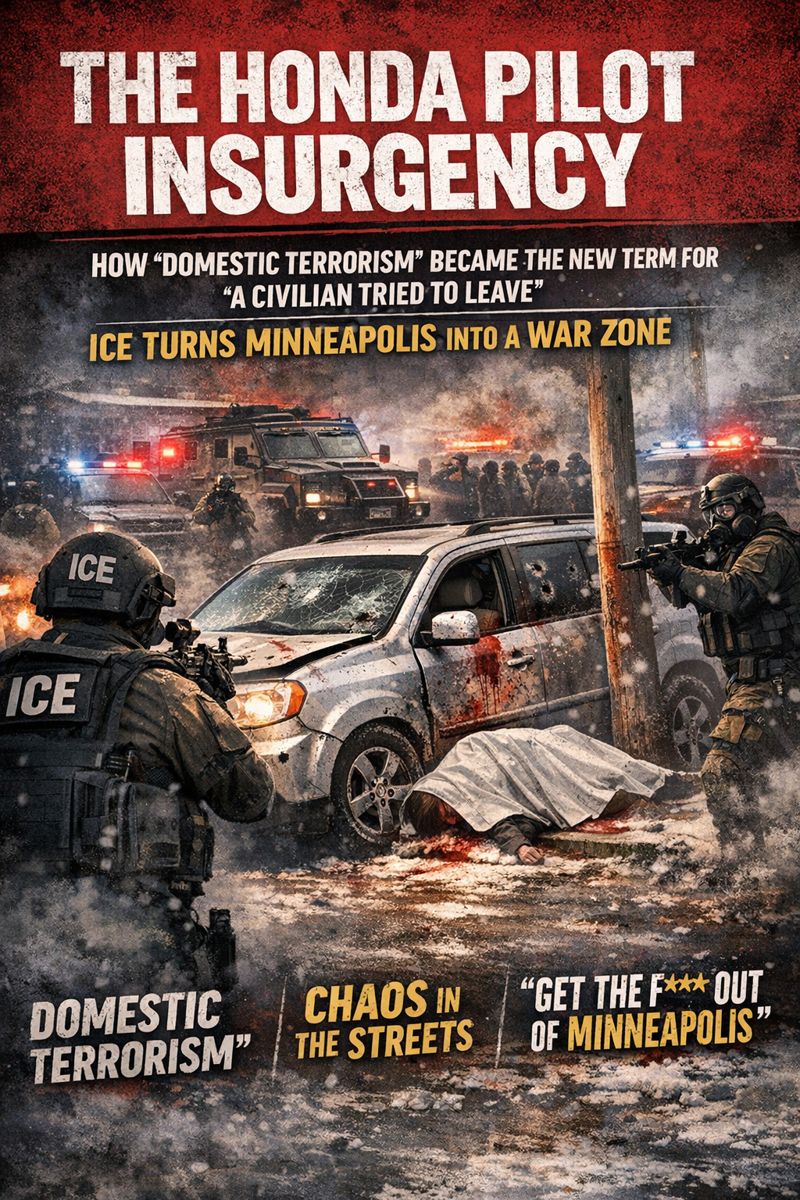
The day “domestic terrorism” became the new term for “a civilian tried to leave.”
On Wednesday, January 7, 2026, in a snowy patch of South Minneapolis near East 34th Street and Portland Avenue, an officer with ICE (U.S. Immigration and Customs Enforcement, under the DHS—Department of Homeland Security) shot and killed Renee Nicole Good, 37, as she sat behind the wheel of an SUV.
That’s the plain fact. Everything else is the fight over who gets to narrate the tape.
Because within hours, DHS and the White House were selling a familiar story: heroic federal agents, besieged by “rioters,” forced into “self-defense,” staring down a rolling four-wheeled weapon in what DHS messaging explicitly framed as an “act of domestic terrorism.”
Minneapolis officials—people who actually have to live in the city after the feds pack up the props truck—watched video of the incident and responded with the rarest thing in modern politics: a public official describing federal spin in language normal humans use.
Mayor Jacob Frey called the administration’s version “garbage,” said the video contradicted it, and delivered the kind of municipal poetry you can’t workshop in a comms meeting: ICE, “Get the fuck out of Minneapolis.”
And that right there is the whole American moment in miniature: one side yelling “DOMESTIC TERRORISM” like it’s a cheat code that unlocks immunity; the other side yelling “BULLSHIT” because they’ve seen what happens when you let federal agencies run a reality show in your streets.
The five seconds America is now arguing about
According to accounts summarized by Reuters and local reporting, videos posted online show a chaotic, fast interaction: agents approach the SUV; one agent is near the front of the vehicle; the SUV moves forward as if trying to leave; shots are fired; the vehicle drives off and crashes into parked cars and a utility pole.
DHS’s public line is that the driver tried to run over officers—violent act, terrorist framing, the whole post-9/11 cinematic universe—while the mayor and other local officials say the video doesn’t support that story.
This is where America’s brain breaks, because we’ve built a system where the label is the verdict. If DHS calls it “domestic terrorism,” you’re supposed to stop asking questions, as though words are magical police tape. But Minneapolis—scarred, famously, by a prior video the country couldn’t unsee—didn’t accept “trust us, bro” as an investigative standard.
The city’s own timeline says Minneapolis police responded just after 9:30 a.m., the victim was taken to Hennepin County Medical Center, and later died.
Meanwhile, the scene turned into what these scenes always turn into: crowds, shouting, anger, federal agents looking like they’re auditioning for a cable thriller, and “chemical irritants” deployed on the public like a can of “please disperse, peasant.”
“Largest operation ever,” brought to you by the Department of Escalation
This shooting didn’t drop out of a clear blue sky. It landed in the middle of a major federal enforcement surge in Minnesota that DHS has boasted about—thousands of officers, “largest operation,” dramatic language about going after the worst of the worst.
That’s the official vibe: We’re here for murderers and gang members and monsters.
The lived reality looks more like: an unarmed U.S. citizen who local officials say was not the target of enforcementends up dead in her car, and the public gets tear-gassed for showing up mad about it.
America has created a traveling federal roadshow that rolls into town announcing “SAFETY,” immediately increases the odds somebody dies, then blames the locals for not clapping hard enough.
Even Minnesota’s governor, Tim Walz, framed it as governance designed for “fear, headlines and conflict”—the state version of it’s not policy, it’s content. He also said he was preparing the National Guard amid the fury.
So now we’re here: the feds say “domestic terrorism,” the city says “get out,” the governor says “we might need the Guard,” and everyone else is supposed to pretend this is what normal public safety looks like.
The “car as weapon” loophole: America’s favorite self-defense bedtime story
There’s a grim little pattern in U.S. law enforcement controversies: the vehicle becomes the magic object that turns lethal force into paperwork.
Say the car moved toward an officer. Say it “came close.” Say it “lunged.” Congratulations—your agency just unlocked the Self-Defense DLC.
Reuters notes DHS messaging claiming officers were injured and the agent “saved multiple lives,” while video described by Reuters raised doubts about whether the officer was struck and shows at least one shot fired after the bumper had already passed him.
That doesn’t automatically mean the shooting was unlawful. It means the public is not crazy for demanding an investigation that isn’t run like a press release.
And that’s the real scandal: not that people disagree, but that we’ve normalized federal agencies grading their own homework while calling dissent “radical” and “violent” and, increasingly, “terrorism.”
Minneapolis has seen this movie before—and it knows what the ending costs
There’s a reason this landed like a bomb in Minneapolis specifically. The city is one of the places where video evidence previously collided with official narrative and the narrative lost. You don’t get to stroll into that civic memory with a fresh “trust us” monologue and expect applause.
CBS notes the scene was just blocks from where George Floyd was murdered in 2020—another moment where “what happened” and “what officials said happened” were not the same thing.
So when the mayor watches the video and says the federal story is “bullshit,” it’s not just rhetoric. It’s Minneapolis signaling it refuses to be gaslit by the same playbook, even if the uniform has different letters.
Thoughts, Prayers, Etc.
The shooting is being investigated by the FBI and Minnesota’s BCA (Bureau of Criminal Apprehension), according to local reporting and city officials.
Good. But “investigated” is one of those words Americans have learned to treat like “thoughts and prayers”: it sounds nice, it doesn’t guarantee anything.
And look—people can debate immigration enforcement policy all day. But if your enforcement strategy requires armored vibes, gas masks, irritants, and a PR vocabulary stolen from counterterrorism to justify killing someone in a residential neighborhood, you’re not “restoring order.” You’re manufacturing disorder and calling it security.
That’s the angle here. Not left versus right. Not “open borders” versus “law and order.” It’s the older American fight: Does the state get to declare reality, or do people get to look at what happened and say what they saw?
Because when the government’s first instinct after a death is to slap a terrorism label on the dead person—before the snow on the street has finished absorbing the blood—you’re not watching justice.
You’re watching branding.
And branding, as Minneapolis just reminded DHS in the only language that seems to cut through, doesn’t get to occupy a city.
 The American Beast