
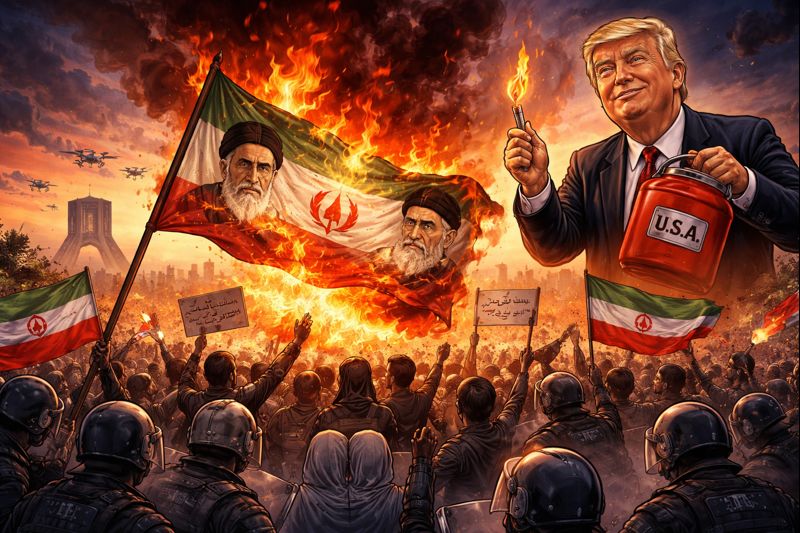
If you want to understand what’s happening in Iran right now, picture a crowded theater where the audience has been trapped inside for years. The exits are chained. The ushers are armed. The sprinklers don’t work. The popcorn costs a week’s salary. And the management keeps announcing over the intercom that everything is fine, the show is going great, and any screaming you hear is “foreign interference.”
This isn’t some tidy “pro-democracy moment” you can package for MSNBC like it’s the next color revolution infomercial. Iran is in full metabolic collapse. The economy isn’t broken—it’s been deliberately rigged into a sadistic game show where the prizes go to the Revolutionary Guard’s cousins and everyone else gets to compete in “How Long Can You Eat Dirt Before You Snap?” Sanctions? Sure, America’s economic warfare is the sledgehammer, but the regime’s the one swinging it at its own people’s knees. Corruption isn’t a bug here; it’s the operating system.
The newest wave of unrest didn’t start with ideology. It started with the most revolutionary thought in human history: I’m broke and I’m furious.
That’s how it usually begins. People don’t pour into the streets because they read a 40-page policy paper about democratic reforms. They pour into the streets because they can’t afford food, rent, medicine, or a future, and because they’ve watched the people in charge treat the country like a private bank account guarded by secret police.
Of course the protests go economic to existential in about five minutes flat. Because everyone knows the misery isn’t bad luck—it’s policy. It’s a system engineered to reward bootlickers and punish anyone with a spine. So the rage metastasizes: markets to campuses, back alleys to boulevards, chants about prices turning into howls against the whole rotting edifice of clerical fascism. And the regime? They do what scared authoritarians always do when the mask slips: yank the violence lever until it breaks off in their hand.
Arrests by the thousands, beatings on livestream, live ammo into crowds, blackouts that turn the country into a giant Faraday cage. It’s not strength—it’s panic. These mullahs aren’t cracking down because they’re invincible; they’re cracking down because one good gust of wind and the whole house of cards collapses. Every corpse they make becomes a martyr, every funeral becomes a flash mob, every flash mob becomes another excuse to shoot more people. It’s a death spiral greased with grief and tear gas.
And the economic rot? Sanctions hit like a blunt instrument dropped from orbit—everybody bleeds, but the people at the top just buy more bandages on the black market while the rest starve. Inflation doesn’t just jack up prices; it annihilates hope. It turns “planning for the future” into a sick joke. You do the math every morning: Can I feed my family today, or do I gamble on tomorrow? That kind of pressure cooks rage until it blows.
THE GOVERNMENT’S MESSAGE: “SHUT UP OR BLEED”
Here’s a grim truth the world keeps re-learning like it’s a class we keep failing: regimes don’t crack down because they’re strong. They crack down because they’re scared.
Iran’s leadership is terrified of crowds, terrified of visibility, terrified of momentum. They know that protests are contagious. They know that if people realize they’re not alone—if they see streets full of other angry, starving, fed-up citizens—the psychological wall collapses. The spell breaks.
So the state does what it always does: it tries to make public protest physically expensive.
Arrests. Beatings. Gunfire. Internet disruptions. Intimidation. The whole familiar menu of repression, served with the smug confidence of a government that believes history ends when you control the television station and the prison system.
And the sick little twist is that the crackdown becomes part of the story. Every death creates a funeral. Every funeral creates another protest. Every protest becomes an excuse for another crackdown. It’s a feedback loop made out of grief and rage.
A lot of governments fear “instability,” like it’s a weather pattern that might drift in. Iran’s ruling class doesn’t fear instability. They fear the one form of instability that actually matters: the kind that ends with them being dragged out of their offices.
So they hit harder. They blame foreigners. They call protestors “terrorists.” They insist everything is being orchestrated by outside powers. That’s not just propaganda—it’s psychological self-defense. Because admitting the truth (“we did this to our own people”) is unbearable.
THE REAL FUEL: A BROKEN ECONOMY AND A RIGGED COUNTRY
People in the West hear “Iranian sanctions” and imagine a clean, simple moral story: pressure a bad regime, reduce its resources, force it to behave. In reality, sanctions don’t work like a moral laser beam. They work like a hammer dropped from a roof.
They hit everyone.
And in a system like Iran’s, where corruption is institutional and power is vertically stacked, the people who suffer first aren’t the top brass. The people who suffer first are the people who already had nothing. The “ordinary” citizens—the ones who are told to sacrifice for the nation while they watch the elites cruise around untouched.
The economic misery inside Iran isn’t just about external pressure. It’s about internal rot. It’s the familiar authoritarian economy: monopolies, patronage networks, black markets, insiders siphoning resources, and the rest of the country stuck with the bill.
Inflation doesn’t just make things expensive. Inflation destroys trust. It dissolves the idea that tomorrow is real. It turns normal life into constant panic math: “If I don’t buy it today, I can’t buy it next week.”
That kind of stress builds up like a gas leak. Eventually someone flips a switch.
AMERICA’S ROLE: MORAL POSTURING WITH A SIDE OF CHAOS
Into this mess wanders the United States, which has a long and noble tradition of showing up to complicated countries like a guy arriving late to a fistfight, already yelling, holding something heavy, and insisting he’s here to restore order.
Washington is doing what Washington always does: publicly rooting for “freedom,” privately weighing power calculations, and occasionally tossing out statements that sound like they were written by a motivational speaker trapped inside a missile silo.
There’s been plenty of talk about “help,” about standing with protestors, about the Iranian people deserving better. Which is true—obviously. They do.
But the U.S. also has a habit of treating foreign uprisings like a TV show: “Season 5 is heating up! Who will be the breakout hero? What twist will happen next episode?” It’s easy to post slogans from thousands of miles away. It’s harder to deal with the consequences.
And there’s a deeper cynicism here that people in Iran understand better than Americans do: U.S. concern for human rights tends to fluctuate depending on whether the country in question is cooperating with American interests.
Freedom is a principle—unless it’s inconvenient.
THE BIG HAMMER: ECONOMIC WARFARE DRESSED UP AS STRATEGY
The latest tool the U.S. is swinging is economic pressure—tariffs and threats aimed not just at Iran, but at anyone doing business with Iran. That’s the move: don’t just isolate Tehran; punish the rest of the planet for touching it. Make Iran radioactive.
This is the kind of policy that gets pitched in Washington as “maximum pressure,” which is a phrase that makes it sound like a gym routine. In practice, it’s a gamble that the world will choose American markets over Iranian oil and trade, and that Iran will buckle instead of retaliating.
Sometimes, pressure works.
Sometimes, pressure produces black markets, hardliners, desperation, and violence.
You don’t “squeeze” a country into calm. You squeeze it into something else.
THE NUCLEAR SHADOW: THE REASON THIS NEVER STAYS LOCAL
And now we reach the part of the story where every Iran crisis turns from “internal revolt” into “global panic.”
Because Iran isn’t just a country with protests.
Iran is a country with protests and a nuclear program and enemies who would love an excuse to hit it.
This is why the Iranian regime doesn’t just fear protestors. It fears looking weak in a region where weakness invites attack. That’s the horrible incentive structure: the more unstable Iran gets internally, the more it needs to project strength externally, and the more it projects strength externally, the more likely somebody decides to test it.
So even if protestors are demanding economic relief and political reform, the state is thinking about deterrence, the Revolutionary Guard, air defenses, proxy forces, regional chess moves—because that’s what paranoid states do. They treat their own population like a threat and their neighbors like sharks.
Iran right now is what you get when a theocracy demands endless sacrifice while offering zero future in return. A young, wired, furious population staring down a gerontocracy that’s lost the plot but still has the guns and the oil money. A U.S. foreign policy blob that mistakes strangling economies for strategy. A region full of sharks circling blood in the water.
Meanwhile, everyone else is watching for signs that the whole thing might tip into an international confrontation—whether that’s covert sabotage, retaliation strikes, shipping disruptions, or a direct military exchange.
The Middle East doesn’t do “contained.”
And the reason the rest of the world can’t look away is that Iran’s internal collapse doesn’t stay internal. It radiates outward, into oil prices, into regional war calculations, into proxy conflicts, into the nuclear question, into American politics, into everything.
That’s the nightmare. Not that Iran blows up—but that when it does, the rest of us get the bill.
 The American Beast