
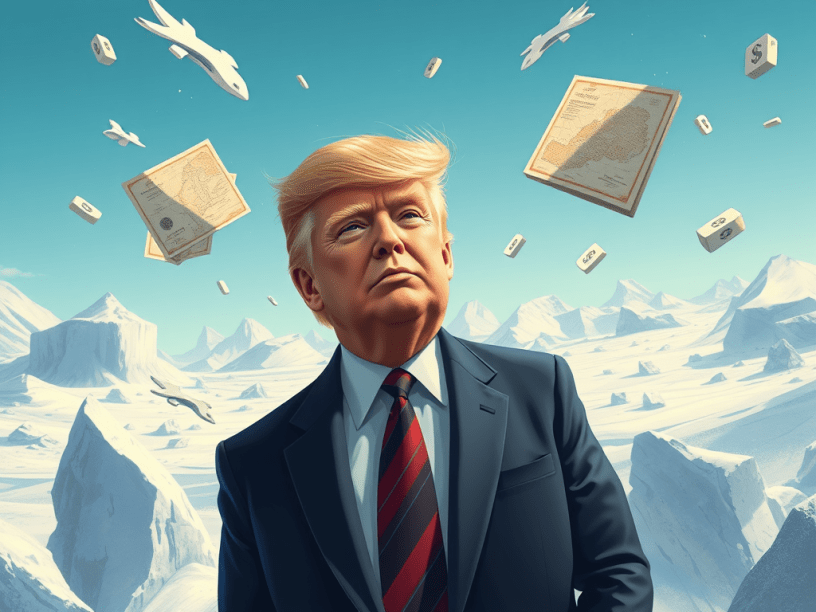
There are certain things that should never be purchased on a whim: a timeshare, a boat, a monkey, and an island the size of Western Europe covered in ice, geopolitics, and people who did not ask to be adopted by a U.S. president with the attention span of a golden retriever in a fireworks factory.
And yet—here we are again.
At the World Economic Forum in Davos on January 21, 2026, President Donald Trump did what he does best: walked into a room full of global elites and treated the planet like a Monopoly board where he’s already palming the dice. He pushed—publicly—for the United States to acquire Greenland, describing it as “our territory,” and announced he wants immediate negotiations to purchase it.
That’s right. Immediate negotiations. Like he’s trying to buy a used Jet Ski off Facebook Marketplace before the seller “has other interested buyers.”
Now, to his credit, he also said he wouldn’t use military force to get it. Which is reassuring in the same way it’s reassuring when someone tells you, unprompted, that they probably won’t set your house on fire.
So what is this whole Greenland thing?
It’s the same pitch as before, just louder, shinier, and delivered from a Swiss mountaintop like he’s Moses descending with the Ten Commandments of Real Estate Expansionism: Thou shalt annex the cold rectangle.
Greenland is the world’s largest island that isn’t Australia, and it’s technically part of the Kingdom of Denmark—an arrangement that Greenland itself has been gradually reevaluating for years, because everyone likes to fantasize about independence until some other country starts shopping for you like you’re a vacation home. Greenland’s politics have been swirling around independence debates, and in 2025 it held a major parliamentary election where the “gradual independence” crowd did well—partly because the island’s citizens do not wake up every day dreaming of being rebranded as North Dakota: Arctic Edition.
Denmark’s position remains: Greenland isn’t a spare lawnmower someone forgot in the garage. It’s not for sale. It’s for Greenlanders to decide. Which is a pretty normal stance for a country dealing with an ally who just discovered colonialism is back, like it’s a fashion trend revived by TikTok.
But Trump’s brain is not wired for “international norms.” His brain is wired for ownership. Possession. Dominance. The mental comfort of being able to slap your name on something big enough to be seen from space.
And Greenland is big. It’s also positioned in the Arctic, which has become one of those cheerful new global hot zones where everyone smiles politely while sharpening knives behind their backs.
The serious people will tell you it’s about strategy. Pituffik Space Base (née Thule) sits up there like a giant middle finger to incoming missiles—radar, early warning, space tracking, the whole acronym soup the military uses because sentences are too hard. It’s also part of the broader architecture of North American defense coordination, including NORAD (North American Aerospace Defense Command), which has been running exercises involving U.S. and Canadian aircraft in Greenland recently because nothing says “calm, normal times” like warplanes practicing near the top of the world.
So yes: Greenland is strategically important.
But here’s the problem. There’s a difference between strategic cooperation and treating your ally’s territory like a clearance rack item at Target.
Trump’s pitch in Davos wasn’t “let’s strengthen NATO’s Arctic posture and deepen our defense partnership with Denmark and Greenland.” It was “this is ours.”
That’s not diplomacy. That’s the verbal equivalent of licking a donut so no one else can have it.
And because this is Trump, the entire thing got wrapped in the usual fog of contradiction: he says he wants Greenland, he says the U.S. “needs” Greenland, he says Denmark can’t protect it, he suggests he won’t use force—then the vibe immediately becomes we’re negotiating, but also everyone should be nervous.
Some reports even described Trump stepping back from earlier threats (like tariffs) and talking about a “framework” related to Greenland and Arctic security after discussions involving NATO’s leadership.
So is this a policy? A stunt? A branding exercise? A diplomatic hostage situation?
Yes.
This is what it looks like when foreign policy becomes a late-night infomercial:
“Act now and we’ll throw in Greenland absolutely free—just pay separate shipping and handling and permanently poison your alliances.”
Because here’s what makes this whole thing such a perfect monument to American derangement: it’s not enough for us to have a base there. It’s not enough to cooperate militarily. It’s not enough to have decades of agreements with Denmark that already cover defense access and mutual security.
No, no. We have to own it.
It’s the same mindset that turns every relationship into a power struggle and every interaction into a transaction. Like the entire planet is a strip mall and the United States is the landlord walking around with a clipboard, measuring square footage.
And for Trump, it’s personal: Greenland is the ultimate trophy property—remote, intimidating, “tough,” and so massive it makes your ego feel even bigger by comparison. It’s a national-scale flex. A way to signal that America isn’t just a country anymore, it’s a corporate brand acquiring “assets.”
You can practically hear the pitch meeting:
“Okay, what if America… but bigger?”
“Sir, we already have Alaska.”
“Bigger.”
“Sir, Greenland has its own government.”
“Not after the closing.”
Meanwhile, the people of Greenland are just living their lives, trying to manage modern political choices, climate pressures, and economic realities—while being turned into the centerpiece of a geopolitical fantasy draft. It’s the Arctic version of being minding your business at a bar and suddenly two guys start fighting over who gets to “take you home,” even though you never spoke to either of them.
And look, if the argument is that the Arctic is becoming more militarized and contested, and the U.S. needs stronger partnerships there—fine. That’s a serious conversation. But it requires diplomacy, investment, respect, and long-term planning.
Trump’s approach is the opposite. It’s vibes. It’s conquest cosplay with a “deal-making” sticker slapped on it.
It’s the political equivalent of a guy seeing a “For Sale” sign on a house and assuming it means the whole neighborhood is up for grabs.
So here we are in 2026, watching the President of the United States pitch Greenland like it’s a beachfront lot in Atlantic City, only colder and with significantly fewer casinos.
The question isn’t “why Greenland?”
The question is: what does it say about us that we keep doing this?
Because when your national identity gets reduced to expansion fantasies and property disputes, you’re not projecting strength.
You’re projecting that you’ve run out of ideas—and now you’re just shopping for map upgrades.
And Greenland, bless it, is sitting there like:
“Please stop looking at us like we’re a winter coat you saw in a window and decided you deserve.”
Because the last thing this burning circus of a world needs right now is a U.S. president at Davos trying to impulse-buy a country-sized iceberg for the same reason a guy buys a lifted truck: to feel like he has a large penis.
 The American Beast