
America used to be the country other nations pretended to hate while secretly asking for our jeans, our movies, our money, and our military umbrella. We were the global prom king: obnoxious, loud, occasionally punched a wall, but still somehow the guy everyone expected to bang all the cheerleaders and pay for the pizza.
Now we’re the guy getting booed on the Jumbotron.
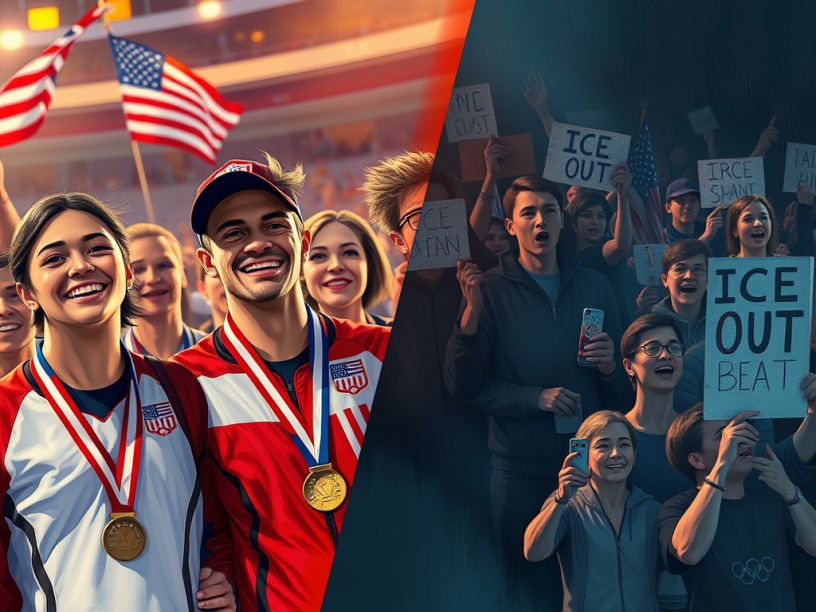
At the Milano Cortina 2026 opening ceremony on February 6, the crowd cheered the American athletes—and then pivoted into audible jeers when U.S. Vice President J.D. Vance and Usha Vance popped up on the stadium screens. Reuters also noted protests in Milan tied to “ICE OUT” messaging and a chillier reception for the U.S. political delegation than for the athletes themselves.
And that’s the tell. It’s not that the world suddenly hates Erin Jackson’s skating form. It’s that “USA” now comes with a political aftertaste—like you took a bite of tiramisu and discovered a layer of tear gas and detention paperwork.
So: are we the bad guy now?
Not in the comic-book sense. Not “twirling a moustache while launching a space laser” bad. More like the modern villain: a bored empire in sweatpants, moralizing loudly while doing the exact thing we’re moralizing against. The kind of villain that doesn’t feel evil because it’s always got a PowerPoint presentation explaining why evil was necessary for “security,” “stability,” “freedom,” or whatever word the administration is currently using like deodorant.
From “shining beacon” to “ominous threat”
Here’s how it used to work: America’s self-image was a Marvel origin story. We were a shining beacon of liberty, a nation of hustlers and dreamers, the world’s firewall against tyranny. We sold that story to ourselves so hard that we started exporting it like corn syrup.
But the global audience has seen too many sequels. You can only reboot “Land of the Free” so many times before people notice the plot holes.
Because while we’ve been shouting “freedom,” the rest of the world has been watching us turn “security” into a permanent government posture and treat international law like the rules posted in the corner of McDonald’s play room. They see America run foreign policy like a corporate merger: hostile takeovers, asset protection, quarterly earnings. They hear us lecture the planet on human rights while building a domestic system that looks, from the outside, like an anxiety factory with a flag.
And then there’s the vibes problem. America has become the global villain in the same way the final boss becomes the final boss: not by one single act, but by a long, cumulative campaign of “Are you serious right now?” moments.
The Olympics are a vibe-check—and we failed the vibe-check
The Olympics are supposed to be the world’s temporary ceasefire where everyone agrees to pretend geopolitics isn’t real, because a person on skis did a beautiful arc and it made us cry.
But the booing at San Siro—again: cheers for the athletes, jeers for the American political figurehead—was a reminder that the world can separate “Americans” from “American power,” and right now it’s the second part that’s catching heat.
That’s new-ish. The old model was: “We hate America,” meaning everything. The new model is more damning: “We don’t hate your people, we hate what your country does—and how smug it is about doing it.”
And yes, part of that is who’s in charge and what they’ve signaled. But it’s bigger than one administration. Booing doesn’t happen because of last week. Booing happens because of the backlog.
How did we get here?
1) We turned “leader” into “enforcer.”
America’s role in the world used to be framed as reluctant sheriff. Now it looks like an aggressive bouncer who starts fights so he can justify staying employed. Even when we’re right about a threat, our method is often: escalate first, explain later, deny forever.
2) We exported our culture war like it’s a franchise.
There’s nothing more American than taking a domestic identity fight and shipping it overseas as a moral ultimatum. It’s not just exhausting—it’s confusing. Allies aren’t sure if we’re offering partnership or a subscription service where they get monthly lectures and surprise tariffs.
3) We made everything transactional.
Even our friendships have started to look like invoices: We did X, you owe Y, also here’s a bill for our feelings. When you treat alliances like business deals, don’t be shocked when other countries shop around.
4) We lost the “competence halo.”
This is the quiet killer. A country can be feared. A country can be loved. But being seen as reckless, unstable, and self-absorbed is the fastest route to becoming the villain in everyone’s story—especially when you have the biggest toolbox.
When people abroad look at us and see chaos, polarization, and political theater, it becomes harder to accept our claims that we’re acting out of principled leadership rather than impulsive dominance.
5) We became the land of “lazy selfish gluttons” on camera—then acted surprised.
We did this to ourselves. We exported reality TV politics, influencer narcissism, and corporate gluttony as the public face of the American experiment. We turned excess into identity and then demanded respect for it.
From the outside, America can look like a country that eats like it’s a sport, shops like it’s therapy, and votes like it’s a cage match. And then we fly a delegation abroad and act bewildered when the crowd doesn’t clap like we’re arriving to distribute salvation.
The villain doesn’t think he’s the villain
That’s the trick. The United States isn’t out there thinking, “Let’s be the global menace today.” We’re thinking, “Why doesn’t everyone appreciate our sacrifice?”
Every villain has a monologue. Ours is just longer and comes with charts.
We tell ourselves we’re protecting the world order. Others experience it as us protecting our order. We tell ourselves we’re defending democracy. Others see us picking favorites, toppling inconvenient governments, and weaponizing rules when it suits us. We tell ourselves we’re the indispensable nation. Others hear: indispensable to whom?
So when the Olympic crowd cheers the athletes and boos the political face of the empire, it’s not “anti-Americanism” in the old, lazy sense. It’s something more precise: the world is tired of the way American power shows up—armed with certainty, allergic to humility, and permanently convinced it’s the protagonist.
So what now?
You don’t fix this with a nicer slogan. You don’t fix it with a commercial where a diverse group of Americans smiles in slow motion while a voiceover says, “At our best…”
You fix it the brutal way: by acting like a country that wants respect, not obedience.
That means fewer moral lectures paired with coercion. Less transactional friendship. More consistency. More restraint. More willingness to be bound by the same rules we demand others follow. And domestically, it means looking less like a decadent reality empire and more like a functioning society that can handle its own problems without turning them into a global export.
Because right now, “USA” is still a brand the world recognizes—but it’s drifting from “beacon” to “warning label.”
And when you hear boos in a stadium that used to clap on reflex, you’re not hearing hatred of your people.
You’re hearing the sound of your country’s reputation catching up with your country’s behavior.
 The American Beast