
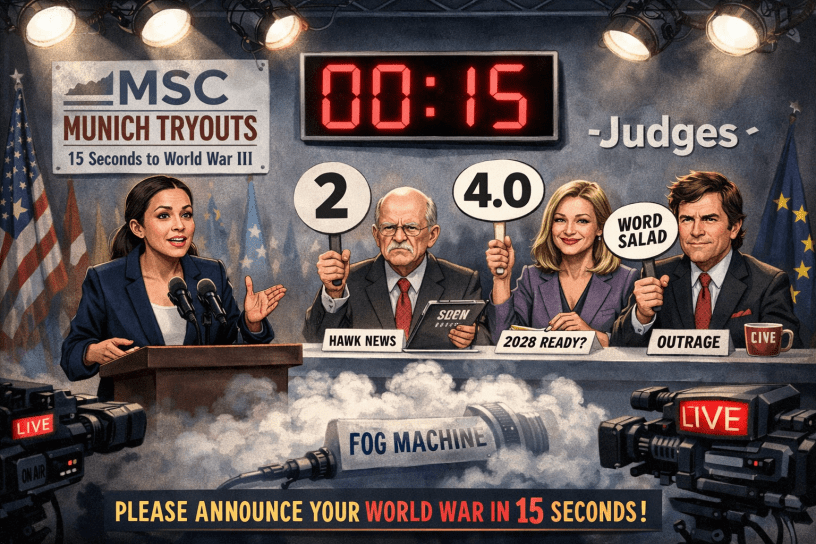
We just bore witness to the Munich Security Conference, the annual European ritual where serious adults in serious coats gather to discuss the end of the world—politely, over espresso—while Americans show up like it’s a televised combine for the next presidential cycle. Forty-yard dash: moral clarity. Bench press: “values.” Wonderlic: can you commit to a war you don’t control in a sentence short enough to survive a social-media clip.
This year, Rep. Alexandria Ocasio-Cortez landed in the middle of the pageant, and within hours the internet declared she “bombed,” because she did the one unforgivable thing in modern politics: she answered a live-fire foreign policy question like a human being who has heard of consequences.
The alleged crime scene, per the right-wing highlight reel, is a Taiwan question. Bloomberg’s Francine Lacqua asked whether the U.S. would and should commit troops to defend Taiwan if China moved. AOC didn’t say “yes, we ride at dawn.” She didn’t say “no, good luck out there.” She did what every American official does when cornered on Taiwan: she reached for the fog machine—longstanding policy, avoid escalation, hope it never comes to that, don’t let it get to that point. And that’s when the content vultures swooped in to scream “WORD SALAD,” because the algorithm has no category for “strategic ambiguity” unless it’s wearing Crocs and doing a dance.
Here’s the part that makes the whole “she bombed” chorus so stupid it qualifies as performance art: the United States has spent decades not answering that question on purpose. It’s not a gaffe when you refuse to announce World War III on a panel. It’s basically the job description.
The Taiwan posture is built around deterrence-by-uncertainty: don’t tell Beijing exactly what you’ll do, don’t tell Taipei exactly what you’ll do, don’t tell voters exactly what you’ll do, and for God’s sake don’t tell a reporter exactly what you’ll do—because the minute you turn ambiguity into doctrine-on-a-soundbite, you’ve changed the game. (And you’ve also guaranteed that half the country will start pricing out the cost of a carrier strike group like it’s a kitchen remodel.)
But Munich Tryouts isn’t about policy. It’s about vibes. It’s a global-security version of “tell us your biggest weakness,” except the weakness is: “Sometimes I don’t want to pledge troop deployments in a hotel ballroom.”
So the right calls it “rambling” and “stumbling.” Media sites repackage the clip as a one-minute IQ test. Aggregators do the same, only with less punctuation. Everyone lines up to declare that the woman is either unfit to lead or proof that the left can’t handle geopolitics, as if the standard for geopolitical fitness is “can you do a clean yes/no while a nuclear-armed superpower is watching.”
And because we live in a country where nothing can just be “a moment,” the moment gets upgraded into a prophecy: “This hurts her 2028 prospects,” etc. That framing has already been floating around Munich itself—coverage describing various Democrats “testing” foreign-policy chops at the conference like it’s an audition tape.
Which is the real story. Not whether AOC was “smooth.” Not whether her answer made Tucker Carlson’s eye twitch in the correct direction. The story is that we now treat foreign policy like a reality show—and then act surprised when it’s produced like one.
The Format Is the Trap
A Taiwan question on live TV is a trap disguised as a test of “clarity.”
If you say “Yes, we’d send troops,” congratulations: you just turned a hypothetical into a promise, gave Beijing a propaganda gift, and probably gave every defense contractor within 50 miles of Arlington a spontaneous nosebleed from arousal.
If you say “No, we wouldn’t,” congratulations: you just invited a crisis, undercut deterrence, and told Taiwan it should start learning “strategic relocation.”
If you answer like an adult—“our goal is to avoid that scenario; policy is complicated; escalation is bad”—congratulations: you have been diagnosed with word salad by people whose entire worldview is built on the belief that wars are won by tough-guy syllables.
This isn’t unique to AOC. If you forced a dozen mainstream Washington figures into the same corner, you’d get the same evasive hymn with different lyrics. The only difference is that establishment figures have the benefit of low expectations: when they refuse to answer, it’s called “discipline.” When AOC refuses to answer, it’s called “a stuttering mess,” like she just got asked to solve calculus while being tased.
“Word Salad” Is a Content Term, Not a Diagnosis
“Word salad” in 2026 doesn’t mean incoherence. It means: I didn’t get the clip I ordered.
People say “word salad” the way they say “gaslighting”: as a magic spell that ends the conversation and makes them feel like a prosecutor in a prestige drama. They don’t have to argue substance. They don’t have to acknowledge the policy logic. They just wave the label like a hall pass.
The Daily Caller describes her response as rambling and uses her hesitation as proof of incompetence, packaged with a side of “she’s on the global stage now” and “2028 rumors” and “she once said she wasn’t an expert,” like the whole point is to grade her as an archetype: the lefty influencer meets the grown-up room.
But the problem with grading policy by clip is that policy is the thing that happens after the clip.
Taiwan isn’t a debate-team prompt. It’s the kind of scenario that gets people killed and sends markets into seizures. It’s also the kind of scenario where officials—rightly—try not to create commitments by accident.
So yes, her answer was careful. That’s what you do when you’re not trying to turn a panel into a press release from the Pentagon.
Meanwhile, the Gaza Comment Turns Munich into a Viral Funhouse
Of course, Munich wasn’t only the Taiwan clip. The weekend also featured her remarks in a town-hall setting accusing the U.S. of enabling a “genocide” in Gaza through unconditional military aid—comments that, delivered in Germany, immediately sparked a different kind of outrage-industrial response.
You can agree with her, disagree with her, or do the classic American thing and scream “semantic!” while refusing to engage with the policy. But the political mechanics are the same: Munich becomes content, the content becomes tribal sorting, and the tribal sorting becomes a new round of “AOC is either a prophet or a menace.”
And because modern discourse is a rotting carnival, the two controversies get blended into one mega-narrative: “She’s not serious.” Not serious because she didn’t pledge troops. Not serious because she used the wrong word. Not serious because she’s not performing the correct kind of American confidence in front of Europeans.
The telling detail here is that none of these arguments are actually about what to do. They’re about whether her tonematches the role the audience wants her to play.
What Munich “Tryouts” Really Are
Munich Tryouts are a spectacle where Americans audition for the part of “Statesperson” in front of an audience that has its own anxieties: war in Europe, alliance credibility, the long hangover of U.S. unpredictability. Even the live coverage out of Munich reads like a rolling anxiety attack—Ukraine, Russia, transatlantic strain, Greenland drama, everyone trying to sound firm without sounding panicked.
In that room, “clarity” is worshiped like a saint, even though clarity is often the fastest route to escalation. Americans, meanwhile, are trained by domestic politics to treat clarity as virtue and ambiguity as weakness—except when ambiguity is literally the policy.
So you end up with a system where the “correct” foreign-policy answer is often unpublishable in a domestic soundbite, because the honest answer is: “This is complicated, and the tradeoffs are ugly, and no, I’m not going to commit to troop deployments on a panel.”
Try saying that on the internet. You’ll be called a coward by people who treat war like a brand identity.
One Man’s Word Salad Is Another Man’s…. Uh, Whatever
AOC didn’t fail Munich Tryouts. Munich Tryouts are the failure.
They’re the moment when “serious” international politics gets forced into the same content grinder as a TikTok feud. They’re the place where the U.S. deterrence posture gets judged by how confidently a politician can refuse to answer a question they shouldn’t answer.
And if you want the darkest punchline: the people screaming “word salad” are basically demanding a more dangerousanswer, because the only answer they’d accept is the one that escalates the hypothetical into a promise.
So maybe she “bombed” as entertainment. Fine. Give her a buzzer. Send her home from the game show.
But if your metric is whether she avoided accidentally turning a panel into a casus belli—congrats: she just did the most American foreign-policy thing imaginable. She ran the fog machine. She kept the script inside the lines. She refused to announce your World War in 15 seconds.
And the internet, furious that it didn’t get its clean clip, called that “word salad,” which is like calling a seatbelt “hesitation.”
If you want to “fix” that, here’s the only honest reform: stop treating the most catastrophic questions on Earth like they’re rapid-fire trivia. Stop demanding that politicians perform apocalypse with better lighting.
Or don’t. Keep the tryouts. Keep the clips. Keep the grading. Keep the dopamine.
Just don’t act shocked when one day the fog machine breaks—and somebody finally gives you the clean, confident, viral answer you demanded.
 The American Beast