
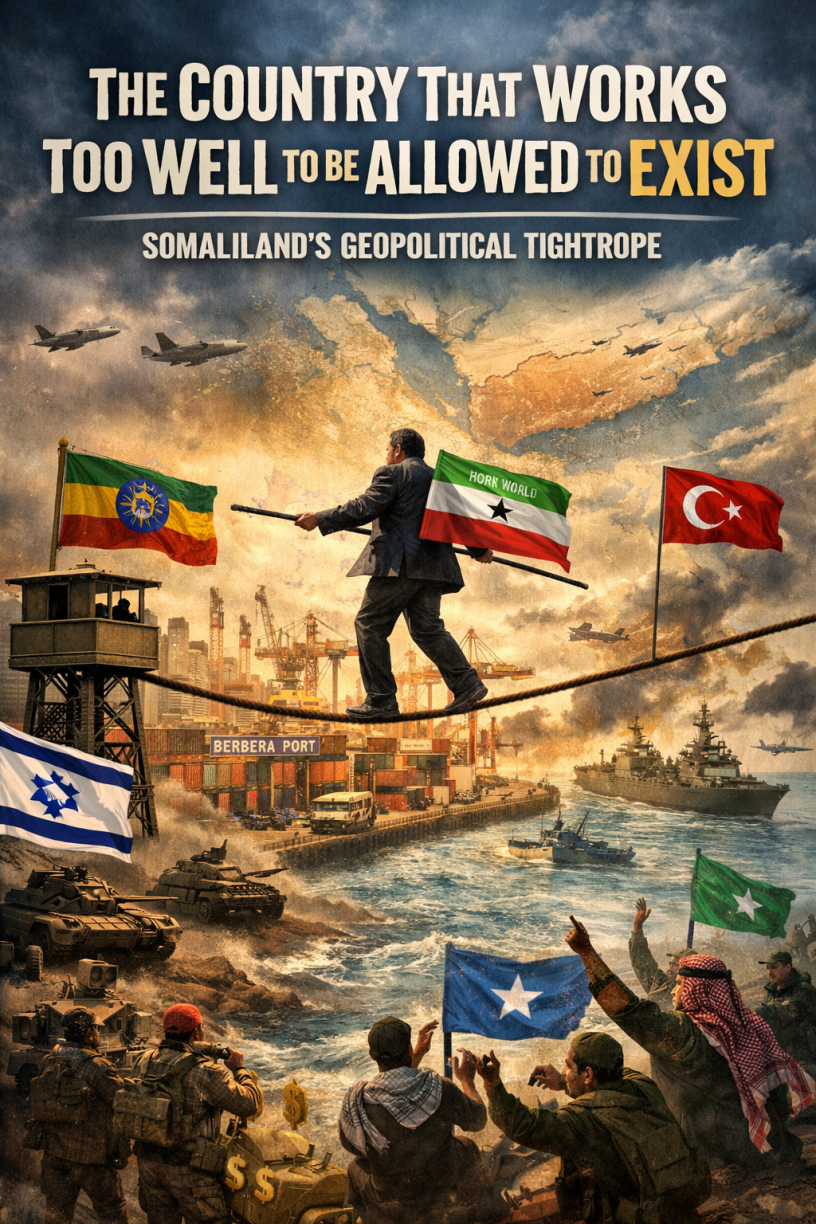
Somaliland is the geopolitical equivalent of the guy who shows up to a house party, picks up the broken glass, puts the beer in the fridge, and politely asks if anyone wants to Venmo for pizza—only to be informed, by a coalition of pedophiles, drunks and arsonists, that he is not legally a person.
For three decades, Somaliland has been the awkward contradiction in the Horn of Africa: a self-declared state that actually functions—with its own government, currency, elections, security apparatus, and the kind of low-grade bureaucratic competence that makes international observers uncomfortable because it ruins the plot. Meanwhile, the world’s official response has been: That’s cute, but no. We are very busy recognizing other things.
And then, in late December 2025, the global community finally looked up from its phones because someone did the one thing nobody was “supposed” to do:
Israel formally recognized Somaliland as an independent state, the first country to do so.
Now the party’s awake. Everyone’s clutching pearls. Shitting bricks. Emergency meetings. Angry statements. The diplomatic equivalent of a record scratch: Wait—Somaliland is… real? And suddenly the question isn’t “Does Somaliland deserve recognition?” It’s the more honest question: Who benefits from pretending it doesn’t exist?
The international order’s favorite hobby: rewarding failure, punishing success
Somaliland’s story is inconvenient because it breaks the inspirational poster version of foreign policy. The West loves to say it supports stability, democratic institutions, and governance—until those things show up without permission.
Somaliland declared independence in 1991. It never got international recognition, mostly because recognizing it would require admitting an obvious fact: Somalia is a sovereign country on paper, but “Somalia” as a functioning unit has been a long-running group project where half the team doesn’t show up and the other half insists the stapler is a Western conspiracy.
The standard argument goes like this: recognizing Somaliland could encourage separatism, trigger conflict, destabilize the region, offend the African Union, etc. Which is bullshit, because the region is already destabilized, conflict is already here, and the international community has been running a 30-year experiment in pretending the map is more important than the people living on it.
So Somaliland has been stuck in diplomatic purgatory: too stable to be treated like a humanitarian emergency, too unrecognized to be treated like a state, and too useful to be ignored forever.
Then Israel lit the fuse
Israel’s recognition wasn’t a little symbolic tweet. It was a direct strike on the “we don’t change borders” doctrine—the same doctrine that somehow becomes flexible the second a strategic advantage appears. Reuters reported that Israel’s move could reshape regional dynamics and test Somalia’s longstanding opposition to Somaliland’s secession.
Somalia reacted like a country whose sovereignty is being auctioned off by people who can’t find it on a map. There were major protests across Somalia in late December 2025, described as the largest public demonstrations since the recognition announcement.
And Turkey—Somalia’s increasingly muscular patron—came out swinging. President Erdoğan called Israel’s recognition “unacceptable” and “illegal,” accusing it of destabilizing the region, while standing beside Somalia’s president like the world’s most intense wedding DJ hyping up a dance floor brawl.
At the U.N., Israel defended the move and got side-eyed hard. Reuters reported multiple countries questioned Israel’s motives, including whether the recognition was tied to basing ambitions and the regional fallout of the Gaza war. The Washington Post also noted the backlash and linked suspicion to strategic positioning across from Yemen and the broader geopolitical hypocrisy of recognition politics.
So, yes, Somaliland finally got recognized—but not in a warm Hallmark way. More like the way a pawn gets recognized by a chess grandmaster: as a useful piece.
The Horn of Africa: where ideals go to die and shipping lanes get what they want
To understand why Somaliland suddenly matters, you don’t need a PhD. You need a map and an attention span long enough to stare at the Red Sea/Gulf of Aden without checking Instagram.
Somaliland sits along one of the world’s most critical maritime corridors—near the chokepoints that keep global trade from turning into a Mad Max barter economy. It’s also a place where ports, bases, and logistics are worth more than a thousand speeches about democracy.
Which brings us to the part of the story everyone pretends isn’t the story:
Berbera.
Somaliland’s Berbera port has been expanding into something real—an infrastructure project with actual economic gravity. The UK-backed development finance institution British International Investment highlighted that the upgraded port and the adjacent Berbera Economic Zone supported about 2,490 jobs and added $45.1 million in value to Somaliland’s economy in 2024.
DP World, the Emirati logistics giant, has also openly positioned Berbera as a regional node, including a shipping route connecting Berbera with Jebel Ali in the UAE (with stops like Aden and Djibouti), explicitly pitching it as an alternative logistics chain feeding inland—especially toward Ethiopia.
So Somaliland isn’t just a “breakaway region” with a flag and vibes. It’s a piece of working infrastructure in a strategic location, and that makes it the one thing the international system can’t resist: a deal.
Ethiopia tried to buy a coastline. Turkey tried to tape the argument back together.
This whole mess didn’t start with Israel. Israel just poured gasoline on a fire already burning.
Back on January 1, 2024, Ethiopia and Somaliland signed a memorandum of understanding that reportedly involved leasing a stretch of Somaliland’s coastline and—crucially—dangling the possibility of Ethiopian recognition of Somaliland in return.
Somalia lost its mind, because from Somalia’s perspective this is like your neighbor leasing out your backyard to a third guy who shows up saying, “Don’t worry, I’m just building a navy.”
The International Crisis Group called the Ethiopia–Somaliland deal a driver of heightened tensions in the region, warning about broader reverberations and miscalculation risk.
By December 2024, Turkey stepped in to mediate a cooling-off agreement between Ethiopia and Somalia—what’s been called the Ankara Declaration—where both sides reaffirmed sovereignty and territorial integrity and agreed to pursue commercial arrangements for sea access under Somalia’s sovereignty.
Translation: Turkey tried to put the toothpaste back in the tube. Not because it loves peace (though sure, maybe), but because Turkey has its own rapidly expanding interests in Somalia—military, economic, and (as Erdoğan announced) even ambitions around offshore energy exploration starting in 2026.
So when Israel recognized Somaliland in December 2025, it wasn’t a fresh controversy. It was a sequel—and the regional powers immediately reacted the way they always do when someone else moves the furniture: rage, panic, and intense moral language masking very practical interests.
Recognition isn’t morality. It’s a receipt.
Here’s the ugly truth: the international community doesn’t “recognize” countries because they deserve it. It recognizes them because recognition becomes convenient, profitable, or strategically necessary.
Somaliland’s whole pitch—implicitly for years, and more explicitly now—is: We’re stable. We’re located in the right place. We can be a partner. Please stop pretending we’re imaginary.
And Israel’s recognition proves the point: the taboo wasn’t moral. It was political. The taboo was “don’t mess with Somalia’s borders,” until somebody decided the benefits outweighed the anger.
Now every actor has to recalibrate:
- Somalia has to defend sovereignty it cannot fully enforce, and it has to do so loudly, because the alternative is admitting the map is fiction.
- Turkey has to act like the adult in the room while simultaneously securing influence—because mediation is just empire-building with better stationery.
- Ethiopia still needs access to the sea, and will keep shopping for it like a desperate man browsing Zillow after a divorce.
- Somaliland gets to wave recognition like a trophy while hoping it doesn’t turn into a target.
And the rest of the world gets to pretend this is all about principles, when the principles are basically: Ports good. Chokepoints important. Everyone else please stop screaming.
The irony: the “rules-based order” is the thing making this dangerous
The most unstable element here isn’t Somaliland. It’s the international system’s inability to admit reality until reality forces its hand.
Somaliland’s lack of recognition has created a trap:
- Without recognition, it’s harder to access international finance, formal security guarantees, and normal diplomatic channels.
- Without those channels, outside powers engage through backdoors: port deals, base rumors, quiet coordination, semi-recognized “offices,” transactional partnerships.
- The result is a shadow diplomacy marketplace, where the most important questions—security, access, sovereignty—get negotiated without the accountability that recognition would actually bring.
So when Israel recognized Somaliland, it wasn’t just a headline. It was a stress test of a system that has been pretending for decades that “Somaliland” is just a regional administrative issue, not a de facto state.
Now that someone broke the seal, the rest of the world has a choice:
- Continue the official ghosting campaign and hope nothing escalates, or
- Admit the obvious and deal with the consequences like adults.
But don’t bet on adulthood. International politics is mostly just adults playing musical chairs with shipping lanes.
What happens next: a bidding war dressed up as diplomacy
If you want the likely next chapter, it’s not hard to imagine:
Somaliland will push for more recognition, using Israel’s move as precedent and proof of concept. Somalia will push back hard, seeking regional and international statements reaffirming territorial integrity (and it’s already been rallying support). Turkey will deepen its role as “mediator” while simultaneously cementing its presence in Somalia.
Meanwhile, Berbera keeps getting more valuable, and value attracts suitors, and suitors attract trouble.
And the saddest part is that Somaliland—the place that did the work, built the institutions, kept the lights on—may finally get its moment in the sun… as a pawn in a regional power struggle.
Which is the most Somaliland thing imaginable: prove you can govern, and the reward is becoming important enough to be fought over.
 The American Beast