
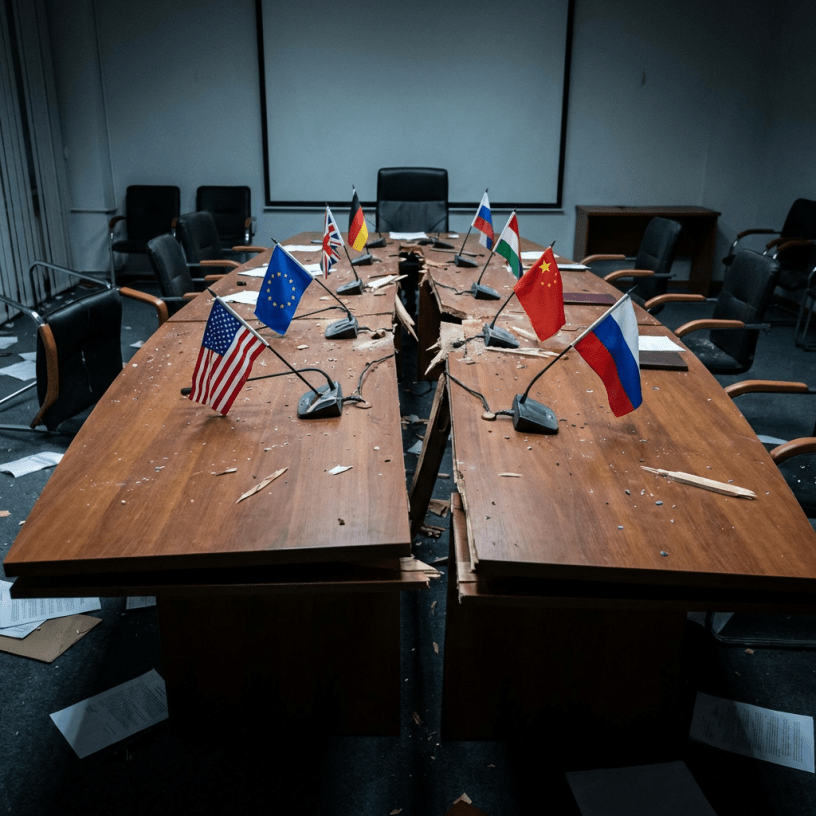
Donald Trump wanted allies to help secure the Strait of Hormuz, which is a little like asking your neighbors to chip in for new windows after you drove your truck through the living room. Europe, to its credit or cowardice depending on your taste, looked at the flaming Gulf, looked at its own energy bills, looked at its voters, and decided this was one American adventure best observed from a safe legal distance. European leaders at the Brussels summit made clear they did not want to join the U.S.-Israeli military campaign against Iran, even as they worried openly about energy prices and a new refugee shock.
That is the official version, anyway. The less official version is that even America’s usual sidekicks have finally developed the nervous instinct of a man who has watched his drinking buddy start three bar fights in one night and is now pretending not to know him when the cops arrive.
This is what decline looks like in real time. Not enemy tanks rolling through the Fulda Gap. Not flags lowered in some operatic imperial finale. Just a room full of supposed allies hearing Washington say, “Come on, everybody, one more Middle East war,” and reacting the way normal people react when a guy at a bachelor party announces he has rented a bulldozer.
For decades, the Atlantic arrangement worked on a simple premise: America would provide the muscle, the money-printing, the aircraft carriers, and the moral language about liberty, democracy, and rules-based order; Europe would provide the handwringing, the procedural objections, the carefully worded press statements, and eventually some level of compliance. They were not equals, exactly. More like a domineering boss and a set of high-strung middle managers who learned to nod whenever he started talking about “global leadership.”
The beauty of the setup, from Washington’s point of view, was that it converted obedience into virtue. If Europe followed, it was solidarity. If Europe hesitated, it was weakness. If Europe raised legal questions, it was naïveté. The United States could smash into another region of the world like a drunken excavator operator in wraparound shades and still expect the applause line afterward: We stood together.
Only now the applause is getting faint.
Reuters reported that Germany, France, Spain and other European governments balked at joining Trump’s war, citing the fact that they were not consulted, that the war aims were murky, and that the whole enterprise looked reckless, unpopular and strategically incoherent. Spain called the war illegal. Britain, usually the eager golden retriever of Atlantic militarism, also kept its distance. France has been looking for maritime security arrangements that do not require wrapping itself around Washington’s axle.
This is the important point. Europe did not suddenly discover a conscience. Nobody should kid themselves about that. The continent that sold arms, outsourced cruelty to migrant camps, and spent years giving TED Talks about human rights while buying gas from whichever monster had inventory did not awake one morning in a halo of moral clarity. Europe refused because Europe has become practical. It has seen enough American strategic genius to know the pattern by heart.
First comes the sermon. Then comes the urgency. Then comes the demand for allied unity. Then comes the claim that action is necessary because inaction would be catastrophic. Then comes the expansion of objectives. Then comes the surprise that regional actors have agency. Then comes the bill. Always, always, always the bill.
And Europe, at this precise historical moment, is in no mood to pick up another tab.
The European Union summit in Brussels was dominated by fears over rising oil and gas prices, economic fallout, and a potential refugee crisis tied to the widening Middle East war. AP reported that leaders who would not commit troops were nonetheless scrambling for ways to cushion consumers and economies from the shock. In other words: the continent has no interest in joining the arson, but it is already pricing out fire extinguishers.
That, more than any lofty speech, tells you everything. The war reached Europe the way these wars always reach everybody else: not as glory, not as principle, not as a thrilling map on cable news, but as pain in the wallet. Europe’s energy markets have already been battered. Reuters reported that the European Central Bank kept rates on hold at 2% while warning that the Iran war is clouding the outlook through higher oil and gas prices and renewed inflation pressure.
That is what empire sounds like once translated into ordinary language. Not “credibility.” Not “deterrence.” Not “regional stability.” Just this: your heating bill is going up because Washington and its client state decided to audition for Apocalypse Now again and the Strait of Hormuz happens to matter more than whatever soothing lie they are feeding the Sunday shows.
The real insult is that the people forever calling for sacrifice are never the ones doing any of it. The war planners will not choose between groceries and gas. The think tank ghouls will not be pawning jewelry to make rent. The TV colonels will not be riding a bus to a second job because the cost of everything from food to electricity just lurched upward. History’s most consistent law is that the people who shout “we must act” are almost never volunteering themselves as the ones to bleed, pay, or freeze.
So Europe looked at the situation and did something almost revolutionary by modern allied standards: it treated the United States not as a protector, but as a liability.
That shift is the whole story.
In Reuters’ reporting, European leaders’ objections were not just tactical. They reflected a deeper distrust of Trump’s unpredictability and of an American political system that has become unable to explain where war begins, what victory means, or why every strategic intervention somehow leaves behind a larger crater than the one before.
And this is where the satire writes itself, because Europe is not exactly behaving like a brave anti-imperial resistance movement. It is behaving like a weary junior partner in a collapsing criminal enterprise. It still wants the protection racket. It still wants the U.S. security umbrella. It still wants the shipping lanes open and the oil flowing and the bad guys deterred by somebody else’s navy. It just no longer wants its fingerprints on the latest broken bottle.
Which is why the second act of this farce is so perfect. Even while rejecting military participation, Britain, France, Germany, Italy, the Netherlands and Japan issued a joint statement saying they were ready to help ensure safe passage through Hormuz and work to stabilize energy markets. Reuters reported they supported planning for maritime security and welcomed the release of strategic petroleum reserves.
That is the modern alliance in one sentence: “We will not help you start the fire, but we may assist with crowd control after you torch the neighborhood.”
It is too cynical to call that principled and too honest to call it solidarity. It is something more pathetic and more revealing. The vassals are not revolting. They are renegotiating the terms of humiliation.
You can see the same instinct everywhere. Spain is moving troops out of Iraq because the war’s spread has made their position riskier. Reuters reported that Madrid also criticized the offensive and restricted U.S. aircraft use at shared bases in southern Spain. Germany and Norway have also relocated some personnel from the region. These are not the actions of governments thrilled to stand shoulder to shoulder with Washington in another righteous crusade. These are the actions of governments quietly moving their desks farther from the blast radius.
Meanwhile the material reasons for panic keep multiplying. Reuters reported that attacks on Gulf energy infrastructure and disruption around Hormuz have pushed Brent crude above $114 a barrel and sent European gas prices sharply higher. AP likewise described EU leaders scrambling to contain the economic consequences as the conflict threatens supplies and drives up costs. So when European leaders say, “Not our war,” it does not mean, “This won’t affect us.” It means, “We are already paying for this and would prefer not to also own it.”
That, again, is the American genius: to make even abstention feel expensive.
The old myth of American leadership was that, however brutish and self-interested the United States could be, allies ultimately preferred its dominance to the alternatives. That may still be true in some formal sense. But something more corrosive has crept in. America’s allies increasingly seem to believe that U.S. leadership no longer reliably produces order. It produces volatility. It produces inflation. It produces strategic improvisation disguised as doctrine. It produces the kind of geopolitical chain reaction that forces half the world to spend its weekends discussing tanker routes and reserve releases because one empire still thinks history is a video game with an unlimited respawn budget.
That is why Europe’s refusal matters. Not because it stops the war. It doesn’t. Not because it transforms the continent into a force for peace. It won’t. It matters because it shows the erosion of the one thing empires need almost as much as weapons: the confidence of their own clients.
When the enemies stop fearing you, you have a problem. When the friends stop trusting you, you have something worse.
So here we are: Washington still strutting around like the sheriff of the free world, while the free world checks its bank account, reads the casualty projections, glances at the gas ticker, and quietly backs toward the door.
 The American Beast