
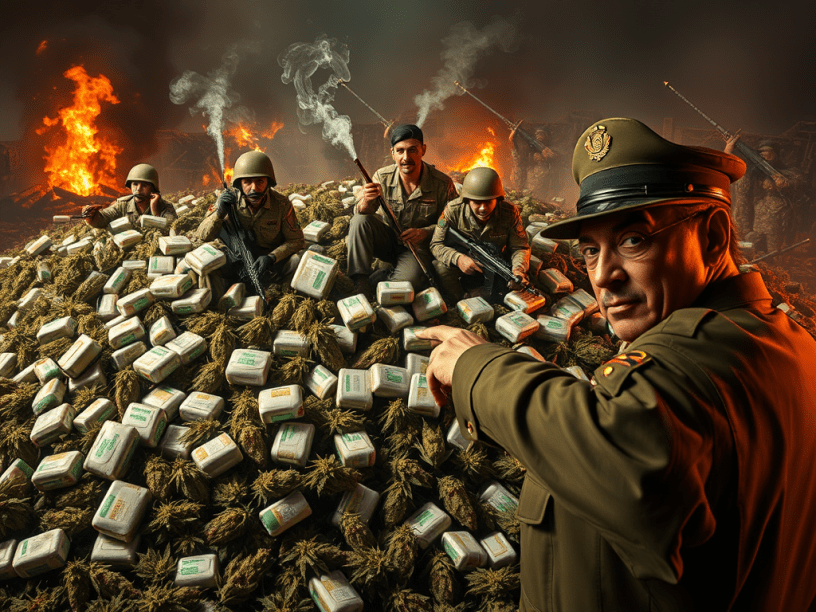
The War on Drugs: A Multi-Trillion Dollar Scam Disguised as Policy
For over 50 years, the U.S. government has waged a war on drugs, but calling it a failure gives it too much credit. The War on Drugs was never meant to “stop drugs”—it was designed to criminalize the poor, fill up prisons, militarize police forces, and ensure that the real drug pushers—the pharmaceutical executives and money launderers in boardrooms—never see the inside of a jail cell. It’s the greatest con in modern history, a trillion-dollar state-sponsored racket built on hypocrisy and selective prosecution.
The Numbers Tell the Story
Since Richard Nixon first unleashed this disastrous crusade in 1971, the U.S. has spent over a trillion dollars fighting a war it had no intention of winning. In return, drug use has skyrocketed, overdoses are at record highs, and America remains the largest consumer of illegal narcotics on Earth. The U.S. imprisons more people for drug offenses than any other country—about half a million at any given time—while actual treatment for addiction is an afterthought. The so-called War on Drugs isn’t about protecting Americans; it’s about keeping the right people behind bars and the right industries flush with cash.
The Biggest Drug Cartels Wear Suits
The most prolific drug dealers in America aren’t guys slinging dime bags on street corners. They’re billionaires in corporate boardrooms, running companies like Purdue Pharma, which flooded the country with opioids under the false pretense that OxyContin was “non-addictive.” They made billions, fueled a nationwide crisis, and when the lawsuits finally came crashing down, they walked away with golden parachutes while tens of thousands of people died.
Johnson & Johnson, McKesson, and Cardinal Health were all complicit in pumping out opioids like they were candy, bribing doctors, falsifying studies, and burying the science that showed how addictive their products really were. And what happened to these companies? A couple of settlements. A few billion dollars in fines—pocket change compared to the profits they made. No one went to prison. Meanwhile, thousands of Americans are still serving life sentences for selling weed.
The Marijuana Hypocrisy
Speaking of weed, let’s talk about the absolute clown show that is marijuana policy in America. For decades, politicians, police, and the media sold cannabis as a gateway drug, an instant ticket to crime and degeneracy. Millions of people—mostly Black and Latino—were thrown in prison for possession, their lives wrecked over a plant that is now legally making white investors billions in states like California and Colorado.
The hypocrisy is staggering. The same government that spent decades fearmongering about marijuana is now taxing it, regulating it, and treating it like the economic goldmine it always was—but only for the right people. If you were arrested for selling weed in 1995, too bad. If you’re a hedge fund manager investing in a cannabis startup in 2024, congratulations, you’re a “pioneer.”
Crack vs. Cocaine: The Blueprint for Racist Drug Policy
The War on Drugs has always been a war on the wrong kind of drug user. Case in point: the crack vs. powder cocaine sentencing disparities. For decades, possessing crack (cheap, used by poor Black Americans) carried penalties 100 times harsher than powder cocaine (expensive, used by rich white executives). Same drug, different clientele, wildly different consequences.
The results were exactly what they were meant to be: thousands of Black men sentenced to decades in prison for minor possession, while Wall Street bankers snorted their weight in cocaine and kept their corner offices. This wasn’t just bad policy—it was intentional, racist, and devastating. And even when the sentencing disparity was “reduced” in 2010, the damage had already been done.
Policing for Profit: The Drug War’s Hidden Grift
The War on Drugs isn’t just about locking people up—it’s about making money off locking people up. Civil asset forfeiture laws allow police to seize money, cars, and even homes simply by suspecting a drug crime took place—no conviction required. Entire police departments fund themselves by seizing property from people who often aren’t even charged with a crime. It’s legalized highway robbery, with cops acting as bounty hunters, taking whatever they can under the flimsy excuse of “fighting drugs.”
Private prisons love the drug war, too. More inmates mean more profits, and the prison-industrial complex has spent decades lobbying for harsher drug laws, longer sentences, and fewer chances for parole. Even after release, former drug offenders face a lifetime of punishment: denied jobs, housing, and even the right to vote in many states. The system isn’t designed to rehabilitate—it’s designed to recycle people through it, over and over again.
What About Treatment? America’s “Lock ’Em Up” Approach to Addiction
While other countries have figured out that addiction is a public health issue, the U.S. still treats it as a criminal offense. Portugal decriminalized all drugs in 2001 and redirected money from enforcement to treatment, resulting in lower drug use and fewer overdoses. Meanwhile, in the U.S., we’re still raiding homeless encampments and arresting people for possession while Big Pharma execs sip champagne and count their opioid profits.
Even when America does invest in treatment, it’s a mess. Rehab centers are expensive, poorly regulated, and often little more than glorified cash grabs. Insurance companies dictate who gets help and for how long, and if you don’t have money? Good luck. The waiting lists for publicly funded treatment can be months or even years long—assuming they exist at all.
The War on Drugs Was Never Meant to Be Won
If the goal of the War on Drugs was to actually reduce drug use and make America safer, it would have ended in disgrace decades ago. But that was never the goal. The real mission was control—control of Black and brown communities, control of poor people, control of the prison pipeline. It’s a war that was designed to be endless, profitable, and just selective enough to ensure that the right people get punished while the real criminals walk free.
If justice were real, DEA agents would be kicking down the doors of Big Pharma boardrooms instead of harassing small-time dealers. But in America, crime isn’t about what you do—it’s about who you are. If you’re rich and connected, you get settlements and golden parachutes. If you’re poor and unlucky, you get a jail cell.
Drugs won. The War on Drugs was never a war on substances—it was a war on people. And it’s still raging, not because it works, but because there’s too much money in keeping it going.
 The American Beast
Excellent!
My BS meter kicks into high gear whenever I see DAs and police chiefs parade pictures of drug “suspects” one of their several FREE media platforms.
I realized 30 years ago that the proverbial War On Drugs, since 1973, is not intended to be won. They NEVER stop the top SOURCE dealers.
Why? Because they want the “war” to continue for their ETERNAL GOVERNMENT JOB SECURITY.
LikeLike
Thanks for stopping by and reading!
LikeLike