
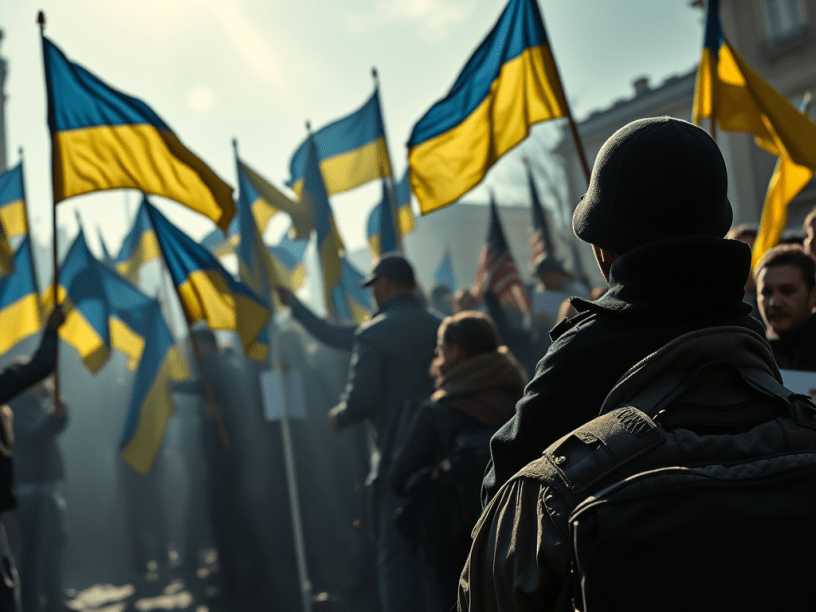
There was a brief moment, somewhere between the Ghost of Kyiv memes and Sean Penn hauling an Oscar into a war zone like a talisman, when the average American gave a shit about Ukraine.
It didn’t last.
We were all in at first. Slava Ukraini. Blue and yellow flags in bios. Hashtags. Bono in a bomb shelter. Congressional selfies with Zelensky like he was the Dalai Lama with a drone army. You couldn’t throw a soy latte in Brooklyn without hitting someone wearing a “Stand With Ukraine” button next to their N95. There was unity. Resolve. A thrilling sense of moral clarity—just like Iraq in 2003, only this time we were sure we were on the right side.
Now, two years later, that dopamine buzz has worn off like an early morning wake and bake session. Congress can’t pass an aid bill without dragging it behind a pickup truck full of Border Patrol agents and fentanyl test kits. The American public’s attention span has returned to its natural resting state: total disinterest in any conflict that can’t be streamed in under 90 seconds. And Ukraine? Ukraine is the war equivalent of a prestige drama that got too many subplots. Nobody’s watching anymore, but they’re too embarrassed to admit they stopped after season one.
Let’s not pretend this is a surprise. We are a nation that treats foreign policy like fast food: fast, greasy, and forgotten by the next day. The average American voter has the geopolitical memory of a goldfish with a head injury. We spent twenty years in Afghanistan and couldn’t tell you who Hamid Karzai was if he showed up shirtless on The Masked Singer. Iraq? We remember a shoe being thrown at Bush and something about WMDs—whatever the hell those were.
Ukraine, by those standards, had an impressive run. It had the right ingredients: a photogenic underdog, a cartoonishly evil villain in Vladimir Putin, and a rolling supply of human horror piped directly to our phones via Telegram and Twitter/X. But like all good cable dramas, it started to sag under its own moral weight.
Because war—real war—is ugly, slow, and full of compromise. It’s not TikTok-friendly. It’s not Instagrammable. It doesn’t fit into a tidy narrative that makes people feel good about themselves. So we moved on.
THE POLITICS OF ATTENTION
There are two wars now: the one still grinding away in the Donbas, and the one on Capitol Hill, where Ukraine aid has become a political football fumbled by every possible idiot. In the House, support for Ukraine is now a litmus test for how willing Republicans are to throw democracy under a tank for a Fox News segment. On the left, progressives have quietly shifted from “arm the resistance” to “wait, how much are we spending on this again?” Faster than you can say Raytheon stock split.
What was once a bipartisan cause has metastasized into the usual swamp fight: performative patriotism, culture war noise, and shameless grandstanding. Republicans talk about “border security” like Ukraine’s war budget comes with a prepaid wall. Democrats sputter out platitudes about democracy abroad while flinching from anything that smells like escalation. Meanwhile, Zelensky makes whirlwind tours like a doomed rock band trying to raise money for one last comeback tour. The merch table is getting sparse.
According to Pew polling, support for military aid to Ukraine among U.S. adults dropped from 60% in spring 2022 to about 48% by late 2023, with Republican support falling off a cliff. Democrats are still mostly on board—but mostly in theory, like that gym membership they stopped using six months ago.
And in D.C., Ukraine has gone from “righteous cause” to legislative hitchhiker—something to be stapled onto any border security bill or TikTok ban that needs moral window dressing. Ukraine’s fight for democracy has been turned into a bargaining chip between ghouls.
The truth is that aid for Ukraine is still, technically, popular with voters—when you ask them. But you’d be forgiven for thinking otherwise from the way Washington has turned it into a hostage negotiation. It’s become legislative haggis—inedible, incomprehensible, and full of offal.
FOLLOW THE MONEY, OR DON’T
Let’s be real: no one in America really knows how much we’ve spent on Ukraine. Not because it’s hidden (it’s not), but because the number is big and abstract and doesn’t mean anything to people who can’t afford a dentist.
Since February 2022, the U.S. has committed roughly $175 billion to Ukraine, across military, economic, and humanitarian aid. Of that, about $61 billion was locked in a funding freeze for months thanks to political gridlock and anti-Ukraine sentiment in the GOP.
Yes, much of the funding actually circulates back to U.S. arms manufacturers—Raytheon, Lockheed Martin, Northrop Grumman—the usual suspects who suckle at the golden teat of the Pentagon’s $850 billion budget. It’s a giant subsidy machine dressed up as a foreign policy strategy.
This gives ammo—literal and rhetorical—to critics on both left and right. Populists say it’s a racket. Leftists say it’s militarism wrapped in moral candy. Hawks say it’s “deterrence.” The public just sees a number and wonders why their rent went up 40% while Congress bickers about tanks.
But here’s the thing: you can hold two thoughts at once. Yes, America’s military-industrial complex is a grotesque, bloated parasite. And yes, Ukraine has every right to defend itself from a revanchist petro-thug who invades sovereign nations and mass kidnaps children.
But nuance is dead, and complexity doesn’t sell. The longer this war drags on, the more both sides of the aisle default to their cartoon narratives: Ukraine is either a brave freedom-fighting underdog or a corrupt, money-laundering sinkhole for globalist elites. There is no middle.
DEMOCRACY FOR RENT
This is the part Zelensky gets. He knows he’s not just fighting Putin—he’s fighting boredom. He’s been doing press junkets, speech tours, award shows, and moral appeals for two years straight. He’s the only world leader who could lose a war by dropping in Q ratings.
And frankly, he’s right to be terrified. Because once American interest dies, the weapons stop flowing. Once the weapons stop flowing, Ukraine’s army stalls. And if it stalls too long, Russia gains ground, plants flags, and declares “liberation” for every town it reduces to ash.
Meanwhile, Europe is watching nervously from across the table. The EU just passed its own multi-billion euro aid package, but it’s still America that provides the heavy metal. If Washington shuts the faucet, Kyiv doesn’t just get cold—it gets crushed.
And when that happens, the postmortem will be full of excuses. “We did all we could.” “It wasn’t sustainable.” “We need to focus on domestic priorities.” Every talking head will act shocked, as if a year of dithering didn’t lead directly to the unraveling of Ukraine’s defense.
But the truth is that America never commits halfway. We binge, then we bail. We fall in love with causes like they’re indie bands, then ghost them the moment they get complicated.
A WAR IN THE DARK
Ukraine’s presence in the American media ecosystem has dropped off like the Hawk Tuah girl’s popularity. From wall-to-wall coverage in 2022, it’s now a background hum—visible if you squint between Supreme Court leaks, Trump arraignments, and whatever viral garbage is trending that hour.
CNN gave it solid airtime when missiles were falling and Zelensky’s face was on a dozen green-screened “live from Kyiv” backdrops. But as soon as the story lost the shock factor, so did the producers. There are only so many times you can show a blown-out apartment complex before even the most earnest anchor moves on to the next ratings bump.
The irony is, the war isn’t winding down. It’s evolving—slowly, painfully, and far more dangerously. The West overestimated how fast Ukraine could adapt to combined-arms warfare. The Russian army, bruised and stupid but persistent, dug in with mines, trenches, and a World War I-style killbox strategy that chewed up tanks like a woodchipper.
This isn’t dramatic television. It’s meat grinder war—logistics, artillery shells, winter trenches, and slow-motion catastrophe.
And Americans, collectively, are out of gas. We like our wars like we like our Marvel movies: loud, righteous, and over in two and a half hours. The Ukraine war is in year three. There’s no satisfying ending on the horizon. No victory montage. Just more shattered cities and funerals.
Zelensky’s greatest trick early in the war was weaponizing narrative. He knew how to sell a story. He turned a fight for national survival into a global morality play. It worked—for a while.
But the longer a war drags on, the harder it is to keep the story straight. There’s no clean ending in sight. The 2023 counteroffensive was supposed to break Russian lines and force a reckoning. Instead, it turned into a bloody stalemate, and Ukraine is back on the defensive. Now you have a war without momentum, without media coverage, and without a clear path forward.
For cable news, that means it’s over. Ukraine coverage is down by more than half from 2022. The same media outlets that breathlessly covered every missile strike now relegate updates to the fourth segment after a Trump court case and a weather map.
Even social media has moved on. War content is no match for TikTok dancing doctors, AI-generated girlfriends, or whatever garbage Elon Musk is spewing today. The algorithm has no memory. And the war doesn’t care.
APATHY AS POLICY
In the end, this isn’t just about war fatigue. It’s about a country that can no longer hold a thought longer than an election cycle. We demand moral clarity, but reject moral consistency. We scream about democracy abroad, then defund it when we get bored. We want to fight fascism, but only if it fits between DoorDash deliveries and YouTube ads.
What’s left is a kind of numbed complicity. Americans aren’t actively rooting for Ukraine to fail. They’re just tired. And that fatigue is lethal. Because wars aren’t decided by attention spans—they’re decided by resources, logistics, morale. And once the money dries up, all the moral high ground in the world won’t stop a Russian tank.
So Ukraine now fights not just against Russia, but against apathy—the slow death that all long wars face in a country that doesn’t believe in long anything. And that’s the ultimate tragedy: not just that we might let Ukraine lose, but that we’ll barely notice when they do.
Ukraine may still win. It may claw out a frozen conflict, a partition, or some vaguely honorable endgame with enough Western aid and luck. But it won’t be because America stayed strong—it’ll be in spite of the fact that our attention span gave out halfway through act two.
So we go back to our distractions. Our subscriptions. Our scandals. And Ukraine goes back to bleeding for the sin of believing we meant what we said.
Not with a bang, but a scroll.

