
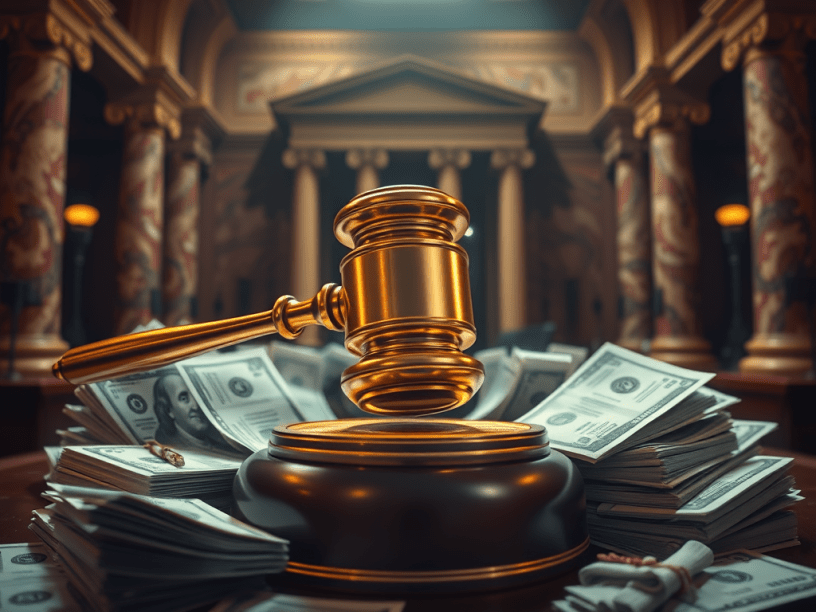
Let’s get one thing straight: the Supreme Court isn’t a temple of justice. It’s a high-end auction house where the gavel swings for the highest bidder. The black robes, the marble columns, the sanctimonious drone of “equal justice under law”? Pure theater. A distraction to keep you from noticing the billionaires slipping cash under the table to ensure their version of “freedom” gets chiseled into the Constitution. The court’s recent rulings—especially on campaign finance and donor disclosure—aren’t just bad law. They’re a neon sign flashing “Democracy for Sale” to anyone with a checkbook big enough to play. And the mega-donors? They’re laughing all the way to the ballot box.
The Roberts Court: Plutocracy’s Personal Cheer Squad
Under Chief Justice John Roberts, the Supreme Court has become the legal equivalent of a Vegas casino—rigged for the house, and the house is always the ultra-rich. Since Roberts and his buddy Sam Alito slithered onto the bench in 2005 and 2006, the court has churned out a greatest-hits album of decisions that sound like love ballads dedicated to billionaires. Citizens United v. FEC (2010). McCutcheon v. FEC (2014). Americans for Prosperity Foundation v. Bonta (2021). Each one a middle finger to the idea that democracy should be more than a rich man’s playground.
Let’s start with Citizens United, the 2010 ruling that unleashed a tsunami of cash into elections by declaring corporations and unions could spend unlimited sums as long as it wasn’t “coordinated” with candidates. The court’s logic? Money is speech, and restricting it violates the First Amendment. Never mind that this turned elections into a pay-to-play arms race where a single hedge fund bro can drown out millions of voters. The decision was a masterclass in judicial sleight-of-hand—dressed up as free speech absolutism but delivering a system where the loudest megaphone goes to whoever can afford it. As the Brennan Center pointed out, the ruling “tilted political influence toward wealthy donors and corporations,” with outside spending exploding to levels not seen since the Gilded Age.
Then came McCutcheon in 2014, where the court struck down aggregate limits on how much one donor could give to federal candidates, parties, and PACs in a two-year cycle. Before, a fat cat was capped at $123,200. Now? They can funnel millions, as long as they stick to the per-candidate limits ($5,200 back then, $6,600 today). Chief Justice Roberts, with that smug professor vibe, argued this wasn’t corruption—just “general influence” and “access,” which he called “a central feature of democracy.” Translation: it’s totally fine if a billionaire buys a senator’s ear, as long as there’s no explicit quid pro quo. Justice Stephen Breyer’s dissent nailed it: the ruling “eviscerates our nation’s campaign-finance laws,” creating “a loophole that will allow a single individual to contribute millions of dollars to a political party or to a candidate’s campaign.”
And then there’s Americans for Prosperity Foundation v. Bonta in 2021, where the court gutted California’s requirement for nonprofits to disclose major donors to the state. The Koch-backed Americans for Prosperity Foundation whined that revealing their sugar daddies might harsh their First Amendment rights. Roberts, ever the loyal servant, agreed, calling the law a “blanket demand” that failed “exacting scrutiny.” The result? Dark money groups—those shadowy 501(c)(4)s that spent over $1 billion in 2020 alone—can keep their donors secret, no questions asked. Justice Sonia Sotomayor’s dissent saw through the charade: the ruling “marks reporting and disclosure requirements with a bull’s-eye.”
These aren’t isolated oopsies. They’re a pattern. The Roberts Court has systematically dismantled campaign finance laws, greenlighting a system where mega-donors don’t just influence elections—they *own* them. The court’s reasoning hinges on a fantasy: that unlimited money doesn’t corrupt, that transparency isn’t necessary, and that a billionaire’s “speech” deserves more protection than a regular Joe’s vote. It’s a legal framework custom-built for oligarchs.
The Donor Class: Buying Justice Like It’s a Yacht
Who’s pulling the strings? The usual suspects: Charles Koch, the late David Koch, Tom Monaghan, Harlan Crow, and a rogue’s gallery of other billionaires who treat the Constitution like a menu at a Michelin-star restaurant. The Bonta case, for instance, was bankrolled by the Kochs’ Americans for Prosperity Foundation, a nonprofit that’s less about “prosperity” and more about ensuring the rich stay untouchable. The Thomas More Law Center, the other plaintiff, got its cash from Domino’s Pizza founder Tom Monaghan. These aren’t scrappy underdogs fighting for free speech—they’re front groups for tycoons who want to buy elections without leaving fingerprints.
Then there’s the dark money pipeline. Groups like DonorsTrust and Leo’s 85 Fund have funneled tens of millions into conservative causes, including amicus briefs in cases like Moore v. Harper (2022), which flirted with giving state legislatures unchecked power over elections. Accountable.US tracked $90 million in anonymous donations to eight conservative groups backing that case. This isn’t pocket change—it’s a coordinated effort to tilt the judicial playing field. And the justices? They’re not just passive recipients. They’re wining and dining with the donor class at fancy university events, where schools foot the bill to put them in rooms with industry titans whose cases often end up before the court. Justice Clarence Thomas, for example, took private plane rides from GOP megadonor Harlan Crow. Cozy, right?
The liberal justices aren’t saints either, but the conservative majority’s rulings consistently align with the interests of their benefactors. It’s not hard to see why. The Federalist Society, a breeding ground for right-wing legal talent, has been grooming justices like Brett Kavanaugh and Amy Coney Barrett for decades, with funding from—you guessed it—dark money groups. Leonard Leo, the Society’s puppet master, has turned judicial nominations into a billionaire-funded machine. The result is a court that’s less an impartial arbiter and more a rubber stamp for the 1%.
The Fallout: Democracy as a Paywall
What’s the damage? For starters, elections are now a billionaire’s sandbox. Post-Citizens United, outside spending by super PACs and dark money groups has skyrocketed. In 2020, over $6 billion flooded federal elections, with dark money alone hitting $1 billion. The McCutcheon ruling made it easier for a single donor to bankroll entire slates of candidates, turning parties into glorified ATMs. And *Bonta* ensured those donors could stay anonymous, so voters have no clue who’s buying their government.
This isn’t just about elections. It’s about power. When a handful of donors can dictate who wins and who loses, they’re not just picking candidates—they’re shaping policy. Tax cuts for the rich, deregulation for corporations, gutted environmental protections? All flow from a system where money calls the shots. The court’s rulings have created a feedback loop: the rich get richer, the powerful get more powerful, and the rest of us get fucked.
The court’s defenders will cry “free speech!” They’ll say restricting money in politics stifles expression. But let’s be real: this isn’t about speech. It’s about amplification. A billionaire’s $10 million ad blitz isn’t the same as your tweet or my yard sign. It’s a megaphone that drowns out everyone else. As Justice Breyer put it in McCutcheon, “Where enough money calls the tune, the general public will not be heard.” The First Amendment was meant to protect dissent, not to auction off democracy.
The Fix: Burn It Down (Metaphorically, Sort Of)
So what do we do? The Supreme Court’s not going to fix itself. These are lifetime appointees who think they’re philosopher-kings, not public servants. Here’s a start:
1. **Overturn Citizens United: It’**s a pipe dream, but a constitutional amendment could reverse the “money is speech” nonsense. Short of that, Congress could pass laws requiring full transparency for all political spending and crack down on super PAC coordination with candidates. The Brennan Center’s got ideas: stronger disclosure laws, stricter anti-coordination rules, and public funding for campaigns to level the playing field.
2. **Court Reform**: Expand the court. Impose term limits. Create a binding ethics code. The justices aren’t gods—they’re bureaucrats in robes. Right now, they’re accountable to no one, which is why they can hobnob with donors without consequence. Senator Sheldon Whitehouse has been screaming about the “dark money scheme” capturing the court. Listen to him.
3. **Expose the Money**: If the court won’t force disclosure, journalists and watchdogs need to keep digging. Groups like OpenSecrets and Accountable.US are already tracking dark money. Amplify their work. Name the donors. Shame the justices. Sunlight’s the best disinfectant.
4. **Vote Like It Matters**: The court’s composition depends on who controls the White House and Senate. Every election is a chance to shift the balance. Apathy hands the gavel to the billionaires.
The Bottom Line: A Court of Thieves
The Supreme Court’s recent rulings aren’t just legal missteps—they’re a betrayal. By dismantling campaign finance laws and shielding dark money, the Roberts Court has turned democracy into a gated community for the ultra-rich. The justices aren’t naive. They know who’s bankrolling their ascent, and they’re delivering the goods. Every time they strike down a disclosure rule or lift a donation cap, they’re handing another key to the kingdom to the donor class.
This isn’t justice. It’s a heist. The mega-donors—Kochs, Crows, and their ilk—are the getaway drivers, and the court’s the inside man. Until we call it what it is and fight back, the only “equal justice” we’ll get is the kind you can buy with a seven-figure check. So grab your pitchforks, folks. The auction’s still open, and the gavel’s still swinging.
 The American Beast