
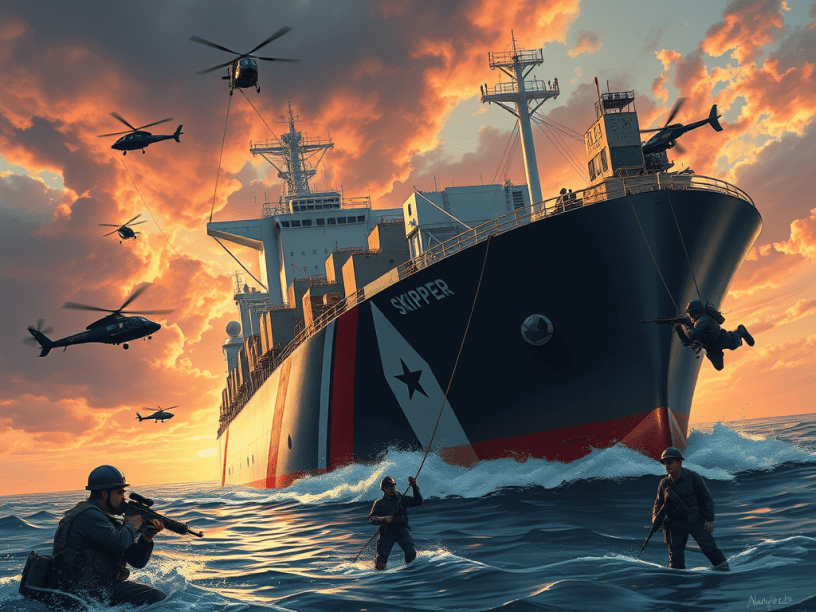
Trump Turns Sanctions Enforcement into Live-Action Regime Change
The video looks like a trailer for a Tom Clancy game somebody forgot to write a plot for.
A vast oil tanker—nearly a quarter mile of steel called the Skipper—rolls on gray water off Venezuela’s coast. From the sky: helicopters. From the helicopters: U.S. Coast Guard commandos sliding down ropes, rifles up, swarming over the railings while sailors in hard hats raise their hands. Attorney General Pam Bondi posts the clip like an Instagram influencer unboxing a new ring light. President Trump brags that it’s the “largest tanker ever seized” and hints there’s “more coming.”
If you didn’t know better, you’d think the Skipper had fired on Miami.
In reality, the ship’s great, civilization-ending crime was schlepping cheap sanctioned oil between two countries the U.S. hates—Venezuela and Iran—using a fake flag, a fake GPS signal, and the world’s least subtle disguise. The Skipper used to be called Adisa, and before that The Toyo; it’s a 20-year-old rust bucket already sanctioned in 2022 over alleged links to Iran’s Revolutionary Guard and Hezbollah. Think Scooby-Doo villain with too many aliases, except the mask is 1.1 million barrels of crude.
According to U.S. officials, the ship was broadcasting a bogus location and illegally flying Guyana’s flag while quietly topping up at Venezuela’s José oil terminal—part of a “shadow fleet” of sanctioned tankers that play transponder hide-and-seek for a living.
Washington’s response: seize the whole thing under Operation Southern Spear, a catch-all “counter-drug and counter-oil smuggling” campaign in the Caribbean, and drag it into U.S. legal limbo for forfeiture. Caracas’s response: call it what it looks like from shore—“an act of international piracy” and a naked grab for someone else’s resources.
So congratulations, America. We have finally found a way to make actual piracy boring.
Piracy With Paperwork
The genius of 21st-century empire is that it never shows up in a skull-and-crossbones hat. It shows up with sanctions lawyers.
On paper, the Skipper raid is pure technocracy. The Justice Department got a U.S. judicial warrant. The Treasury Department had already sanctioned the ship and its owner, Triton Navigation Corp, for allegedly moving oil money for Iran’s Revolutionary Guard. The Coast Guard executed the warrant “in international waters near Venezuela” with Navy backup, exactly the way you’d repossess a delinquent SUV, if SUVs floated and carried enough oil to power Belgium for a month.
White House press secretary Karoline Leavitt says the plan is simple: auction the tanker, keep the oil, and slap a few more sanctions on Maduro’s family for dessert. Not an escalation, just “strong enforcement of our laws.”
From the shore, though, it looks a lot less like law and a lot more like a smash-and-grab.
Venezuela’s government put it bluntly in an official statement: this has never been about migration, drugs, democracy, or human rights—it has “always been about our wealth, which belongs exclusively to the Venezuelan people.” The tanker was in a queue with more than 80 vessels loaded or waiting to load oil in or near Venezuelan waters, over 30 of them already under U.S. sanctions. The message from Washington is clear: any of you could be next.
International lawyers are politely freaking out. An Al Jazeera legal explainer asks the obvious question—is this piracy or law?—and points out that, yes, countries can enforce their own sanctions on their own citizens and territory, but boarding foreign-flagged tankers near another state’s coast for violating unilateral U.S. measures is… bold.
That’s before you remember we’re also running live-fire missile strikes on “narco-boats” in the same region under the same Operation Southern Spear branding, with at least one incident already under scrutiny as a possible war crime after U.S. forces allegedly hit shipwreck survivors.
So, to recap: we have a named military operation, a carrier strike group, combat rules of engagement, and now the forcible seizure of a foreign supertanker carrying another country’s oil. At some point the line between “sanctions enforcement” and “blockade” stops being a line and starts being a punchline.
Sleepwalking Into a War Over Somebody Else’s Gas Money
Even Congress noticed this one, and those people sleep through everything.
Within hours of the raid, a bipartisan swarm of senators—the rarest creature in Washington—came out to say the quiet part very loudly: seizing a sovereign country’s oil tanker off its coast is dangerously close to an act of war.
Democrat Chris Van Hollen called the administration’s stated justification—a mix of drugs, terror, and broad hand-waving about “narco-regimes”—a “big lie” and accused Trump of “risking a disastrous war of choice.” Republican Rand Paul, who occasionally remembers he is supposed to be libertarian, labeled the seizure “an initiation of war.” Democrat Chris Coons warned that Trump is “sleepwalking us into a war with Venezuela.”
They’re not wrong to be jumpy. Trump already has a carrier group parked in the Caribbean, an airspace warning telling pilots to stay away from “ongoing operations,” and a steadily growing list of “shadow fleet” tankers his people would like to intercept. U.S. destroyers have already forced at least one sanctioned Russian tanker, the Seahorse, to make a U-turn after cutting across its path like a road-raging Uber driver at sea.
You don’t need to be Clausewitz to see how this goes sideways. You’ve got U.S. warships playing bumper cars with Russian and Iranian-linked tankers in crowded shipping lanes around a country whose government already thinks it’s under siege. One misread maneuver, one over-eager admiral, one captain who doesn’t want to be the next Skipper, and suddenly you’re not arguing about maritime law—you’re arguing about who fired first.
That’s why some of those lawmakers are introducing a War Powers resolution to pre-emptively block unauthorized military action against Venezuela. They’ve seen this movie. The soundtrack is the same: “We’re just enforcing sanctions.” “We’re just interdicting weapons.” “We’re just protecting our troops.” Cut to: forever war.
The World’s Pickiest Pirate
The thing that makes all of this darkly hilarious is how incredibly selective our piracy is.
The U.S. government says the Skipper deserved to be nabbed because it was helping Iran and Venezuela dodge sanctions and funneling oil revenue to terrorists instead of schools. That may well be true. The Maduro regime is a spectacularly corrupt mess; Iran’s Revolutionary Guard is not exactly Greenpeace.
But at the very same time, Chevron is flying employees into its Venezuelan fields—defying U.S. aviation warnings about military interference—after getting special waivers to keep pumping oil there. U.S. refiners quietly lobby for more access to heavy Venezuelan crude because their equipment was built for it. Wall Street happily insures and finances ships that dance right up to the sanctions line and wink.
So the rule isn’t “no one can move Venezuelan oil.” The rule is “no one we don’t like can move Venezuelan oil without cutting us in.”
If a tanker is owned by a company with the right lobbyists, it’s “stabilizing global markets.” If it’s owned by Triton Navigation Corp and happens to have a shady history with Iran, it’s suddenly a floating crime scene that must be liberated at gunpoint for the good of humanity.
This is not rules-based order. This is paywall geopolitics.
Sanctions as Foreign Policy Fanfic
The seizure of the Skipper is being sold as a surgical strike in the noble crusade against terrorism and narcotics. Look closer and you can see the actual plot: this is regime change on the installment plan.
For years, U.S. sanctions have strangled Venezuela’s economy in the name of democracy, turning one of the world’s largest oil producers into an economic collapse so complete it makes the Great Depression look like a bad quarter. The idea was that starving the regime of cash would force Nicolás Maduro from power. Instead, it forced millions of ordinary Venezuelans to flee while Maduro dug in, made side deals with Russia, Iran, and China, and perfected the art of surviving on smuggling and repression.
Now Trump is trying a sequel: if sanctions and covert ops didn’t topple Maduro, maybe gunboat sanctions will. Block the shadow fleet, seize a tanker or three, and you drive up the cost of exporting oil enough that the regime’s last revenue streams start drying up. Bonus: oil prices tick up, pleasing domestic drillers and giving the administration something to blame for your next gas-station panic.
The people who pay for this experiment are not sitting in Miraflores Palace. They’re the ones whose subsidies vanish when the state goes broke, whose hospitals run out of basic supplies when imports stall, whose boats get interdicted when “counter-narcotics” morphs into “counter-everything.” They’re also the refugees who then get turned away at the U.S. border by the same politicians who helped wreck their economy.
Because in Trump’s America, the sequence is always the same:
- Sanction a country until it collapses.
- Intercept the ships that keep it afloat.
- Build a militarized zone in the Caribbean to enforce it.
- Call the people fleeing the wreckage “invaders” and hire more border agents to repel them.
You can’t make this up. You don’t have to.
The Shadow Fleet and the Real Shadow
There is a real story here, under all the posturing. The “shadow fleet” of sanctioned tankers is a genuine problem for any system that pretends to care about safety, transparency, or climate. These ships spoof their location data, switch flags like burner phones, run on the cheap end of maintenance, and occasionally crash, leak, or explode in ways that make Exxon Valdez look like a spilled latte.
But the U.S. approach isn’t “let’s create global rules so everyone has to clean this up.” It’s “let’s deputize our Navy as repo men and take the cargo.”
It is possible—just barely—to imagine an international effort where we say: nobody gets to run ghost tankers, not Russia, not Iran, not the trading houses in Geneva. You build a multilateral regime with inspections, shared data, and real penalties that don’t depend on whether the ship is currently annoying a U.S. president.
Instead, we have Pam Bondi posting raid videos on social media and Trump on TV promising there will be “more” seizures, while think tanks close to the administration brag that this is “just the first phase.”
Somewhere in all of this, the line between enforcement and spectacle disappeared. We’re not dismantling a shadow fleet; we’re filming a series.
And like every bad series, it’s been renewed for another season before anyone checked whether the plot made sense.
The Skipper raid is being hailed in some circles as a bold stroke—a “very necessary step,” says Venezuelan opposition leader and freshly minted Nobel laureate María Corina Machado, who argues that cutting off Maduro’s oil money is the only way to starve his security apparatus.
Maybe she’s right about the regime. She’s almost certainly right about its corruption. But if the past two decades of U.S. foreign policy have taught us anything, it’s that we are catastrophically bad at targeted strangulation. The people at the top find new ways to breathe. The people at the bottom suffocate.
Meanwhile, the world’s most powerful navy is out there in the Caribbean pretending to be the Coast Guard from Waterworld, boarding tankers and calling it peacekeeping, while a president who once said “we should have kept the oil” now has his staff openly confirming that yes, actually, we plan to keep the oil.
Call it piracy. Call it law. Call it sanctions enforcement. Whatever you call it, understand what you’re watching: a superpower that used to overthrow governments with covert ops and proxy armies is now trying something cheaper and dumber.
It’s trying to starve a regime by mugging its tankers on the open sea—and hoping nobody notices when the line between “shadow fleet” and “act of war” disappears under the wake.

