
Trump’s New National Defense Area and the Fantasy of the Internal War Zone
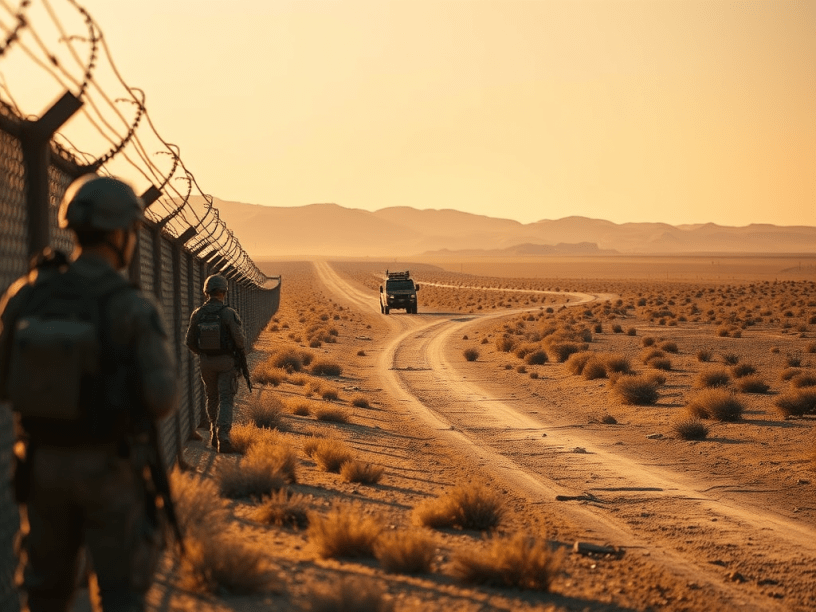
The newest “base” in America’s forever border war isn’t a town, or a fort, or even a wall. It’s 760 acres of scrubland in San Diego and Imperial Counties that the government just decided is no longer really part of the country at all—at least not in the way you’re used to.
With the stroke of a pen, the Interior Department transferred those 760 acres of public land to the Navy for three years so it can be turned into a National Defense Area, a kind of pop-up military reservation pressed right against the California-Mexico border. On maps it will still look like the United States. In law, it’s something closer to a federally subsidized paranoia theme park where uniforms outrank civilians, “temporary detention” is baked into the mission, and the normal rules about who can put hands on you get…flexible.
The sales pitch is familiar: “border security,” “national defense,” “high-traffic corridor for unlawful crossings.” The reality is more embarrassing. Border Patrol arrests along the southern border are at their lowest pace since the 1960s, thanks in no small part to Trump’s own mass-deportation blitz and asylum freeze. There is no tidal wave of migrants overwhelming San Diego. But there is a tidal wave of political need for a TV backdrop where Trump can stand in front of barbed wire and say there is.
So we’re getting Camp Border: a militarized sandbox whose purpose is less to stop people crossing, and more to prove that the president is still the main character in a war only he can see.
The official description reads like someone took every vague phrase from the last 25 years of security memos and threw them in a blender. The new zone will “support ongoing border security operations” and “national defense.” It gives the Navy “installation security authorities,” including the power for armed personnel to patrol, control access, and detain civilians who wander into the wrong arroyo without proper papers. Criminal penalties for “unauthorized entry” can be ratcheted up inside the perimeter.
In other words, a chunk of ordinary public land is being converted into something that looks a lot like a domestic forward operating base. Not a base in the old sense—with housing, schools, maybe a commissary—but a strip of ground whose entire reason for existing is to blur the line between policing and war.
If this sounds new, it isn’t. It’s just the California franchise of a growing chain. The Pentagon and Homeland Security already have National Defense Areas along the Rio Grande and in Arizona, including a 170-mile-long, 60-foot-wide strip of federal land in Texas and the Yuma NDA patrolled by Joint Task Force–Southern Border under U.S. Northern Command. These NDAs are like military pop-up ads on the border map: click anywhere and there’s a new one, complete with checkpoints, cameras, and a legal force field.
The new California zone is just the latest proof that the border isn’t a line anymore. It’s a moving camp, a belt of semi-permanent war footing that can be expanded whenever a president feels bored, threatened, or behind in the polls.
The timing is almost comical.
On one side of the state, the administration is celebrating its shiny new militarized zone. On the other, in Los Angeles, a federal judge just told Trump to pack up his “standing army” and go home.
Back in June, when federal immigration raids sparked protests around Southern California, Trump invoked a dusty statute—10 U.S.C. § 12406—to federalize 4,000 California National Guard troops and send them into L.A. under his personal command. Local cops were dealing with the protests; the city hadn’t asked for soldiers. The governor definitely hadn’t asked for soldiers. But the president wanted his own troops on the streets, so the Guard stopped being California’s and became his, Title 10 style.
By October, most of those troops were gone, but a few hundred remained in federal status—essentially on loan to ICE and DHS as a uniformed backdrop for “protecting federal facilities” from the possibility that protesters might show up again. When California sued, U.S. District Judge Charles Breyer looked at the situation and politely went nuclear.
The administration’s argument boiled down to: once we’ve federalized your Guard, we can keep it as long as we like, because the mere threat of future unrest means the president is “unable” to execute the laws with regular forces. Breyer’s response was the judicial equivalent of “are you kidding me?” If that logic stood, he wrote, “federalization justified federalization” and you could build a “positive feedback loop that perpetually rationalized federal control of state troops,” effectively creating a national police force in violation of every tradition and statute on the books.
So he ordered the Guard returned to Governor Gavin Newsom’s control, calling the deployment “contrary to law.”
That’s the backdrop for Camp Border: a presidency told, in writing, that it can’t simply grab state troops and use them as a personal immigration police force in America’s second-largest city—so it grabs federal land instead, hands it to the Navy, and builds a militarized playground in the desert where no uppity judge or governor can tell it what to do.
If you can’t turn L.A. into a permanent security zone, you turn the desert into one and hope the cameras can’t tell the difference.
Strip away the legalese and you can see what’s really being constructed out there in the scrub. It’s not just fences and floodlights. It’s precedent.
The National Defense Area framework has three key features that make authoritarian hearts flutter. First, it treats domestic land the way we treat a foreign battlefield: the military, not civilians, controls the ground. Second, it comes with “temporary detention” authority, creating a space where a soldier or Marine who thinks you look suspicious can hold you while someone digs around in your life. Third, it’s sold as temporary—three years only, just like your favorite surveillance program was “temporary” in 2001.
Temporary is the new permanent. The Yuma NDA was “temporary.” The Rio Grande NDA was “temporary.” The entire post-9/11 “emergency” surveillance apparatus was temporary. Ask your phone how that worked out.
Once you accept the idea that the president can turn a patch of public land into a mini-base with special rules whenever he says “national defense,” the only real question left is where he points that power next.
Southern border today. Maybe ports tomorrow. Maybe chunks of coastline, rail yards, urban “critical infrastructure corridors.” The bureaucratic muscle memory is already there: find a perceived security problem; carve out an NDA; give the military patrol and detention powers; promise it’s just for a few years until things “stabilize”; forget to ever turn it off.
And remember: this is happening at a time when border crossings are historically low, not spiking. The entire rationale for building Camp Border is backwards. The emergency is not migrants; the emergency is that Trump’s whole political brand depends on pretending we’re under siege. A quiet border is bad for ratings. So you invent a war zone and hope people stare at the concertina wire instead of the numbers.
There’s another, quieter casualty here: the idea that public land is, you know, public.
Those 760 acres used to be part of the national commons—ugly, dusty, ecologically fragile, probably full of beetles some biologist has devoted a career to, but theoretically belonging to everyone. Now it’s a restricted government facility where you can be detained for wandering in the wrong direction with the wrong ID.
This is the same administration that screams about “federal overreach” when a park ranger posts a sign about climate change, and swears it wants to “give power back to the states.” In California, giving power back to the state looks like trying to annex the state’s Guard and getting smacked down, then annexing its landscape instead.
Meanwhile, cities like San Francisco are scrambling in the opposite direction, trying to pass laws that would keep ICE from using city property—parks, garages, municipal buildings—as staging grounds for raids. You have local governments trying to demilitarize their own turf while the feds are busy turning empty ground into a training camp.
Call it a quiet civil war over who gets to decide what land is for: human life, or border theater.
None of this is going to stop people from coming. If your family is starving or a cartel has decided you’re target practice, a few more Marines and a Navy sensor tower aren’t going to change the calculus. What Camp Border will do is give Trump a set of drone-ready establishing shots and a place to park thousands of troops where they can’t be easily called off by some uppity judge with a copy of the Constitution.
And that might be the most honest thing about the whole project.
The administration tried to use the California National Guard as a domestic immigration police force in Los Angeles and got told no. So it is now creating a federalized guard of its own, made of Navy, Marines, and whoever else the Pentagon can spare, anchored to a legal fiction called a National Defense Area.
From there, the logic writes itself. If unrest flares at the border, you already have a domestic war zone. If someone suggests using those troops for “crowd control” in nearby cities, well, they’re just “supporting federal personnel.” If another president someday decides to declare a similar NDA around a refinery protest, a pipeline blockade, or a refugee camp, the precedent will be sitting in the Federal Register waiting.
When that day comes, official statements will say exactly what they’re saying now: the situation is “unique,” the measures are “temporary,” the land in question is “particularly sensitive.” The only people who will recognize Camp Border for what it really is—a test case—will be the ones who remember that this all started when a president needed a new war zone and couldn’t get one in Los Angeles.
The border isn’t where a country ends. It’s where you find out what it’s willing to become. Right now, on 760 acres of California dust, the answer looks a lot like this:
A permanent emergency. A rolling camp. And a commander-in-chief who keeps building little pieces of a police state wherever he can find open ground.
 The American Beast