
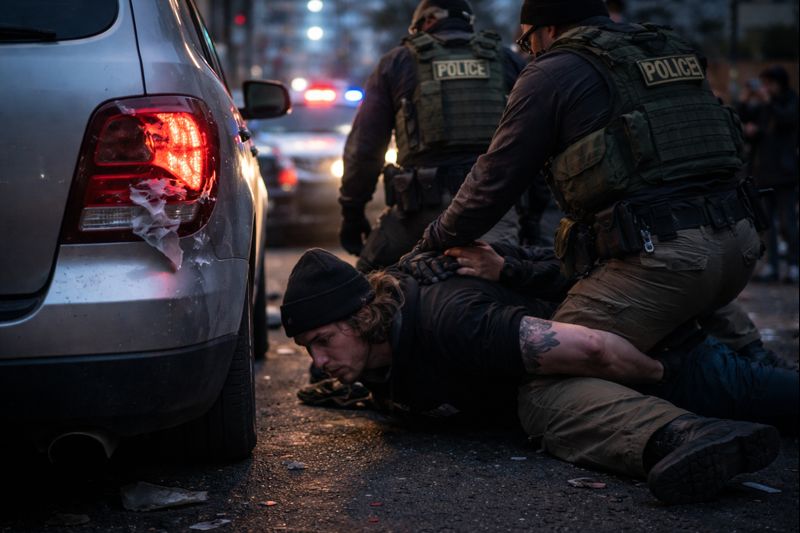
A new video is circulating of Alex Pretti on January 13, 2026, in Minneapolis—angry, in the churn of a protest, kicking out the taillight of what appears to be a federal vehicle, then getting taken down by federal agents. In the same clip, a handgun is visible in his waistband. He doesn’t appear to reach for it. And the video, by itself, doesn’t answer the question people are screaming at each other online. It raises a more uncomfortable one: what, exactly, counts as “law enforcement” now—arrest, detention, punishment, or performance?
Because eleven days later—January 24—Pretti is dead, shot by federal agents during another encounter in Minneapolis. And if you zoom out, the new footage doesn’t “explain” the killing. It adds context, sure. It also makes the official narrative harder to keep straight without duct tape.
The right-wing take: “See? He deserved it.”
The video has been treated like a moral time machine: rewind to a moment where Pretti did something illegal (property damage), then fast-forward to his death and declare the ending “earned.” That isn’t a principle. It’s a vibe.
And it collapses under the lightest pressure. Even if Pretti committed vandalism on January 13, the law’s response is not supposed to be “get killed later.” The idea that a taillight becomes a death sentence—handed down on a delay—doesn’t strengthen the case for the shooting. It weakens the legitimacy of the state.
In fact, the only way the taillight incident meaningfully connects to the later shooting is in a way the “he had it coming” crowd doesn’t want to touch: if January 13 mattered to the shooters on January 24, that’s not justification—it’s motive. It starts looking less like “split-second self-defense” and more like retaliation dressed up as procedure.
We don’t have public proof that the same agents were involved in both incidents, and reporting has noted it’s unclear. But the logic still holds: if people insist the earlier video is the reason the later shooting makes sense, they’re basically arguing that a prior insult or offense can shadow a person until force becomes “inevitable.” That’s not policing. That’s feud logic.
The part that should make everyone nervous: why wasn’t he arrested on January 13?
This is where the new video opens the real can of questions.
If agents witnessed someone damage a government vehicle—on camera, in public—why doesn’t the video trail end in the most boring, bureaucratic place possible: an arrest record, charges, a court date?
CBS reported the January 13 video “does not indicate whether Pretti was detained” after that incident. AP similarly described him being taken down, but the public-facing, standard “here’s the charge, here’s the booking” clarity is exactly what’s missing from the conversation.
There are only a few possibilities, and none are reassuring:
- They could have arrested him and didn’t. Why? Lack of interest? Lack of follow-through? A decision to keep things “informal”?
- They detained him and released him without charges. If so, what was the legal basis, and what’s the standard for when detention turns into prosecution?
- They used force as the entire point. Meaning: the “consequence” wasn’t the justice system—it was getting slammed to the ground in the street.
When people talk about sliding into authoritarianism, they often imagine some grand announcement, some cinematic moment. In reality it’s smaller and uglier: when the state starts using coercion as the process and paperwork as optional. If you can violently detain someone for clearly illegal conduct and then… not arrest them… you’ve created a system where the rules are whatever the armed people say they are in that moment.
And if you’re cheering that, because you think it’ll only happen to “the right people,” you’re betting your future on a government’s permanent goodwill. That is historically a bad wager.
The shooting story keeps shifting around the evidence
After Pretti was killed on January 24, initial official statements framed him as an imminent threat—armed, dangerous, the kind of person you’re supposed to stop asking questions about once the magic words “officer safety” are spoken.
But multiple reports describe a messier reality.
Reuters reported that a preliminary U.S. government review of the shooting did not mention Pretti “brandishing” a firearm, despite early claims that implied he did. The same Reuters piece says video evidence showed the gun being removed from his waistband before the shooting, and that the internal review highlighted inconsistencies between early public claims and what the video/documentation suggested.
AP reported that multiple videos from the fatal encounter show Pretti holding a phone, and described him being shot while on the ground—again clashing with the simplified “he threatened agents with a gun” storyline people rushed to adopt.
CBS Minnesota added another wrinkle: agents involved in the shooting were placed on administrative leave—standard protocol, but also a point that reportedly contradicted earlier public comments about them still being on the job.
So now drop the January 13 taillight video into this environment. It doesn’t “settle” anything. It intensifies scrutiny around two themes:
- Escalation: If force was used quickly on January 13, what does that suggest about posture and judgment leading into January 24?
- Narrative management: If early official descriptions are repeatedly softened or contradicted by video and internal reviews, why should the public assume good faith the next time around?
The political response is telling—especially the sudden focus on the gun
President Trump weighed in by saying Pretti “should not have been carrying a gun,” comments that Reuters noted put him at odds with gun rights groups, who emphasized Pretti was legally carrying.
That reaction is revealing because it tries to make the entire controversy about the mere presence of a gun—not about whether it was used, reached for, brandished, or posed an imminent threat at the moment deadly force was applied. It’s a rhetorical shortcut: if you can turn “legally carrying” into “therefore he’s basically guilty of whatever happened next,” you don’t have to grapple with the messier question of whether federal agents acted lawfully or recklessly.
It’s also politically convenient: it lets “law-and-order” messaging keep its emotional payoff while dodging the procedural details that law-and-order is supposed to care about—arrests, charges, standards of force, accountability.
What the taillight video actually changes
It changes the conversation in one important way: it makes it harder to pretend the issue is just one bad moment on one day.
Now you’ve got two encounters, in close proximity, involving federal agents operating in public, with significant force and public blowback—plus major ambiguity about what happened procedurally on January 13. That creates the kind of accountability questions that don’t go away with memes:
- What are agents authorized to do in protest settings?
- When does detention become arrest, and when is force being used as punishment?
- Who reviews this, and how transparent is that review?
And if the answer to those questions is “trust us,” then the new video isn’t a character indictment of Pretti. It’s an institutional indictment of a system that keeps asking the public to accept lethal outcomes while the paperwork and explanations come later—if at all.
So yes: the taillight kicking is illegal. Charge it. Prosecute it. That’s what a functioning state does.
But if the taillight is being used as a moral coupon to cash in for a killing 11 days later, then the real story isn’t Pretti’s temper in a chaotic moment. It’s a government that looks increasingly comfortable with street-level punishment and increasingly irritated by the expectation that it should justify itself.
If you want a country run by laws, you don’t get to cheer for outcomes and sneer at process. The process is the whole point.
 The American Beast