
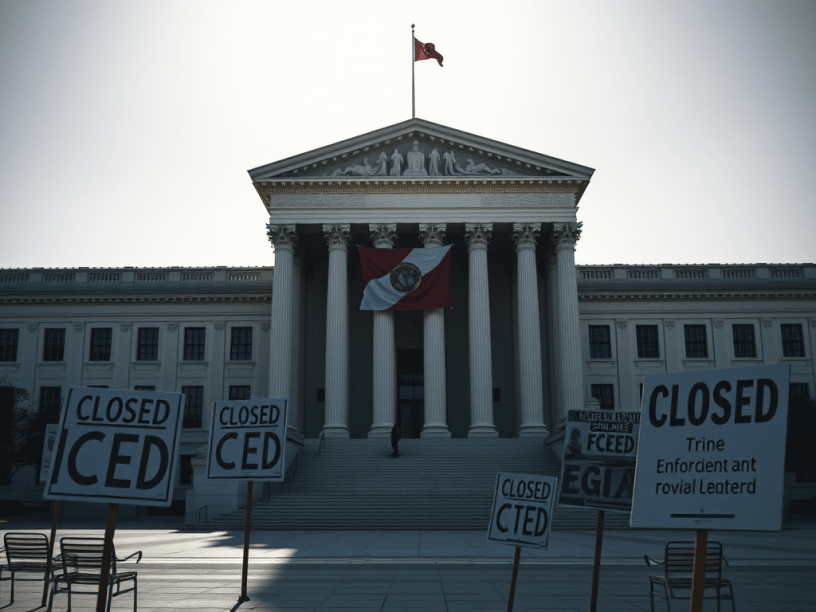
Washington loves a good shutdown the way toddlers love testing gravity: not because it’s productive, but because it produces a reliable, on-demand thud that proves the universe still works. So here we are again—staring at a partial federal government shutdown that kicked in over the weekend and rolled right into Monday, February 2, 2026 with the same tired soundtrack: blame, cable hits, finger-pointing, and the phrase “responsible governance” being used like a shop rag.
But this one isn’t just the usual funding-food-fight where everyone pretends they’re fighting for “taxpayers” while actually fighting for their own talking points. This shutdown has a clear, nasty center: what the country is willing to tolerate from immigration enforcement—specifically from Department of Homeland Security and its agencies—and what it’s willing to pay for it.
The peg is brutally simple. After a flashpoint in Minneapolis involving federal enforcement and two deaths tied to the unrest/protests that followed, Democrats decided the old routine—fund the machinery first, argue about the human consequences later—was over. Republicans decided that was hostage-taking. And so the government started doing what it now does whenever the parties disagree about reality: it partially closes its doors and calls it strategy.
The actual argument isn’t money—it’s permission
The Democratic asks are not the usual “study,” “review,” “consider.” They’re the kind of stuff that, in a functioning society, you’d expect to be boringly uncontroversial:
They want agents identifiable (including limits on masks), they want body cameras, they want judicial warrants for home raids, and they want to end “roving patrols” that feel like freelance policing with federal branding.
Republicans have responded like Democrats demanded the abolition of gravity.
Speaker Mike Johnson has framed this as reckless obstruction—Democrats “demanding” changes that could endanger agents—while signaling he’s not going to rush a vote. Which is the key move: the faster he brings this to the floor, the more he legitimizes the premise that the enforcement machine needs immediate guardrails. The slower he goes, the more time he has to repackage the story into the familiar shutdown narrative: Democrats shut down government; Republicans try to reopen it; please ignore what the fight is actually about.
The partial federal government shutdown that began early Saturday (January 31, 2026) is now rolling into this week, and Johnson’s message has been basically: relax, it’ll probably be over by Tuesday—just not too quickly, and definitely not in a way that looks like he blinked.
That’s why Johnson’s “confident by Tuesday” line matters: it’s a promise of resolution without conceding that the demands are legitimate—an attempt to drain this of its moral charge before it hardens into a public expectation.
Why this shutdown feels different
Normally, shutdowns are disputes about numbers nobody can visualize. This one is about whether federal power gets to operate in ways that are deliberately hard to scrutinize.
And this is where the politics gets nasty and very, very modern.
Democrats are betting that a lot of normal people—especially people who don’t live and breathe ideological immigration politics—hear “agents should show identification” and “raids should require warrants” and think: yes? obviously? why are we arguing about this? Republicans are betting that the phrase “mask ban” can be framed as “Democrats want to expose agents to retaliation,” and that the public will stop listening before the details arrive.
Meanwhile, Hakeem Jeffries is trying to keep Democrats aligned around a simple thesis: this isn’t anti-border enforcement, it’s pro-rule-of-law enforcement. The party’s internal logic is: if you can’t use a funding deadline to get accountability now, you’ll never get it—because there will always be a next crisis and always a next excuse.
The White House—Donald Trump—has attempted the classic escape hatch: endorse a temporary two-week funding measure for Department of Homeland Security so the broader government can reopen while DHS becomes a separate negotiation. That move is basically: “Let’s stop the bleeding, then argue about the knife later.”
Johnson embraced that approach too, because it’s the only way to look like you’re “governing” while still defending the enforcement posture that triggered the standoff in the first place.
The cast list matters
One reason this thing has teeth is that it’s personal now.
DHS Secretary Kristi Noem has become a target not just for Democrats, but for the broader “what are we doing?” faction of the public that doesn’t normally track agency leadership. Calls for her removal have popped up because the story has been framed as less “border management” and more “domestic enforcement tactics that look like a dare.”
Trump, for his part, has been juggling optics: on one hand, he’s the architect of a hardline approach; on the other hand, he doesn’t want the visuals of federal presence turning protests into a national referendum on legitimacy. Over the weekend, outlets reported he instructed DHS not to intervene in protests in Democratic-run cities unless asked—an attempt to look like he’s respecting local control while keeping the federal option as a threat hovering just above the skyline.
And then there’s Tom Homan—sent in as part of the “we’re managing this” signal. In Washington, dispatching a well-known enforcer is the political equivalent of bringing a bouncer to a PTA meeting and claiming it’s about “safety.”
The real fight: accountability versus immunity-from-scrutiny
Strip away the theatrics and you’re left with a question that’s going to keep coming back, shutdown or not:
Do we accept a version of enforcement where transparency is treated as optional and accountability is treated as partisan sabotage?
Because “masking” isn’t just about masks. It’s about whether the government believes it owes the public a clear view of who is exercising power in their name. “Body cameras” aren’t just about cameras. They’re about whether the system is prepared to let evidence exist when the political narrative is inconvenient. “Warrants” aren’t just paperwork. They’re the line between “we have rules” and “we have vibes.”
That’s why this shutdown has more heat than the usual DC hostage routine. It’s not merely an institutional tantrum. It’s a culture fight over what power is allowed to look like.
So what happens next?
Practically, Washington will do what it always does: a deal will appear at the last possible moment, everyone will declare victory, and the public will be asked to forget what the argument was actually about.
But politically, this standoff already did something important: it dragged DHS/ICE oversight out of the policy basement and shoved it into prime time. Even if the partial shutdown ends Tuesday, the “ICE reforms” list is now mainstream enough that politicians have to argue about it directly instead of hiding behind generic “border security” slogans.
And once you’ve made “identification, body cams, warrants, and roving patrols” part of the national argument, you don’t get to unring that bell by calling it Tuesday.

