
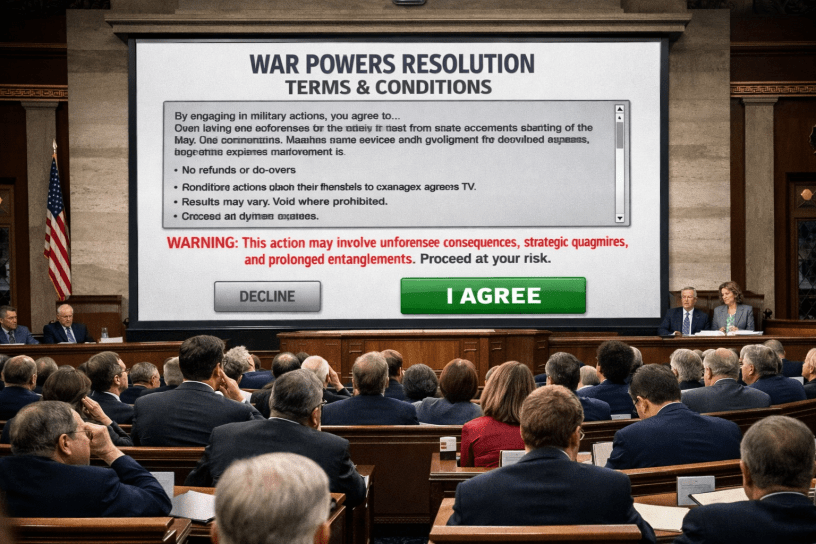
The War Powers Resolution is America’s “I Agree” button: nobody reads it, everyone clicks it, and you only notice it exists once your account has been charged and the missiles are already in the air.
Which is why Congress is now preparing to do what it does best in a crisis: assemble under bright lights, stare gravely into cameras, and argue about whether the president was allowed to do the thing he already did.
Not “should we go to war?” That question is adorable—like asking if the appetizer menu is available after the entrées have been cleared and the waiter is bringing the check. The actual question is more modern, more bureaucratic, more Washington: Can we please get a vote so we can distribute the liability evenly among the coequal branches of government?
Because the war—or whatever euphemism the White House is using this week to avoid the W-word—has already moved from “breaking news” to “ongoing situation.” Lawmakers are expected to vote this week on measures that would require President Trump to seek congressional authorization for further military action against Iran. That is, in theory, Congress reasserting its constitutional role. In practice, it’s Congress trying to jump into the movie halfway through and still control the plot.
The funniest part isn’t that the debate is happening late. The funniest part is that this is the system working as designed—the system we quietly designed by not designing a better one.
The constitutional “Oops” we keep pretending is a glitch
The Constitution gives Congress the power to declare war. Modern America gives Congress the power to deliver reaction statements. Every few years, Washington rediscovers this like a dusty civics textbook someone found under the couch, and everyone does the same ritual: solemn talk about “serious questions,” a flurry of War Powers resolutions, and then the slow, hypnotic drift back into executive discretion once the headlines move on.
This time, though, the stakes are harder to ignore because the opening moves were not subtle. Reuters reported that in a closed-door briefing, administration officials told congressional staff there was no intelligence indicating Iran was going to strike U.S. forces first—a detail that lands like a brick in the middle of the usual “we had to act now” narrative.
That doesn’t automatically make the strikes illegal or unjustifiable on its own—war authorization debates are a messy stew of statutes, AUMFs, executive branch legal theories, and the international law vocabulary everybody suddenly pretends to speak fluently. But it does undercut the most politically durable justification Washington has for unilateral action: imminence. If the briefings didn’t show a clear “they were about to hit us,” then the argument starts to sound less like self-defense and more like something we’ve tried before: a preventive war dressed up as urgent necessity.
Congress wants a vote. Congress also wants plausible deniability.
Here’s the part cable panels won’t say out loud because it ruins the brand: Congress doesn’t just “lose” war power. Congress rents it out—a little at a time, for decades—because taking responsibility for war is politically radioactive.
Voting for war means owning casualties, costs, and the inevitable “why are we still there?” three years later. Voting against war means risking the attack that happens afterward, which will be blamed on your weakness by the exact people who also said you shouldn’t have had a vote. The safest political position has always been to stand behind the president when it goes well and question the president when it goes poorly—preferably while insisting you were never properly consulted either way.
So, yes, there are members who genuinely want to reclaim Congress’s authority. There are also plenty who want the War Powers vote for a different reason: insurance. A vote is a receipt. It’s a way to prove, later, that you either supported “defending America” or tried to “stop a reckless escalation,” depending on how the story ends and what your district wants to hear.
CBS reports that lawmakers are expected to vote this week on resolutions requiring congressional approval for the use of force on Iran, with top Democrats and some Republicans pushing the issue with fresh energy after the weekend’s strikes. That “some Republicans” part matters: war powers has become one of the few issues where ideology sometimes overwhelms party reflexes—usually because a handful of people still remember that Article I exists.
But don’t confuse “new urgency” with “new clarity.” The actual shape of this vote—how binding, how enforceable, how likely to change the trajectory—is still the same old Washington question: is it a real restraint, or a symbolic throat-clearing?
The War Powers Resolution: America’s most ignored “deadline”
The War Powers Resolution is supposed to force the president to notify Congress when U.S. forces are introduced into hostilities and to end such involvement within a set period unless Congress authorizes it. In the real world, it’s more like a gym membership contract: the terms are there, technically, but nobody expects them to be enforced with moral seriousness.
Presidents of both parties have treated it like a suggestion box with a shredder attached. Congress, meanwhile, has often lacked either the votes or the backbone to force the issue—especially when the first few days of a conflict are packaged as “limited” and “targeted” and “surgical,” the way every war begins before it becomes “complex.”
And here’s the rub: even when Congress musters a vote, it is usually voting on a moving target.
Because wars don’t sit still politely while Congress debates. They expand, they mutate, they attract add-ons. They find new justifications. They become “protecting our troops,” which becomes “protecting our allies,” which becomes “maintaining stability,” which becomes “we can’t leave now,” which becomes “we never really left,” which becomes a memorial day speech about how this was all unavoidable.
That’s why Reuters’ briefing detail is so corrosive: if the administration didn’t show “imminent” intelligence, Congress is being asked to ratify not just a strike, but a logic. And once you ratify the logic, you’ve basically endorsed the sequel rights.
The plan problem: Act One is easy. Act Two eats you alive.
A recurring complaint from lawmakers—reported by Reuters—is that they don’t see a coherent plan for what comes next after the strikes. That’s the part that should keep people up at night, because “what comes next” is always where American confidence goes to die.
It’s where the war stops being a PowerPoint and starts being bodies and budgets and blowback.
It’s where you learn the difference between breaking things and controlling what replaces them.
It’s where every phrase you heard in the first 48 hours—“decisive,” “limited,” “restoring deterrence”—gets trampled under the weight of the oldest question in warfare: and then what?
Even if you fully believe the Iranian regime is a destabilizing threat, even if you fully buy the argument that military action was necessary, the “then what” is not optional. It’s the entire point. If Congress is going to reclaim war power, it has to do more than demand a briefing. It has to demand an endgame that is more specific than “until all objectives are achieved,” the kind of phrase that sounds tough until you realize it translates to: until we decide we’re tired.
The theater of oversight: “We demand answers” (that we will promptly file away)
Oversight in Washington often works like this:
- The administration does a thing.
- Congress demands a classified briefing.
- Congress exits the briefing furious but unable to share details.
- Congress holds a press conference expressing deep concern while saying “I can’t talk about what I just learned.”
- The news cycle moves on, and the thing becomes the new normal.
This time, Congress is trying to interrupt the routine with an actual vote. Good. That’s what it’s supposed to do. But here’s the warning label: a War Powers vote can become just another ritual if it’s designed to look like control rather than exercise control.
If a resolution is written to be toothless, it will be toothless. If it’s written to be enforceable, it will be fought in court, spun as undermining troops, and possibly ignored anyway—because the real enforcement mechanism isn’t legal. It’s political. It’s Congress being willing to say: stop. And then being willing to absorb the consequences of saying stop.
That’s the part Congress historically struggles with—because “stop” is a vote with fingerprints on it.
The bipartisan trap: war powers is popular until it costs something
The war powers fight always starts with unity around the concept: sure, Congress should have a say. Then it gets real: do you want to be the person who “tied the commander-in-chief’s hands” if Iran retaliates? Do you want to be the person who “rubber-stamped escalation” if the conflict widens?
That’s why the debate fractures into familiar shapes: some Republicans largely rally around the president, some Democrats oppose but can’t unify on message, and a few outliers on both sides insist that the Constitution isn’t a vibe.
And that fracture is exactly what the executive branch counts on. Because the White House doesn’t need Congress to agree on the perfect legal theory. It needs Congress to fail to assemble a majority willing to impose consequences.
Which brings us back to the “I Agree” button.
If Congress votes in a way that amounts to a retrospective shrug—if the vote is basically “please seek authorization next time, pretty please”—then the War Powers Resolution isn’t a guardrail. It’s a customer satisfaction survey.
What a real coequal branch looks like (and why it terrifies them)
If Congress actually wants its war power back, it has to do a few radical, un-American things:
- Vote early, not late.
- Specify limits: geography, duration, objectives, reporting requirements.
- Attach consequences: funding restrictions, automatic sunsets, hard triggers for reauthorization.
- Accept accountability: meaning no more acting shocked when the president does the thing Congress has quietly permitted presidents to do for generations.
That last one is the killer. Because coequal doesn’t mean co-commentator. It means ownership.
And ownership is the one thing Washington tries to outsource harder than manufacturing.
So yes, let Congress debate war powers—loudly, angrily, publicly. Let them drag the issue into daylight. But if this week ends with another ceremonial vote that changes nothing while everyone claims they did their job, then we haven’t reclaimed constitutional order.
We’ve just updated the paperwork.
And the missiles will keep flying—while Congress refreshes the page, looks at the “I Agree” button, and pretends it still has time to read the terms.

