
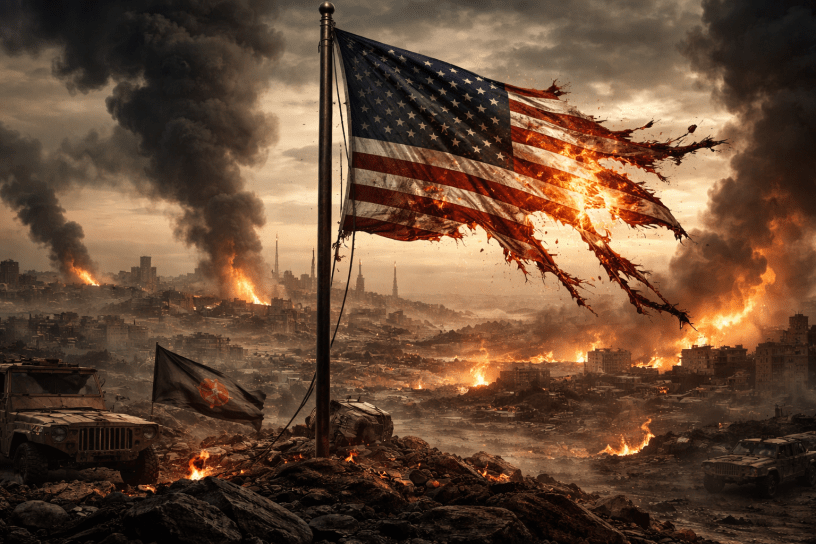
There is a special kind of American delusion that only appears when the bombs start falling.
It arrives dressed as certainty. It speaks in the voice of retired generals on cable, in the clipped confidence of think-tank diagrams, in the orgasmic language of “degradation,” “deterrence restoration,” and “strategic signaling.” It tells us that once again the world’s most expensive military machine has set out to rearrange reality with high explosives and PowerPoint. It assures us that this time the targets are clear, the objectives limited, the allies aligned, the mullahs doomed, the message sent.
And then, a week or two later, the message comes back marked RETURN TO SENDER.
That is the possibility hanging over the U.S.-Israeli war on Iran: not necessarily a neat, cinematic defeat with white flags and surrender speeches, but a slower, more humiliating kind of loss—the kind America specializes in now. Not losing every battle. Not getting pushed into the sea. Something more modern. More imperial. More pathetic. Winning the first round on television and losing the actual war in history.
Because “losing” a war against Iran would not have to mean Iranian tanks rolling into Tel Aviv or Revolutionary Guards storming Miami Beach in speedboats. It would mean failing to achieve the political goals that justified the war in the first place. It would mean the Iranian state surviving. It would mean its nuclear ambitions hardening rather than disappearing. It would mean Israel becoming less secure, not more. It would mean the United States bleeding treasure, prestige, leverage, and domestic stability for the privilege of discovering yet again that dropping bombs is not the same thing as shaping outcomes.
And it would mean that after all the swagger, all the maps, all the solemn talk about red lines and existential threats, the world would look around and conclude that the empire can still smash things—but cannot make anything behave.
That’s what losing looks like now.
The first way we lose: Iran survives, bloodied but unbroken
The most obvious defeat is also the most likely: America and Israel hit Iran hard, destroy a long list of military and nuclear targets, kill important officials, wreck infrastructure, maybe even reduce parts of the country to a charred state of permanent emergency—and still fail to break the regime or impose a favorable political outcome.
This is not some fringe possibility. Even current reporting suggests U.S. intelligence does not see Iran’s leadership as being on the verge of collapse, while outside analysts have been blunt that military force can destroy facilities and platforms far more easily than it can dictate who rules Tehran, or what strategic conclusions Tehran draws afterward.
That’s the trap. Washington always confuses physical destruction with political success. Blow up an airfield, and some genius in a suit calls it leverage. Flatten a base, assassinate a leader, crater an oil terminal, and every ghoul in the green room starts speaking in the hushed language of “momentum.” But states are not Jenga towers. You do not pull out enough blocks and watch the whole thing fall on cue.
Sometimes the opposite happens. Sometimes an attacked government becomes more radical, more paranoid, more nationally legitimized simply because it has been attacked. Nothing stabilizes a hated ruling class like foreign bombs. A regime that could not get people to stand in line for bread can suddenly get them to stand in line for revenge.
If Iran emerges from this war with its governing structure damaged but intact, its security establishment enraged, and its population convinced that the United States and Israel were not trying to negotiate, deter, or discipline—but to humiliate and decapitate the country—then congratulations. You have not solved the Iran problem. You have fossilized it.
That is a loss.
The second way we lose: we turn Iran into a factory for the one thing we said we wanted to prevent
The dark comic masterpiece here would be launching a war in the name of stopping Iran from becoming an actual nuclear weapons state and ending up giving Iran the clearest possible argument for becoming one immediately.
This is the kind of strategic own-goal that should come with circus music.
Analysts had already warned before and during the current war that Israeli and American attacks could push Iran toward abandoning any residual restraint and treating an actual bomb as the only credible insurance policy against future regime-change fantasies. RAND made that point in earlier analysis, and current CSIS commentary has been asking in various forms what military force can realistically accomplish beyond destroying visible assets.
This is the great idiocy of preventive war. It assumes the target will look at the smoking ruins of its facilities and say, “Well, fair enough, guess we shouldn’t pursue a deterrent.” In reality, the lesson is usually the opposite: if you don’t already have a final, undeniable deterrent, get one before the next wave arrives.
So imagine the postwar world in which Iran has lost senior leaders, lost bases, lost export capacity, lost face—and concluded that the one unforgivable mistake was stopping short of a deliverable nuclear weapon. You would then have a more secretive, more embittered, less internationally constrained Iran, pursuing the bomb with the moral clarity of a man who has just been kicked in the teeth by three guys in matching jackets.
Washington would call that “an unintended consequence,” which is Beltway for “we detonated the problem and now it’s everywhere.”
That too is losing.
The third way we lose: the global economy gets strangled and everyone blames us
One of the most amazing recurring features of American war planning is the assumption that oil markets and shipping lanes are just background scenery, like ferns in a dentist’s office.
In reality, the Strait of Hormuz is one of the most critical choke points on earth. The U.S. Energy Information Administration says flows through Hormuz in 2024 and early 2025 accounted for more than one-quarter of global seaborne oil trade, about one-fifth of global oil and petroleum consumption, and roughly one-fifth of global LNG trade. The EIA’s latest outlook also says the conflict has already pushed tankers away, cut shipments, shut in some production, and helped send Brent crude sharply higher, reaching $94 a barrel on March 9. Reuters has reported that Iran has laid mines and that humanitarian agencies are already warning about disruptions through the strait.
This is the kind of thing that can turn a war from “regional security operation” into “planetary recession generator” very quickly.
If the conflict keeps choking Hormuz, you are not just talking about expensive gas. You are talking about inflation shocks, shipping disruptions, spiking insurance costs, pressure on allies, political instability in import-dependent states, and every government on earth deciding that Washington and Jerusalem have once again set fire to the global wiring and then acted confused when the lights flickered in Jakarta, Berlin, and São Paulo.
And there is a geopolitical cost to that. Countries already tired of U.S. dominance will not see this as the defense of civilization. They will see it as another demonstration that the so-called rules-based order is mostly a euphemism for “our clients may do whatever they want until the oil price makes your groceries more expensive.”
If the result of this war is a weaker global economy, angrier allies, and a worldwide hunt for alternatives to American power structures, then “victory” becomes a public-relations joke told by men with blood on their ties.
The fourth way we lose: Israel wins militarily and loses strategically
Israel’s genius curse is that it is often very good at the immediate part of war and catastrophically bad at the sequel.
Blow things up? Yes. Penetrate intelligence networks? Yes. Kill senior enemies? Frequently. Translate those battlefield gains into a stable, less radical, less dangerous regional environment? That is where the magic act turns into a yard sale.
Current reporting indicates that Israel has relied on informants for targeting inside Iran and has pursued broad military objectives that go beyond simply swatting missiles out of the sky. But even Netanyahu has reportedly acknowledged uncertainty about whether any of this produces regime change or durable political transformation.
And that is the key point. Israel can rack up tactical successes all day and still come out of this war in a worse strategic position.
Suppose Iran’s conventional capacity is degraded for a while, but its desire for revenge is immortalized. Suppose Hezbollah is weakened today but a whole new generation of decentralized, deniable, highly motivated regional networks rises tomorrow. Suppose every surviving faction in Iran concludes that Israel’s existence is now permanently fused with the doctrine of preemptive mutilation. Suppose Arab governments cooperate quietly with the war effort while their populations become even more openly hostile. Suppose Israel buys a short-term lull and a long-term archipelago of enemies.
That is not security. That is a mortgage on future terror.
A state can win every exchange and still build itself a worse century.
The fifth way we lose: the war spreads sideways
The fantasy sold in these moments is always the same: clean strikes, narrow objectives, controlled escalation. Surgical. Focused. Rational. Everyone says the same thing right before the region starts bleeding out through side doors.
Iran does not need to beat the United States head-on in some patriotic IMAX climax. It just needs to make the war broader, longer, costlier, and less governable. CSIS and Reuters have both pointed toward exactly this problem: Iran retains options for missile strikes, attacks on regional energy infrastructure, pressure on shipping, and indirect retaliation through the remnants of its regional network, even if some key proxies are weaker than they once were.
That means U.S. bases in the region. Gulf infrastructure. Commercial shipping. Cyberattacks. Lone-wolf or networked attacks on soft targets. Globalized harassment campaigns calibrated to impose constant cost without triggering one neat, satisfying, total-war response.
America hates this kind of enemy because it cannot be photo-finished. There is no carrier-deck banner for “MISSION ACCOMPLISHED: THINGS GOT ANNOYING EVERYWHERE.” There is just attrition. Anxiety. Insurance. Force protection. Intercepts. Reprisals. More intercepts. Budget overruns. Intelligence failures. Political arguments. Funeral footage.
In other words: the war on Iran becomes a new forever-war ecosystem.
The U.S. does not have to be expelled from the Middle East to lose. It just has to get stuck there again, paying in blood and debt for objectives that mutate every month.
The sixth way we lose: America’s political rot gets worse at home
Wars do not merely reveal a nation’s character; they accelerate its existing diseases.
A war with Iran in the current American climate does not unfold inside some unified, post-9/11 patriotic haze. It unfolds inside a cracked aquarium of conspiracy, propaganda, censorship panic, factional score-settling, and state-security opportunism. Reuters has already reported heightened alert in the United States, along with the obvious reality that wartime anxiety does not automatically produce competent protection at home.
So what happens here if the war drags on or goes badly?
You can predict the script because we’ve performed it before. Dissent gets smeared as treachery. Civil-liberties abuses get marketed as temporary necessities. Every domestic critic becomes a useful idiot. Every bureaucrat wants new authorities. Every media hack wants to cosplay as Edward R. Murrow while laundering government briefings. Every ambitious politician wants to prove he can be more Churchillian than the next haircut on television.
And if the war goes badly, the political right and political center will not calmly reassess interventionism. They will go hunting for scapegoats. Internal enemies. Leaks. insufficiently supportive professors. insufficiently patriotic protesters. insufficiently grateful immigrants. The machinery of domestic repression loves a foreign emergency the way a shark loves blood in warm water.
A war abroad can become a permission slip at home.
That is another way to lose: by “defending civilization” so vigorously that you corrode what was left of your own.
So what would defeat actually look like?
Not parades in Tehran. Not surrender ceremonies in Haifa. Not some cartoon of American humiliation with a giant “L” stamped on a Pentagon map.
It would look like this:
Iran still exists as a hostile, organized state.
Its nuclear incentive is stronger than before.
Its appetite for revenge is deeper than before.
The Strait of Hormuz remains unstable, and the world economy absorbs the costs.
Israel is more feared, more isolated, and not actually safer.
The United States is more hated, less trusted, and once again chained to an open-ended regional mess it claimed would be quick.
China and Russia watch the chaos and quietly note that America still has unmatched destructive power but increasingly limited political intelligence. Global South countries treat Washington’s lectures with even more contempt. Allies hedge. Energy importers panic. Markets shudder. Militias adapt. Security states expand. The dead stay dead.
And somewhere in Washington, a row of human cufflinks will still be on television explaining that the operation was, in a very real sense, a success.
That’s the most American ending of all: the ability to lose catastrophically while preserving elite self-esteem.
The long-term world after a U.S.-Israeli failure
If America and Israel “lose” this war in the broader strategic sense, the long-term result is not a glorious Iranian century. Iran has its own weaknesses, its own economic fractures, its own brutal contradictions. But the larger system would change in ways that matter.
The taboo against major regional war would be weaker.
The incentive for states to get nuclear deterrents would be stronger.
Confidence in U.S. judgment would be lower.
Faith in international law would sink from punchline to fossil.
Global economic fragmentation would deepen as more countries look for ways to insulate themselves from U.S.-anchored shocks.
And the Middle East would become even more explicitly organized around chronic volatility rather than any meaningful order.
That is what defeat means in the 21st century. Not conquest. Contagion.
You do not lose because the enemy plants a flag on your lawn. You lose because your power produces the opposite of the world you claimed it was meant to create.
That is the nightmare here. Not that Iran is ten feet tall. Not that America and Israel are weak. Quite the opposite. It is that they are powerful enough to tear the roof off the region, but not wise enough to know what falls in afterward.
And if that is how this ends—if the war meant to restore deterrence instead spreads chaos, hardens Iran, trashes the global economy, radicalizes the region, and leaves America more paranoid, more broke, more censored, and more absurd—then history will record the verdict with appropriate precision:
They did not lose because they lacked firepower.
They lost because they confused firepower with strategy, vengeance with order, and destruction with control.
 The American Beast