
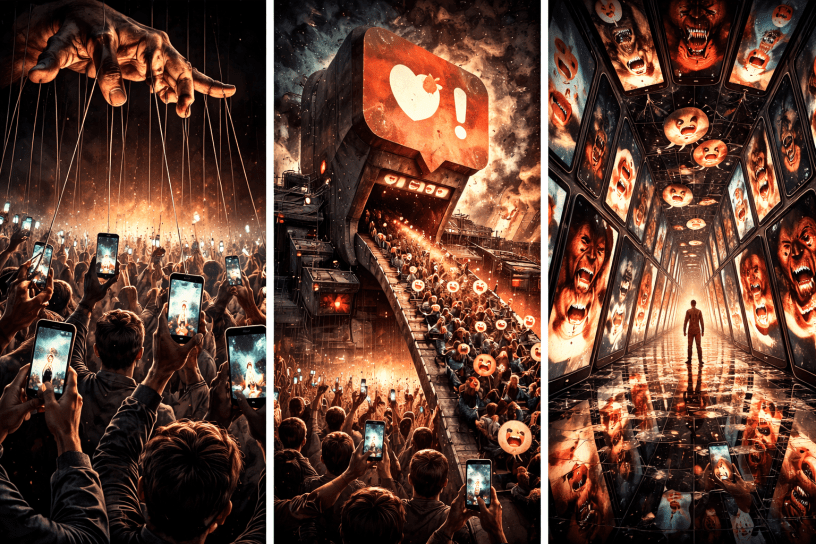
There was a time, not long ago, when a public controversy required at least one actual participant. Somebody said something stupid, somebody else got offended, and then the rest of America put on helmets and ran into walls for 48 hours. It was crude, dishonest, and often idiotic, but at least it preserved one quaint old-fashioned principle: before a national freakout could begin, somebody had to actually freak out.
Not anymore.
Now the machine just does it for you.
That’s what makes the recent Druski-Erika Kirk sideshow more interesting than the skit itself. Yes, the comedian’s “white face” bit was designed to provoke reaction. Yes, it was obvious bait. Yes, the internet swallowed it like a raccoon diving face-first into a grease trap. But the truly revealing part came afterward, when fake screenshots and phony social-media “responses” supposedly from Erika Kirk began circulating as if the woman had entered the octagon swinging a cease-and-desist in one hand and a moral panic in the other.
Except, as far as the public record shows, she didn’t.
Multiple fact-checks and reports said the rumored legal threats and at least one widely shared supposed Erika Kirk response were fake or unsupported. Druski’s representative denied the cease-and-desist story, and Snopes reported that a supposed Kirk post responding to the video was fabricated. In other words, the outrage script got written and distributed without the courtesy of consulting the alleged main character.
And that, right there, is the real story.
The Outrage Arrives Before the Person Does
Because this is no longer just internet lying, which is as old as the modem. This is a more sophisticated and much more depressing mutation: the rise of counterfeit outrage as a standard feature of online entertainment. The scandal no longer depends on what the target said. It depends on what the audience can be convinced they probably would have said, should have said, or secretly deserved to have said. When the real person fails to deliver the quote that keeps the blood pumping, some anonymous ghoul in the content mines just fabricates one and tosses it into the feed like raw hamburger into a piranha tank.
The old internet gave us rumors. The new internet gives us prepackaged emotional set design.
You can almost admire the efficiency. There’s no waiting around for facts. No awkward pause while a real human being decides whether to comment. No need to verify whether the target is angry, litigious, wounded, amused, or too busy doing laundry to care. Someone simply manufactures the screenshot, invents the response, and lets the content economy do what it does best: mistake repetition for truth and engagement for evidence.
That’s where the Druski-Kirk episode stops being a niche culture-war footnote and turns into a useful little parable about how the modern internet works. It is not enough anymore for a piece of content to go viral. Virality is just the opening bell. Once attention has been summoned, the secondary market arrives: fake quote cards, parody posts passed off as real, invented replies, invented threats, invented victories, invented humiliations. A clip is no longer just a clip. It becomes a franchise universe, with fans, haters, opportunists, clout bandits, and digital pickpockets all hammering together fake canon in real time.
And the best part, from the machine’s perspective, is that everybody wins.
The creator wins because the fake backlash extends the life of the original post. The anti-fan wins because now there’s a juicier villain arc to circulate. Aggregators win because “internet erupts” is the easiest headline ever invented for people who regard journalism as a kind of high-speed dumpster-diving. Random account farmers win because counterfeit screenshots are cheaper than original thought. And the platforms win because nothing keeps the ad slots humming like a good old-fashioned argument over something half the participants didn’t even verify before commenting.
Truth, naturally, gets beaten with a tire iron and rolled into a ditch.
Fake Receipts, Real Consequences
What makes this kind of thing especially toxic is not that it is high-level propaganda. It isn’t. This is not statecraft. It’s not even competent disinformation in the old sinister sense. It is much dumber than that, which is exactly why it’s dangerous. It trains people to consume fake evidence casually, recreationally, as part of the normal rhythm of being online. You are not being asked to believe a grand geopolitical hoax. You are being trained, one doctored screenshot at a time, to stop caring whether a screenshot is real in the first place.
That rot spreads.
Today it’s a comedian and a MAGA internet figure. Tomorrow it’s a local teacher, a city council candidate, a fired employee, an ex-boyfriend, a business owner, a journalist, a random woman whose face became useful to somebody else’s algorithmic knife fight. The same techniques scale beautifully. That’s the problem. Once a culture gets comfortable with fake receipts in low-stakes celebrity nonsense, it becomes much easier to weaponize the same aesthetic in higher-stakes situations.
The image is the argument now. The screenshot is the proof. The quote card is the corpse. By the time anyone bothers to ask whether it’s authentic, the jury has gone home.
And that’s the other thing this episode shows: silence is no defense anymore.
In the old rules, if you didn’t respond, at least the mob had to make do with your silence. Now silence is just empty real estate. If the target declines to perform, the crowd hires a ventriloquist. The woman does not need to tweet. The internet tweets for her. She doesn’t need to threaten legal action. The internet drafts the fake paperwork in spirit and circulates it as fan fiction. The result is a hall of mirrors in which a person’s actual public posture matters less than the more narratively satisfying fake version of it.
And of course this all arrives wrapped in the usual garbage-bag glamour of social media populism, where every participant imagines himself a scrappy truth-teller while performing unpaid janitorial services for billion-dollar engagement platforms. One side says, “See? These people are always hysterical.” The other says, “See? This guy is a monster.” Meanwhile, the underlying evidence in the hottest version of the argument may have been assembled by some acne-scarred clout goblin with Canva and too much time on his hands.
That may be the most American part of the whole thing: not a conspiracy, not a master plan, just a decentralized free market of bullshit. Thousands of users, fan accounts, outrage peddlers, wannabe news pages, partisan junk merchants, and anonymous engagement junkies all understand the incentives perfectly. They do not need to be told what to make. They can smell what will spread.
The Free Market of Bullshit
And what spreads is not merely controversy. It is performative certainty. The fake screenshot works because it offers narrative closure instantly. It says: here, now you know how to feel. The target is offended. The creator is embattled. The culture war has assigned jerseys. Proceed directly to screaming. Do not stop at verification.
That’s what should worry people who care about media, politics, or even just the possibility of having a civilization in which words correspond to reality more than 12 percent of the time. The counterfeit outrage economy is not built on persuasion. It is built on convenience. Fabrication is fast. Verification is slow. And in an attention market, speed is victory.
So yes, maybe the Druski skit was tasteless. Maybe it was funny. Maybe it was crude genius. Maybe it was hack bait for an exhausted country whose only remaining recreational activity is pretending every piece of online content is either a revolution or a hate crime. Pick your poison.
But the skit is almost beside the point.
The more revealing scandal is that the internet now reflexively manufactures the missing ingredients of outrage when reality fails to provide them. The target’s silence gets replaced by fictional indignation. The lack of evidence gets replaced by screenshot theater. The uncertainty gets paved over with a fake reply in the right font. A story that didn’t have enough juice becomes one that does, because somebody somewhere understands the first law of digital media: if the truth isn’t dramatic enough, invent a better version.
And then we all act surprised when nobody trusts anything anymore.
That distrust, by the way, does not fall from the sky. It is manufactured too. It is built piece by piece in stupid little episodes like this one, where entertainment gossip merges with propaganda technique and people absorb another microscopic lesson in epistemic nihilism. Screenshots can be fake. Replies can be fake. Legal threats can be fake. Debunks arrive later, panting and irrelevant, like mall cops showing up after the armored car already blew through the wall.
By then the fake version has done its job.
It got the clicks. It shaped the mood. It hardened the sides. It gave the audience a more emotionally satisfying screenplay than reality was willing to provide. And in the modern content economy, that is often all that matters.

