
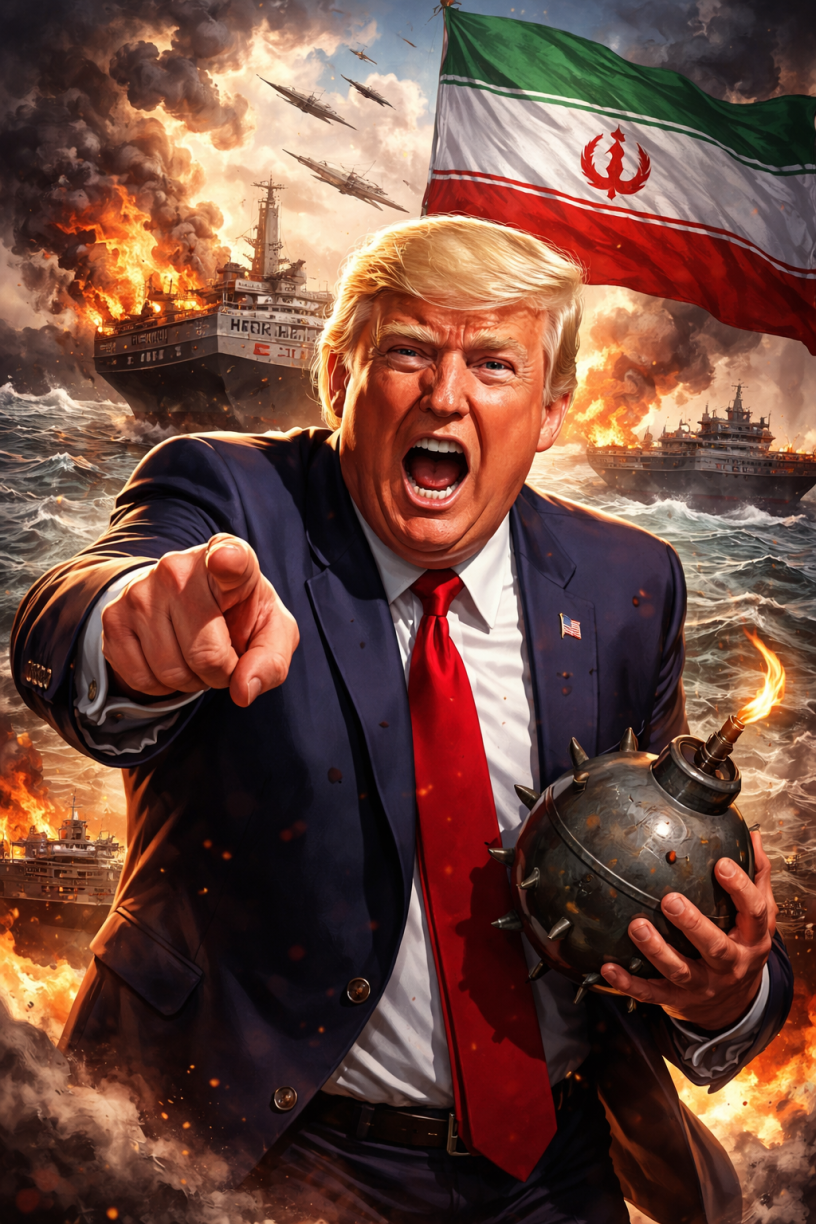
Donald Trump’s foreign policy has always had the aesthetic of a guy in a casino parking lot screaming, “You got ten seconds!” before discovering he has no idea what happens on second eleven. That basic formula appears to have held again this week, as Trump’s much-ballyhooed “deadline” for Iran to reopen the Strait of Hormuz ended not with some roaring imperial victory, but with a two-week ceasefire, a reopened shipping lane, and the unmistakable smell of Washington congratulating itself for negotiating its way out of the hostage situation it helped create.
The administration line is that this was strength: Trump threatened catastrophic strikes, Iran blinked, the strait reopened, oil calmed down, and everybody gets to pretend Dad just restored order to the cul-de-sac. But that reading requires squinting so hard your eyeballs start making dial-up noises. What actually happened, according to Reuters, AP, and other reporting, is that Trump agreed to suspend bombing for two weeks after Pakistan mediated a proposal, Iran agreed to reopen the strait during that pause, and talks are now supposed to continue on a broader set of demands that remain very much unresolved.
That is not nothing. A pause matters. Preventing a wider regional firestorm matters. Not blowing up bridges and power plants like an especially vindictive teenager playing SimCity matters. But if the question is whether America came out of this looking stronger, more feared, or more in control, the answer is a rich, meaty, marinated ehhhhhh. Iran did not emerge looking conquered. It emerged looking like the country that reminded the world it can menace one of the most important chokepoints on Earth badly enough that reopening it became the centerpiece of the deal.
The Great Art of the Deadline That Moves Nothing
Trump’s political style runs on deadline porn. Everything is “48 hours,” “the last chance,” “the final warning,” “we mean it this time,” like the world is a kitchen renovation on HGTV and not a region full of missiles, oil infrastructure, proxy militias, and men with theology degrees and grudges older than the Beatles. This week’s version reportedly included apocalyptic rhetoric and threats of devastating attacks on Iranian infrastructure if the Strait of Hormuz remained shut. Then, just before the hammer fell, the hammer turned into a pause button.
Again, avoiding escalation is good. The problem is the chest-thumping cartoon around it. When you issue a blood-curdling ultimatum and end up taking a truce brokered by Pakistan, that is less Patton and more guy at the bar who stands up to fight, gets physically separated and restrained by the hostess, then tells everyone he “chose peace.” Reuters reported that Trump described Iran’s proposal as a workable basis and said most major issues had been resolved. That is a lovely sentiment, but it is not the same as having actually imposed American terms.
And this is where the whole thing starts to look less like a triumph than a tutorial in how a superpower can accidentally advertise its own limits. The United States did not demonstrate that nobody gets to interfere with Hormuz. It demonstrated that if Iran interferes with Hormuz hard enough, reopening the waterway becomes a bargaining chip in a crisis negotiation. That is not “giving” Iran control in the formal legal sense, but it sure as hell is acknowledging Iran’s ability to exercise coercive leverage over the strait in practice.
So What Did America Actually Get?
This is the depressing part: the answer is probably “time,” “lower oil prices,” and “a chance to avoid something even dumber.”
Markets reportedly responded positively to the ceasefire news, and the reopening of the strait matters enormously because Hormuz is one of the world’s central energy arteries. If the administration’s private goal was simply to stop the bleeding, calm markets, and keep the Gulf from turning into a flaming Exxon logo, then yes, it accomplished something real. A pause is real. De-escalation is real. The avoidance of immediate wider war is real.
But that is a different claim from the macho campaign-poster version. The macho version says America stared down Iran and restored order. The less sexy version says America discovered that military swagger has a nasty habit of colliding with geography. Iran sits next to the chokepoint. Iran can threaten it. The U.S. Navy can project force, escort shipping, bomb targets, and thunderously explain freedom of navigation at a podium, but it cannot repeal a map. The map keeps winning. The map is undefeated. The map should frankly be on the Joint Chiefs.
Worse, Reuters reported that Iran’s preconditions for longer-term peace talks include not only an end to U.S. strikes and guarantees against renewed attacks, but also the right to impose fees on ships passing through the strait. That does not mean the United States agreed to it. It does mean Iran is negotiating from a position where its leverage is plain enough that such a demand can be put on the table with a straight face. That alone should make every “we taught them a lesson” speechwriter walk into the sea.
The Empire of Vibes
This is the deeper disease in American foreign policy now: everything is branding. Deadlines are branding. “Peace through strength” is branding. “Total victory” is branding. “Mission accomplished” was branding. The actual product under the hood is usually a more complicated, more embarrassing mess involving back channels, partial climbs-down, contradictory statements, regional middlemen, and some poor State Department sap trying to translate chaos into a bullet-point memo for cable news.
So Trump gets to say he forced Iran to reopen Hormuz. Iran gets to say it extracted a bombing pause from the United States and preserved its leverage. Pakistan gets to look like the adult in the room. Markets get a temporary sedative. And America gets another reminder that screaming louder than everyone else is not the same thing as controlling events.
That may be the real accomplishment of the “deadline”: not a strategic victory, not a humiliation exactly, but a public demonstration of the new American method. First, threaten apocalypse. Then back away from apocalypse. Then call the absence of apocalypse a win. It’s diplomacy reimagined as hostage negotiation conducted by a man who thinks subtlety is a Deep State plot.
And maybe that’s the fairest reading. Perhaps this was the least bad available outcome. Perhaps the alternative was broader war, more dead civilians, more regional spillover, higher oil, and another generation of pundits using the phrase “kinetic options” like they’re narrating a cologne commercial. Fine. Credit where it’s due: not pressing the detonator is better than pressing it.
But let’s not pretend this was some grand strategic masterstroke. If your deadline ends with the other side reopening the thing it had choked off while still looking like the guy with his hand on the valve, you did not exactly stride off the field carrying Caesar’s helmet. You more or less negotiated for the privilege of calling an unstable pause a trophy.
Which, to be fair, is still more honest than most American foreign policy victories. Usually we don’t even get the shipping lane back.
 The American Beast