
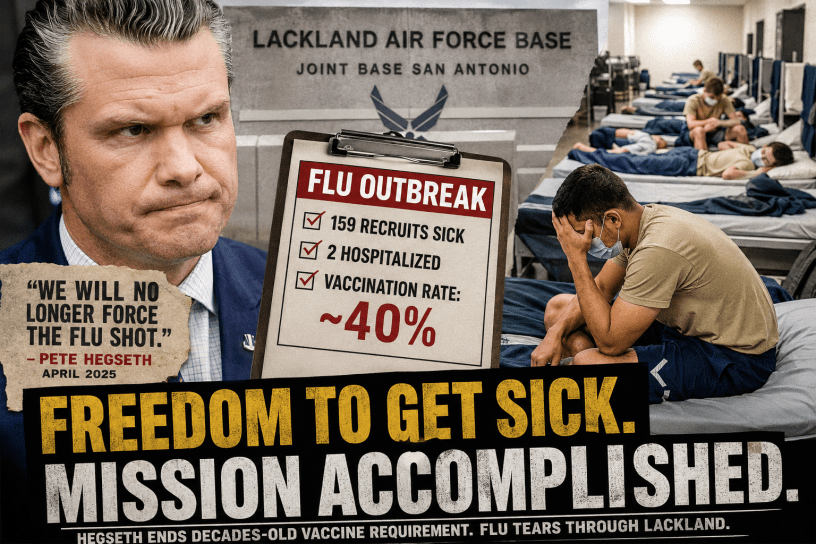
The Pentagon ditched a decades-old flu-shot requirement in the name of “readiness.” Then the flu tore through one of the military’s largest basic-training installations.
Pete Hegseth had a message for America’s troops in April: the military would no longer “force” them to get a flu shot.
The annual influenza vaccination requirement, Hegseth declared, was an “overly broad” mandate. The new Pentagon philosophy would be simple. Warriors could take the shot if they believed it was in their own interest. But nobody, apparently, would be made to do something as tyrannical as protect the people sleeping, eating, training, sweating, coughing, and marching directly beside them.
Two months later, nearly 160 Air Force recruits at Joint Base San Antonio-Lackland have been hit by a flu outbreak. At least two were hospitalized. Medical teams are isolating sick trainees, monitoring those exposed, and handing out antivirals.
The flu, in a shocking betrayal of the Secretary of War’s social-media video, did not honor bodily autonomy.
It moved through basic training the way viruses move through basic training: fast.
Lackland is not a wellness retreat. It is not a collection of rugged individualists living alone in tasteful studio apartments, sipping electrolyte water and making informed lifestyle choices. It is a giant human pressure cooker. Recruits sleep in open bays, eat communally, train in formation, and spend every waking hour in one another’s airspace.
That is why the military required flu shots in the first place.
Not because some sinister cabal of pediatricians wanted to humiliate a Marine with a needle. Not because flu vaccines are perfect. Not because anyone believes a vaccination turns a person into an invulnerable superhero. The military required them because armed forces have known for more than a century that disease can cripple readiness faster than an enemy ever could.
The 1918 influenza pandemic devastated American forces during World War I. Tens of thousands of U.S. troops died. The military learned the lesson the hard way: a force that cannot stay healthy cannot fight, deploy, train, or function. By 1945, annual flu vaccination had become part of the basic machinery of a military that supposedly takes preparedness seriously.
Then came Pete Hegseth, armed with a culture-war talking point and apparently no appreciation for why institutions keep certain boring rules around for eighty years.
His April announcement was pure MAGA performance art. He wrapped the policy in the language of “freedom,” “faith,” and “convictions,” as though a flu shot was equivalent to a midnight raid on a soldier’s civil liberties. He portrayed a routine health requirement as evidence of an authoritarian military that had somehow forgotten the meaning of service.
But military life is, by definition, an environment in which individual preference often gives way to collective necessity.
The military tells people where to live. When to wake up. What to wear. When to deploy. How to cut their hair. What to eat. Where to stand. Where to run. Where to sleep. It does not do this because generals are drunk on power. It does it because an armed force is not a libertarian book club.
Nobody joins basic training under the impression that they are preserving an absolute right to make every decision according to their own private feelings. The whole point is to turn thousands of strangers into a functioning unit capable of relying on one another.
Unless, apparently, the issue involves a vaccine. Then suddenly the Pentagon becomes a sacred temple of personal sovereignty.
The result was utterly predictable. Since the mandate was lifted, flu vaccination among recruits at Lackland reportedly fell from nearly universal compliance to around 40 percent. In a setting built for mass training and communal living, the Pentagon essentially chose to create a giant unvaccinated reservoir of young people who would soon be packed into dormitories and marched around in close formation.
Then influenza showed up and behaved exactly as influenza behaves.
This does not mean every case would have been prevented by vaccination. Flu vaccines are not magic. Their effectiveness varies from season to season. But pretending that the collapse in vaccination coverage had nothing to do with an outbreak among recruits living in close quarters is the kind of intellectual dishonesty that has become standard operating procedure in Trump-era public health policy.
Hegseth did not eliminate risk. He simply shifted it downward.
The people who will pay for his ideological stunt are not the policymakers who filmed triumphant videos about “restoring freedom.” They are the 18-year-olds in basic training who get sick, miss training, end up isolated from their units, or require medical care. They are the medics and public-health officers now forced to clean up the mess. They are the commanders who must explain why readiness apparently means turning barracks into viral incubators.
And there is an even darker note hanging over the outbreak. A recruit, Keon McDaniel, died after suffering a medical emergency during his sixth week of training. Authorities have not linked his death to the flu outbreak, and it would be irresponsible to claim they have. But the timing is a reminder of why military leaders are supposed to take preventable illness seriously before it becomes a crisis, not after.
The Pentagon’s response is almost funny in its hypocrisy. Once the outbreak began, officials moved to isolate symptomatic recruits, monitor close contacts, provide antiviral medication, and invoke exceptions that allow flu vaccination requirements in specific circumstances.
In other words, the Pentagon rediscovered public health the instant its anti-public-health policy began producing public-health consequences.
The real scandal is not that a flu outbreak happened. Flu outbreaks happen. The scandal is that the people charged with maintaining the world’s most expensive military decided to downgrade prevention because “medical freedom” tested well in the culture-war laboratory.
A competent Defense Department would have recognized basic training as the precise place where broad vaccination requirements make the most sense. Instead, Hegseth treated the military like a right-wing podcast set, where every institutional safeguard is recast as oppression and every foreseeable disaster becomes somebody else’s problem.
Now Lackland has nearly 160 sick recruits, two hospitalizations, and a policy failure so obvious it should come with its own warning label.
The flu did not undermine military readiness.
Pete Hegseth did.

