
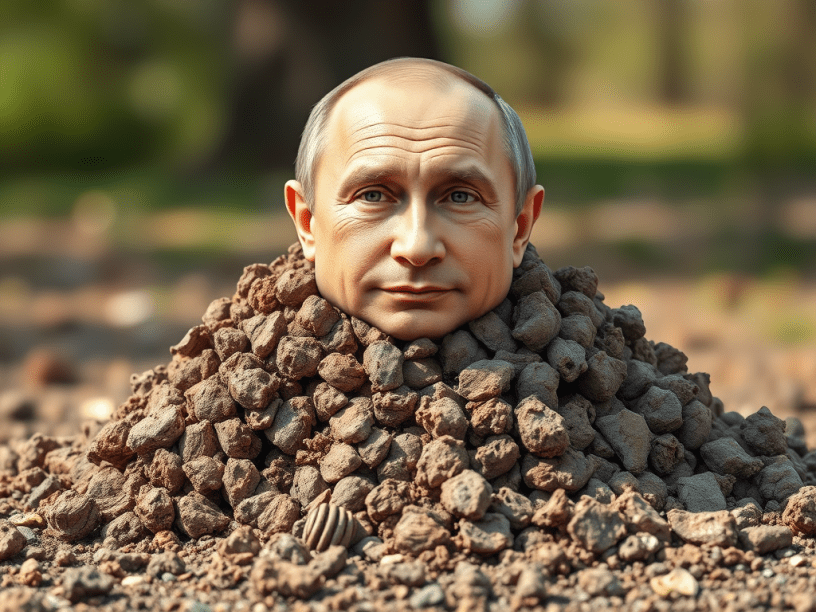
Vladimir Putin: The Man, The Myth, The Miniature Napoleon
I’ve been posting these stories on Facebook to try and generate some traffic, and was accused yesterday by several people of being a Russian bot or “Vlad glazer” for daring to post an article critical of Vladimir Zelensky. As I predicted, people feel you must make a binary decision to champion one Vlad and demonize the other. You cannot cast a critical eye on both, that just isn’t acceptable! Well, whatever. I hate giving in at all but I suppose there is no harm in writing an even more brutal piece on Putin, because he is definitely the Worst Vlad Ever. And yes, I know about Dracula.
There are strongmen, and then there’s Vladimir Putin—a man so insecure about his own power that he’s spent the last two decades bare-chested, straddling various beasts of burden, and flexing his geopolitical ego like an aging bodybuilder who refuses to admit he peaked in the ’80s. The self-styled Tsar of Russia isn’t so much a leader as he is a cautionary tale of what happens when a KGB middle manager with a raging inferiority complex gets access to nuclear weapons.
Born in 1952 in Leningrad (which later rebranded as Saint Petersburg because Russians love a good facelift), young Putin grew up in a grim Soviet hellscape of communal apartments, wounded war veterans, and enough national trauma to fuel a lifetime of paranoia. He joined the KGB in the 1970s and was promptly shipped off to Dresden, East Germany—where the Soviet intelligence brass clearly decided he wouldn’t be a problem. He spent his time there pushing paper, sipping bad beer, and nursing an ever-growing resentment against the West.
And then, the worst possible thing happened: the Soviet Union collapsed. For Putin, this wasn’t just a historical event—it was a personal humiliation, a cosmic insult. He vowed revenge. Enter the 1990s, where he leveraged every dirty trick in the book—cozying up to oligarchs, manipulating political bosses, and conveniently being in the right place at the right time when a series of mysterious bombings in 1999 gave him the perfect excuse to launch a war in Chechnya and catapult himself into the Russian presidency. Pure coincidence, of course.
Once in power, Putin did what all garden-variety despots do: he crushed the free press, jailed or murdered his critics, and turned Russia’s economy into a mafia-run piggy bank for his billionaire buddies. The Kremlin morphed into a hybrid of the KGB, a Bond villain’s lair, and a frat house for ex-wrestlers, casino moguls, and washed-up spies. He became the ultimate geopolitical troll, a man who couldn’t build a functioning state but could certainly interfere in Western elections and make edgy threats about nukes on state TV.
Fast forward to 2022, and Putin’s grand gamble: the full-scale invasion of Ukraine. In his deluded fantasy, Kyiv would fall in a few days, Zelenskyy would flee, and the Ukrainians would welcome their new musty, Soviet-era overlords with flowers. Instead, his vaunted military—bloated with corruption and staffed by generals more interested in stealing toilets than strategizing—got chewed up by an army of determined Ukrainians, drones, and grandmothers handing out molotov cocktails like party favors. By 2025, the war had become an unholy mess, draining Russia’s economy, obliterating its global standing, and turning Putin from a feared autocrat into a walking, Botoxed embarrassment.
But like any dictator who refuses to read the room, Putin just doubled down. More conscripts, more propaganda, more blame hurled at NATO, the CIA, and possibly the ghost of Leon Trotsky. Meanwhile, Russia’s elite whispered behind closed doors, the economy crumbled, and Putin started to look like a sad relic of a bygone era—desperately clinging to relevance as his empire rotted from within.
History rarely ends well for men like Putin. He’s not a genius, not a master strategist—just another aging autocrat trying to write himself into the history books with the blood of his neighbors. Whether his final chapter plays out in The Hague, a bunker, or a dusty Kremlin office where no one takes his calls anymore, one thing is clear: his legacy will be carved into the wreckage of Mariupol, the mass graves of his own soldiers, and the scorched remains of his delusions.
The only real question left is: how much longer can one man keep a nation hostage before history swallows him whole?

