
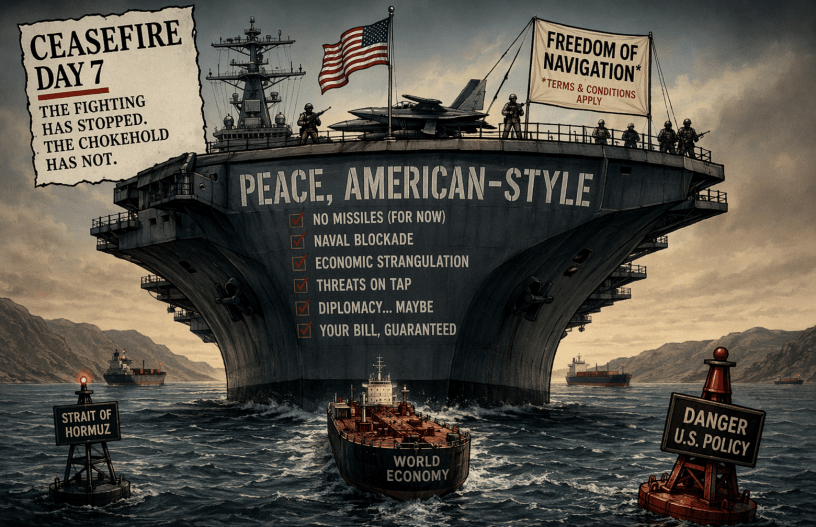
There is something almost inspirational about the way America can take an obvious pile of crap, slap a patriotic label on it, and sell it back to the public as a triumph of statesmanship.
Take the “ceasefire.”
A ceasefire, in normal language, means the fighting stops. Guns go quiet. The temperature drops. Diplomats crawl out from their holes and begin lying to each other in carpeted conference rooms instead of on battlefields. The point, at least in theory, is to create the conditions for peace.
But that is normal language, and normal language has no place in Washington, where words are less tools of communication than rental tuxedos draped over naked extortion.
What America produced in the first week of this supposed ceasefire with Iran was not peace. It was not even a convincing impersonation of peace. It was a naval chokehold, a fresh round of threats, stalled diplomacy, snarled shipping, allies quietly freaking out, and an economic kick in the teeth for everyone from truckers to farmers. This is not what peace looks like. This is what happens when the empire wants the violence to continue, but in a form that sounds less embarrassing on Sunday morning talk shows.
So yes, call it a ceasefire if you want. Just understand that in modern American foreign policy, a ceasefire is often just war after a media consultant has been allowed near it with a spray bottle and a thesaurus.
The Ceasefire That Somehow Includes a Blockade
This is the genius of the whole scam.
The administration gets to say the fighting has paused while simultaneously tightening the screws in every other way possible. The bombs may not be flying at quite the same pace, but the coercion is alive and well, puffed up and polished and rolled out as responsible leadership. The result is a ceasefire that somehow includes a maritime blockade, threats to obliterate Iranian fast-attack boats if they get too close, and a continuing crisis in the Strait of Hormuz that has half the planet staring nervously at maps and oil charts.
That is not peace. That is a hostage note typed on State Department letterhead.
The failed talks in Islamabad made the whole fraud even harder to ignore. Nothing substantial got solved. The same issues that always choke these negotiations—sanctions, nuclear guarantees, prestige, who gets to dominate whom, who has to crawl, who gets to keep pretending they are acting in self-defense while openly squeezing the world’s most sensitive shipping artery—remained unresolved. The answer, naturally, was not compromise. The answer was to keep escalating with a straighter face and a softer vocabulary.
That is the part that would be hilarious if it were not so grotesque. America now conducts foreign policy like a mob boss who has discovered branding. We’re not threatening you, we’re “maintaining deterrence.” We’re not strangling your economy, we’re “preserving regional stability.” We’re not risking global disruption, we’re “ensuring freedom of navigation” by making navigation impossible until everyone agrees we are the world’s designated hall monitor.
At some point you have to admire the nerve. It takes real imperial muscle memory to blockade a country and still expect applause for your commitment to peace. It takes even more to do it while pretending the real danger is the people being blockaded. This is like setting a man’s house on fire and then holding a press conference about your brave efforts to control smoke.
And yet the scam survives because Washington knows most people are exhausted, distracted, broke, or too numb to keep track of the euphemisms. “Ceasefire” sounds good. “De-escalation” sounds good. “Strategic pressure” sounds like something smart men in navy suits say while civilization is being managed by adults. It all sounds much better than the truth, which is that America’s idea of peace has become indistinguishable from domination with better packaging.
The Allies Are Nervous, Because They Can Read a Map
One of the funnier subplots of week one is that even America’s allies seem to have noticed that this arrangement is insane.
European leaders are making worried noises about restoring shipping through Hormuz because, unlike the cable-news lunatics and think-tank ghouls in Washington, they appear dimly aware that the global economy is not powered by slogans. It is powered by actual ships moving actual fuel through actual chokepoints. When that stops, or even when it merely becomes uncertain, the damage begins immediately.
The Europeans, to their credit, can at least smell a flaming carpet when they are standing on it. They know the continued disruption of Hormuz is not some abstract chess move. It is a threat to trade, energy, industry, and every already-frayed supply chain in a world that is held together with zip ties and prayer. So now you have allies trying to figure out how to protect navigation without just saluting and following Washington into another one of its theatrical, open-ended “limited” operations that somehow manages to light money on fire and solve nothing.
That alone is enough material for a Beast article, because it captures the essential obscenity of American power in 2026: we start a crisis, announce that we are stabilizing it, then force our allies to either pretend this makes sense or clean up the global mess after our “leadership” has finished smashing the crockery.
And let’s be honest, this has become the whole model. America no longer exports democracy, if it ever did. It exports managed instability. It exports high-minded chaos. It exports the permanent emergency: just enough violence to keep everyone terrified, just enough diplomacy to keep editorial boards from losing bladder control, and just enough semantic fraud to let officials say “peace” while standing knee-deep in the wreckage.
Peace for the Powerful, Pain for Everybody Else
Of course, the real signature of American statecraft is that the people who pay for all this nonsense are never the ones giving the speeches.
In the first week of the ceasefire, the pain landed right where it always lands: on ordinary people who had nothing to do with any of it. Truckers got hammered by diesel spikes. Farmers and food systems started feeling the squeeze from fertilizer disruption. Shipping stayed shaky. Markets twitched. Costs rippled outward. Somewhere, some genius in Washington probably called this “manageable.”
Manageable for whom?
That is always the question buried beneath every noble foreign-policy slogan. Manageable for the admiral? The defense contractor? The think-tank embalming fluid addict with a fellowship and a flag pin? The TV colonel who gets to say “hard choices” while drawing a salary for appearing calm in front of catastrophe?
It is certainly manageable for the people who will never have to choose between filling a tank, paying a freight bill, or eating the cost of yet another geopolitical brain fart conceived by men who still think in terms like “credibility” and “projection of strength.” The first week of this glorious peace already looks like one more exercise in transferring the cost of elite fantasies onto everyone else.
That is why the word “ceasefire” feels so filthy here. Not because the shooting paused. Thank God for that much, however temporary. It feels filthy because the word is being used as camouflage. It is there to make the continuation of coercion look humane. It is there to make the public think we are moving toward resolution when in fact we are simply switching methods. It is there so the same people who helped drag the world to the brink can now preen as peacemakers because they changed the instrument panel while leaving the engine of destruction running.
And this, really, is the most American part of all.
We are a country that increasingly cannot solve problems, only rebrand them. We cannot end wars, only rename phases of them. We cannot pursue peace in the old, ugly, compromise-heavy sense, because that would require treating other nations like actors rather than props. So instead we create these grotesque hybrid arrangements where open war becomes siege, siege becomes leverage, leverage becomes diplomacy, and diplomacy becomes a form of televised lying performed for an audience too beaten down to boo.
A Pause with a Knife at the Throat
By the end of the first week, the basic truth was impossible to miss.
This ceasefire is not the beginning of peace. It is a pause with a knife at the throat. It is not reconciliation. It is not settlement. It is not some brave first step toward sanity. It is a reconfigured pressure campaign dressed up as statesmanship, one that lets Washington claim the moral glow of de-escalation while preserving the mechanics of punishment.
That is why the whole thing deserves the sneering phrase “supposed ceasefire.” Because “supposed” does all the work the administration’s language is trying to avoid. Supposed as in alleged. Supposed as in sold. Supposed as in this is what peace is apparently called now when the shooting dips but the strangling continues.
Week one told the story. The bombs slowed. The chokehold remained. The diplomats postured. The markets shivered. The allies winced. The bill arrived for everybody else.
Peace, American-style.
No smoke, no crater, no screaming footage for the evening news if we can help it. Just a neat little pause in open slaughter while the empire reorganizes the pressure points and sends the rest of the world the tab.

