
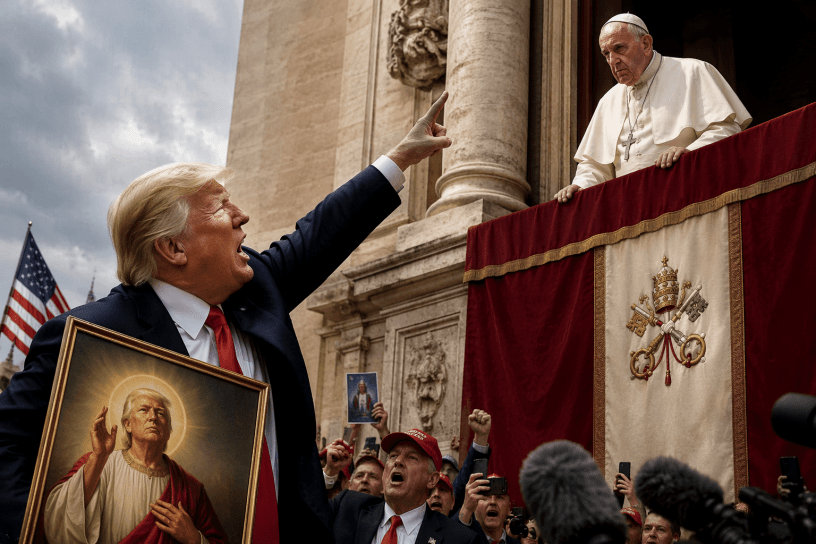
Donald Trump has spent his whole life reacting badly to the existence of any noun he doesn’t own. Courtroom? Witch hunt. Election? Rigged. University? Marxist daycare. Military brass? Disloyal. Intelligence agencies? Deep state. The man’s entire political philosophy can be boiled down to one simple principle: every institution is legitimate until it tells him no, at which point it becomes a nest of traitors, weaklings, or losers who don’t understand real estate.
So of course it was only a matter of time before he picked a fight with the Pope.
Not just any pope, either. An American pope. A pope who, in the middle of Trump’s latest war-drunk chest-thumping over Iran, had the insolence to do something almost unthinkably offensive in modern American political life: speak in moral language. Pope Leo XIV called for peace, dialogue, and coexistence, and said he would keep speaking out against war. Trump responded the only way a man like Trump can respond to that sort of thing: by treating the Vicar of Christ like he was some loudmouth city councilman who’d cut in front of him at the buffet. Reuters and AP both reported that Trump publicly criticized Leo over the Iran war, doubled down, and refused to apologize.
That’s the real story here. Not “Trump and the pope disagree.” Of course they disagree. A casino floor in human form and the head of the Catholic Church are not exactly natural intellectual doubles partners. The story is that Trump cannot tolerate the existence of moral authority that does not wear his face on a T-shirt.
And because this is America in 2026, the disagreement did not stop at policy. It immediately plunged into the toilet bowl of spectacle, where Trump also shared an AI-generated Jesus-style image of himself that sparked backlash, then tried to explain it away in the sort of garbled fashion that suggests even he can’t keep track of which holy delusion he’s marketing on any given day. AP and other outlets reported that Trump said he thought the image depicted him “as a doctor,” which is somehow both less offensive and more insane.
The Don Meets the Gospel
The reason this fight has real bite is that it exposes one of the dirtiest little secrets in American politics: a huge chunk of what passes for “Christian leadership” in this country is just empire with a praise band.
Trump has always understood religion less as a moral discipline than as a branding opportunity. He doesn’t do repentance. He does optics. He doesn’t do humility. He does staging. He doesn’t do theology. He does licensing. If Jesus came back and delivered the Sermon on the Mount today, Trump would call him a weak negotiator, then post an AI image of himself handing the loaves and fishes to a focus group in suburban Ohio.
So when Pope Leo talks about peace, coexistence, and the madness of war, Trump hears something different. He hears disloyalty. He hears weakness. He hears one more global figure refusing to clap on cue while he struts around in the blood-slick pageantry of American force. Reuters reported that Leo explicitly said the world needs a message of peace and coexistence and that he intended to keep speaking against war even after Trump’s attacks.
That’s what makes this so rich. Trump’s whole movement is built on the idea that he alone embodies strength, that every criticism of his violence is really a species of cowardice, and that every limitation on American power is a humiliation. The Pope is out there saying, in effect, that endless war is not a virtue, and Trump reacts like a nightclub owner who just found out the priest isn’t comping his ego.
You can almost admire the purity of it. Most politicians at least go through the motions when tangling with the church. They wrap themselves in respect, mumble something about shared values, maybe quote scripture they barely understand. Trump skips the foreplay. He barrels directly into the central question of the age: who gets to define Christianity in public life, the man selling vengeance in a flag pin, or the old institution still insisting, however imperfectly, that there are such things as moral limits?
Trump’s answer, naturally, is Trump.
American Caesar vs. American Pope
The especially delicious part is that Pope Leo is American.
That ruins the usual MAGA escape hatch. Normally, when a pope annoys the American right, he can be dismissed as a foreign busybody in a funny hat, some Euro-bureaucrat of the soul lecturing the world’s greatest nation about compassion while Europe free-rides on NATO and marinates in decline. But Leo doesn’t fit the usual cartoon. Reuters has described him as the first U.S.-born pope, which means Trump can’t quite wave him away as some continental elitist who doesn’t understand the greatness of Applebee’s and drone warfare.
That’s why this clash feels less like a policy spat and more like a custody battle over the American conscience. On one side you have a pope saying peace is not weakness, and that speaking against war is part of his religious duty. On the other you have Trump, who seems to regard peace the way a shark regards vegetarianism: a hobby for people who do not understand how the world works. Reuters reported Trump said it was important for the pope to understand Iran is a threat and that Tehran could never have a nuclear weapon, which was his way of translating a moral critique into the only language he recognizes: force management.
This is where the show stops being about personality and starts being about national rot. America has spent decades replacing every form of moral reasoning with the rhetoric of domination. Politics became marketing. Journalism became engagement bait. Religion became identity merch. War became content. The presidency became reality television with bunker-busters. So now when the pope says, “Maybe don’t solve every problem by setting the planet on fire,” half the country reacts like he just insulted the troops, the Constitution, and the Buffalo Wild Wings lunch special.
Trump is not an aberration here. He is the logical endpoint. He is what happens when a nation spends years telling itself that wealth is virtue, cruelty is honesty, and bombast is courage. Of course that nation eventually produces a president who thinks he can argue with the pope like he’s leaving a one-star Yelp review.
The Church of Me
The AI Jesus image is the perfect coda because it compresses the whole era into one vulgar little rectangle.
A politician under fire for attacking the pope posts messianic slop of himself glowing like a divine healer, and millions of Americans do not immediately say, “Ah, yes, perhaps we should take a beat and ask whether the republic has become a roadside carnival run by lunatics.” Instead they debate the image the way medieval peasants once debated relics. Is it symbolic? Is it satire? Is it trolling? Is it art? Is it strategic outreach to evangelicals? Is it, perhaps, a little too on the nose?
No. It is simply honest.
Trump has always wanted Christianity without Christ. Resurrection without sacrifice. Judgment without mercy. Glory without humility. Crowds without conscience. He wants the iconography of transcendence stapled to the appetites of a Queens landlord. He wants the throne, not the sermon. He wants the cathedral as backdrop and the congregation as audience. He wants to be praised, not changed.
This isn’t really about one pope, one war, or one stupid AI image. It’s about the collision between two utterly different concepts of power. One says power should be restrained by morality, however inconsistently practiced. The other says morality is whatever flatters power. One says peace. The other says strength, meaning the right to break things without being nagged by anyone in robes.
Trump, in other words, has finally found an institution he can’t fully bully, buy, meme, or sue into submission. And it drives him crazy.
Which is why this is so satisfying. For all his bluster, all his flags and jets and macho Broadway posturing, Trump still turns into the same thing whenever he encounters a limit: a rich baby pounding on the walls of a room he doesn’t control.
This time the room just happens to be the Vatican.
And somewhere in the distance, you can almost hear America’s self-appointed Christian tough guys trying to decide whether they follow the guy selling vengeance, vanity, and AI messiah portraits — or the inconvenient old man saying war is madness.
That’s not just a feud. That’s the whole scam, laid bare.

